This is fun!
Thanks to my buddy Andrew for the link.
Enjoy!
Keep your sightglass full, your firebox trimmed and your water iced!
KJ
Showing posts with label Tesla. Show all posts
Showing posts with label Tesla. Show all posts
Epic Rap Battle Tesla vs Edison

The Electrotherapy Museum
Tesla technology in action.
Found this on Slashdot (thanks to James Rodway for the links).
From the Slashdot Article
Since he was a teenager, Jeff Behary's been interested in the work of Nikola Tesla, and has been collecting antique electric devices of a particular kind: ones that send electricity through the human body to effect medical benefits, many of which do so with the aid of Tesla coils. Tesla's not the only inventor involved, of course, but his influence overlapped and widely influenced the golden age of electrotherapy. Behary's day job as a machinist means he has the skills to rehabilitate and restore these aging beasts, too, along with a growing family of related devices. He's assembled them now, in West Palm Beach, Florida, into the Turn of the Century Electrotherapy Museum. This is a museum of my favorite kind: home-based and intimate, but with serious depth. Though it's open only by appointment, arranging a visit there is worth it, whether you're otherwise part of the Tesla community or not. Behary knows his collection inside and out, with the kind of deep knowledge it takes to fabricate replacement parts and revamp the internal wiring. The devices themselves are accessible, with original and restored pieces up close and personal — you need to be mindful about which ones are humming and crackling at any given moment. (There's also an archive with books, papers, and other effects relating to Tesla and other electric pioneers, not to mention glowing tubes that predate the modern vacuum tube, and the oldest known surviving Tesla coils, recovered from beneath their maker's Boston mansion. Electrotherapy is the organizing principle, but not the extent of this assembly.) And while Behary isn't fooled by all the therapeutic claims made by some machines' makers about running current through your limbs or around your body, he also doesn't discount them all, either, and points out that some of them really do affect the body as claimed. Yes, he's tried most of the machines himself, though he admits he's never dared taking the juice of his personal Tesla-powered electric chair.
The Slashot page also has a transcript of an interview with Jeff Behary.
Fascinating (and slightly scary) stuff here.
Keep your sightglass full, your firebox trimmed and your water iced.
KJ
Merry Christmas!
A Christmas tree for you all!
With a little help from Nikola Tesla


Keep your sightglass full, your firebox trimmed and your water iced.
KJ
Practical Airship Design Part 5
Saturday, December 1, 2012
0
comments
Labels:
Airships,
Flight Engineer,
howto,
Musings,
Steam,
Tesla
Engines Tanks and Bulkheads Oh My!
Having described last time how we are able to generate the steam needed to both lift and power our globe circling airship, it is time to attempt a layout of the system so that we can see how it would fit into the hull. Since in my position as Flight Engineer I will be spending most of my role play time here I admit that it is a subject close to my heart
What would such an airship look like if it must include such a novel power and lift source?
I would like to say she would look like this...
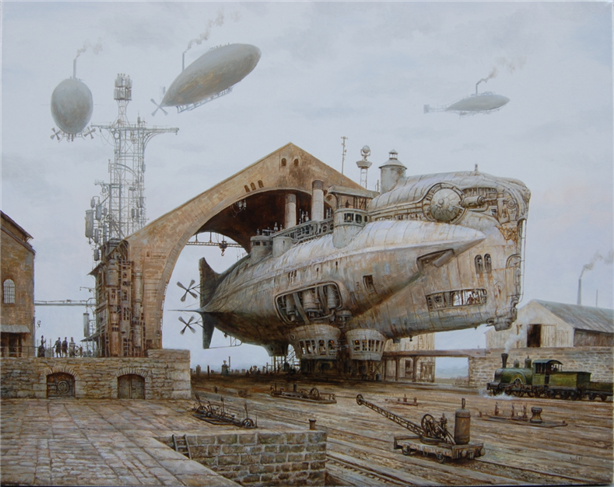 |
| Thunderer by *Voitv |
Unlike a vessel that floats on water, an airship is way more delicate in her balance and weight restrictions. The system I described last time is relatively heavy! My back of envelope calculations suggest that it would be the equivalent of all the engines, fuel and ballast water that the Hindenburg carried and then some. This weight is concentrated into a small area which has implications for where it is positioned in the hull.
The main propulsion engine in the stern with its large counter rotating props, powered by Tesla's wireless electrical system, is also fairly weighty for its power output. One other design idea I had was to use a larger number of smaller engines spread around the hull to avoid this concentration of weight, but it doesn't look quite so cool. (The "Splendid" requirement remember.) In this system these two weights, the power plant and main propulsion system, are at least small in area which simplifies the gross layout somewhat. By placing the power plant appropriately in the design we can balance the ship. The crew accommodations, cargo holds, and bridge are relatively light by comparison.
One other significant weight that needs to be accounted for is the steam condenser. This condenser is needed to recover the water from the high pressure steam used for power, plus the steam vented from the lift system when trimming the ship and any excess steam generated when the core is operating. Remember that our power core is either on or off, and when on must be cooled by steam generation constantly.
When I was originally doodling around with my design I had thought to give our airship a hull that was a shell of a light metal, like duraluminum, rather than the truss and fabric type structure the traditional rigid airships used. The condenser in that design was simply the upper surface of the hull itself. Alas, a quick calculation showed that a hull the size of the Hindenburg would be way too heavy built that way. In fact even using a light metal such as duraluminum the condenser becomes a significant weight in its own right, the third largest weight after the power core and main propulsion engine in fact.
Interestingly, if our airship was buoyed aloft by hydrogen, instead of steam, such a hull would work, and wouldn't need the weight of a condenser. This has some implications for a modern airship design using composite materials like modern graphite fibres etc.
Since we want our airship to be mostly appropriate to Victorian times, and use steam as its lifting gas, our airship will have a more or less conventional hull structure of duraluminum trusses with a fabric cover for the majority of the hull. The three primary weight blocks of power, propulsion, and condenser are laid out in such a way that the airship is in balance. The simplest way to visualize her is something like the Hindenburg with a pair of counter rotating props at the stern aft of the fins, a pair of funnels just forward of amidships, and what looks like a shell of metal on her upper hull just aft of the funnels.
I think that is pretty "splendid" really so our Captain should be happy.
Now let's get into the engine room and get our hands greasy, what would it look like? How do you arrange all the bits that are the core systems that support our airship in flight? As mentioned above the power core and its water tank are the heaviest parts and so must be the lowest in the hull. Water is a good shield for radiation so the rest of the engine room can be close to the core without problems. From an aerodynamic standpoint we don't want to disrupt the hulls smooth contour more than necessary so as much as possible we should keep everything inside the hull along the keel structure.
Here is my proposed gross layout. I would draw a picture but "Dammit Jim, I'm a Flight Engineer not an artist!"

At the lowest point, close to amidships, is the core and its tank. There is really no pressure in the tank so it doesn't have to be cylindrical like a railway engine boiler. However, a cylinder does minimize the weight of the tank relative to its volume. A sphere would be the best of course, but would be harder to fit into the hull. Above the tank is the main low pressure distribution header. This header leads low pressure steam direct from the core to the lift bags inside the hull. Valves in the header control this distribution. A low pressure channel also connects the header with the condenser on the upper surface of the hull. This channel is controlled by a valve and is the primary means to regulate the flow of low pressure steam between the lift bags and/or dumping the excess to the condenser.
Alongside the main distribution header is the main condensate header. This header's main purpose is to connect to the condenser on the hull and direct the condensed steam back to the main tank. This header also collects steam condensed from within the lift bags, as well as from the condensation collected from the inside of the hull itself that results from lift bag leakage.
Forward of the main tank is the engine room proper. Integrated into the forward bulkhead of the main tank is the high pressure boiler. Inside is the steel coil, filled with high pressure mineral oil, that leads directly into the heart of the power core. (Note: I've changed this slightly see the next article for the reasons why) Water from the main tank is pumped into this boiler where it is flashed into steam. The production of steam is regulated by the pump rate, if the pumps stop so does the steam production. This is similar to the way a water tube steam boiler worked on the more advanced steam cars of the period.
The heart of the engine room is the main turbine that takes the high pressure steam from the boiler and converts the energy to electrical power, by the use of an attached Tesla high voltage AC generator. This turbine is a special light weight version of that employed in high speed torpedo boats. Exhaust steam from the turbine is directed to an exhaust header. This header is connected to the main condenser.
A valve also connects the exhaust header directly to the funnels. When activated all the exhaust steam goes directly to the atmosphere, via the funnels instead of the condenser. This is used for two purposes, in case of a problem with the condenser that produces an unacceptable back pressure on the exhaust, and for when the Captain orders "flank" or emergency speeds and the flow of steam from the turbine would overwhelm the ability of the condenser to handle it. Doing so would rapidly deplete the water in the main tank of course, as none of it would be recovered by the condenser. We are a military ship, as well as an exploratory one, so such speeds may sometimes be necessary. Of course we could only run the ship flat out like this for a limited amount of time before we would be forced to shutdown the core. (Hmmm... I foresee some interesting role play possibilities with that, "Sorry Captain I canna push her much longer or she's goin ta blow!")
Ranged along the walls of the engine room are the auxiliary systems needed to support the primary one. I imagine this to look pretty similar to the engine room of a high speed destroyer of the period. Lots of brass gauges, pipes, pumps, and sparking, glowing, electrical devices of a mysterious and dangerous look.
I'll try to describe these systems in more detail in my next article.
Forward of the engine room is the domestic cargo hold, which carries the baggage and supplies for the crew. Aft of the main tank is a larger general purpose cargo hold.
So that will be my domain on this ship. How large a crew would be needed to man the engine room? Not many really. If we used a three watch system similar to that used by commercial surface ships and the great rigid airships, a crew of 6, 3 in each watch, including myself would be sufficient for normal operation.
Please join me next time as I continue to flesh out the mechanical side of this airship.
Don't worry, I haven't forgotten the crew's comforts, that's coming soon as well.
Keep your sightglass full, your firebox trimmed and your water iced.
KJ
Click here for the next article in this series.
You can follow the full design thread by clicking on the tag "Flight Engineer".
Practical Airship Design Part 4
Sunday, November 18, 2012
0
comments
Labels:
Airships,
Flight Engineer,
howto,
Musings,
Steam,
Tesla
To Fly Amongst the Clouds
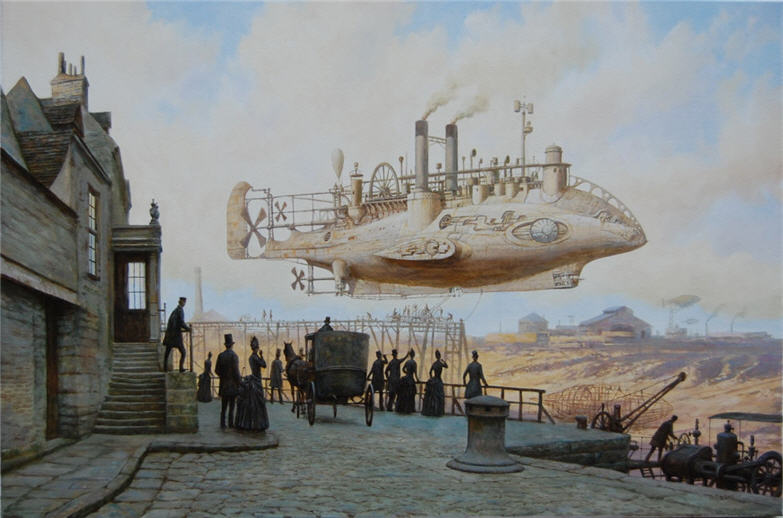 |
| Heavenly Nautilus by *voitv |
Besides, what better steampunk airship could we have than one that flies and is propelled using steam!
Later in this series I will attempt some calculations, to do a kind of "reality check", for the overall design. However to make sure that I wasn't too far off base, I did some quick calculations using the specs of the Hindenburg to see if steam lifting gas would result in useful lift. For an airship the size and dead weight of the Hindenburg, steam does indeed allow a small payload. You may recall that my buddy Grant's calculations had shown that in order to fly it would have to be 25% larger. But she was saddled with passenger accommodations and infrastructure to handle 40 or more people and their baggage, and since our airship is a military/exploratory one, not a commercial passenger ship, we have a lot of weight that can be re-allocated to our power and propulsion systems.
In a conventional gas filled airship the static lift system is independent of the propulsion. In the case of the great rigid airships like the Graf Zeppelin or Hindenburg, the lift was provided by hydrogen and the propulsion by diesel engines. In our case, courtesy of our power source, we can unify these systems with the attendant benefits I discussed last time.
So how would this work in practice?
First I'll talk a bit about one way to make use of our power source to handle both lift and propulsion. Then I'll discuss a way to bring the power out to the propellers so we can begin our grand voyage. In my next post in this series I'll talk about how all this can be laid out in the hull and perhaps what form that hull will take.
Power Core
At the heart of our airship is the core, a dense block of "something" generating very large amounts of heat. (Personally I prefer to treat this core as a fission type nuclear reactor.) Since for our purposes it is our one major fantastical element, we don't have to deal with the pesky details of how it actually generates so much heat. We do however, need to deal with the practicalities of using it.
To keep things simple the core is either an "on or off", "feast or famine", deal. Once running this core continues to generate heat, whether we need it or not, therefore cooling of the core is a priority. The core is mounted in the center of a large tank of water. Thermosyphoning of the tank water around the core, where it is turned into low pressure steam, carries away this heat. This steam is used as our lift gas. In flight, we only need to generate steam to balance that which is condensed and collected from the gas bags inside the hull. This will not be enough to prevent overheating of the core, so a large radiator ,or condenser, is mounted on the top of the hull to condense any excess steam. This radiator is a primary structural component making up a significant portion of area of the hull itself. The radiator is air cooled, sending excess heat to the atmosphere.
In the event that the hull condenser cannot handle the excess steam, or in case of an emergency, steam will be sent directly to the atmosphere through a couple of elegant funnels on the upper hull. (Just cause it looks so damn cool.
)In practice the Chief Engineer (me) and his staff would constantly monitor the heat balance of the main tank, along with the balance of lift steam and condensate reboil, directing excess steam to the condenser as required to keep things stable.
The main tank also serves to shield our crew from any adverse effects of the core itself. Water is a good shield for ionizing radiation. Two meters of water is sufficient to handle the gamma ray flux of a typical spent fuel rod from a modern reactor for example.
Power Generation
My proposal is for our airship to use a Tesla type electrical power system to drive its main propulsion engine. This power is generated in the engine room by the use of a similar system to that found in a modern nuclear reactor.
Given the very large amount of heat being produced continuously, the interior of the core itself is much hotter than its surface. A coil of steel pipes built into the structure of the core when it is made, carries a dense mineral oil into the heart of the core. Here the oil picks up the intense heat, and being under very high pressure, does not boil but remains liquid itself. This high pressure, very hot, oil is directed to a more or less conventional boiler outside the main tank. Here it is used to boil water, supplied from the main tank, to make steam. This steam is used to run a high speed turbine in the engine room. Exhaust steam from the turbine is directed to the hull condenser and thence back to the main tank.
Why not have water in the coil and simply flash it into steam directly?
To keep things simple. If the coil and boiler are arranged and sized correctly, no mechanical pumps are required to maintain the fluid flow through the core, and therefore the heat flow to the boiler. The density effects of temperature will cause the oil to flow in the loop. We want to minimize the amount of things that can fail INSIDE, or close to, the dangerous confines of the main tank near the core. Also it is likely that the fluid used in the loop will become dangerous (radioactive?) as a result of its close exposure to the core. With no mechanical pumps in the loop, there is no need to open the piping for repair or maintenance with the risk of exposure to any contaminated fluid.
The turbine is connected to one of Tesla's high powered AC generators. This power is used to run the main propulsion systems.
Propulsion
Tesla's wireless power transmission system, a kind of tuned resonance, is used to transfer this power to the main engine without wires. The engine drives large counter rotating props at the stern of the airship. These props, by counter rotating, do not induce any rotational torque on the hull. A similar system is used to drive water torpedoes.
Auxiliary engines and propellers are mounted on the hull for use in maneuvering at low speeds during takeoff and landing. These engines also receive their power via Tesla's wireless system.
A side benefit to using Tesla's power system is that lighting and auxiliary power can be taken from the same system without the use of wires, thus helping to minimize weight.
The core gives us both lift and power for propulsion. There are no mechanical pumps necessary to control the primary system, minimizing the points of failure when we are far from our base. With such power at our command we can truly fly amongst the clouds, traveling the world in the search of adventure and in service of Her Majesty, HUZZAH!
Join me next time for some more details of how all this fits together within the airship's hull. An engineer's eye view if you will.
Keep your sightglass full, your firebox trimmed and your heat balance stable!
KJ
Click here for the next article in the series.
You can follow the full design thread by clicking on the tag "Flight Engineer".
Protospace Speech
This is the text of a short speech that I gave as part of the open house for the new Protospace here in Calgary yesterday. Along with Monica Willard of SASS we were invited to give talks on Steampunk. It was well received and seems to have got a lot of "wheels turning".
You can see more about Protospace at their website and Facebook pages.
http://www.protospace.ca/
https://www.facebook.com/groups/43079798204/
The speech I gave is based on a my musings from last Sunday.
Enjoy
Keep your sightglass full, your firebox trimmed and your water iced.
KJ
Good afternoon Ladies and Gentlemen.
It is an honour to be able to join in the festivities to mark the opening of this new home for Protospace.
It's also great to see so many Steampunks in the room today.
I can tell you that many of us are really looking forward to getting our hands on the fantastic equipment Protospace has to offer. Oh the possibilities!
Now the more I wear my Steampunk clothes out in public, after the obligatory "Why are you dressed like that?", the more I get asked "What is Steampunk anyway?"
I've given a variety of answers. Things like; it is neo-victorian, or quasi-victorian, or an alternate history, or techno-fantasy.
Or... It is like the Wild-Wild-West and Sherlock Holmes movies, or the stories of Jules Verne or H.G.Wells etc.
While these are all reasonable catch phrases to use to describe Steampunk, they are just that, "catch phrases", and not really a very informative description or explanation. When I get a request for more information, I usually fall back on the traditional "What If" comments...
"What if Babbage's mechanical computer had worked."
or
"What if the technological development had stopped with Steam?" or things like that.
This difficulty with explaining Steampunk, is not an uncommon problem. Anyone who has ever looked up "What is Steampunk?" on Google will turn up many pages worth of different descriptions and explanations.
So why is it so difficult to distill Steampunk down to a neat and tidy explanation?
It should be easy to explain, the "What ifs" and Neo-Victorian costuming should be enough but it doesn't feel right, it is too simplistic.
I think it's because the Steampunk scene is actually a "World" in the big sense of that word. It is not only a costume style, or an alternative music scene, or a design aesthetic. Steampunk encompasses all of these, as well as the diversity and complexity of the social Goth and Punk movements. It is also not simply a matter of being "Goths who discovered brown" as a friend once snidely remarked. Nor is it strictly speaking a "Geek" thing or an "historical re-creation gone bad" thing, or a basement tinkerer's thing.
There is vastly more here that should be explained. Steampunk is of surprising interest to many people. People that one would not at first expect to be interested at all, are donning a corset and goggles, or a top hat and cravat, and heading out for tea at the nearest fancy hotel, or quaffing a pint at an English style pub. People who would never think of taking their car apart for fun, are tearing apart old clocks and gluing and sewing their gears to their hats and delving into the arcane mysteries of Babbage's Difference Engine, or watching Youtube videos of old steam engines, airships and early motor cars, and becoming intimately acquainted with the smell of brasso, leather,steam heated oil, and coal smoke.
I've noticed an interesting pattern, when there is one Steampunk there will shortly be more!
The same can be said about cockroaches of course, but hey...
Once people see that it is OK to dress up and pursue their interests, in the way the Steampunk scene allows them to do, it doesn't take long before they start to do just that.
My own reasons for being active in the Steampunk Scene are probably not the same as anyone elses, and like most things in life, our motivations are idiosyncratic, the result of our own history and experiences. So trying to distill "Steampunk" down to a soundbite is just as hard as doing that for our everyday lives, and perhaps, just as futile.
A better way, is to contrast the Steampunk Worlds with our everyday world. I'm going to do that through two of the great pillars of invention in the late 19th and early 20th centuries.
Thomas Alva Edison and Nicola Tesla were men of outstanding genius and creativity, but, they were radically different in how they worked and how they saw progress and invention.
Tesla, Edison and JP Morgan
This video is a section of a movie called The Secret of Nikola Tesla
Produced in 1980 and directed by Krsto Papic, it stars Petar Bozovic as Nikola Tesla, Dennis Patrick as Thomas Edison and Orson Welles as J.P. Morgan.
In this scene Morgan holds a meeting between Tesla and Edison in an attempt to decide what form the new electrical systems will take.
A fascinating recreation of one of the turning points in technological history.
You can watch the entire film at YouTube here.
It is a reasonably accurate biography of Tesla from what I can see.
Keep your sightglass full, your firebox trimmed and your water iced.
KJ
Match made in...
Hmmm
Well... Not really sure where.

KJ
The "World System" of Nikola Tesla
The more I read of Tesla, that wunderkind inventor and experimenter of the early Electric Age, the more I am fascinated by the immense scale of his vision.
For example, in 1900 he had an idea for what he called his "World System". Keep in mind that this was when wireless telephony was still in it's very early stages. Tesla's description of what his system could achieve is striking in its scale and depth. It is also very prescient and although we do not use his "World System", which was based on wireless power transmission through tuned resonance between the Earth and its Atmosphere and Magnetic field, the results of our developments have come very close to his predictions.
Below is a description of his "World System" in his own words.
Enjoy
Keep your sightglass full, your firebox trimmed and your water iced.
KJ
From My Inventions By Nikola Tesla
At the age of 63 Tesla tells the story of his creative life.
First published in 1919 in the Electrical Experimenter magazine.
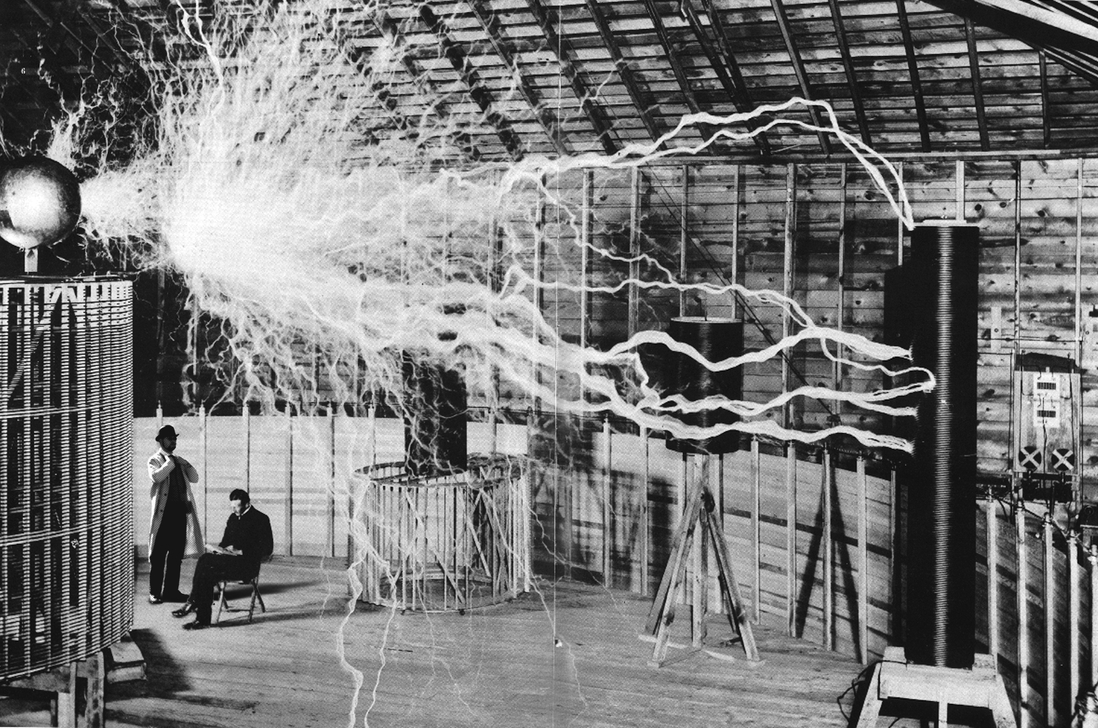
This invention was one of a number comprised in my "World-System" of wireless transmission which I undertook to commercialize on my return to New York in 1900. As to the immediate purposes of my enterprise, they were clearly outlined in a technical statement of that period from which I quote:
"The 'World-System' has resulted from a combination of several original discoveries made by the inventor in the course of long continued research and experimentation. It makes possible not only the instantaneous and precise wireless transmission of any kind of signals, messages or characters, to all parts of the world, but also the inter-connection of the existing telegraph, telephone, and other signal stations without any change in their present equipment. By its means, for instance, a telephone subscriber here may call up and talk to any other subscriber on the Globe. An inexpensive receiver, not bigger than a watch, will enable him to listen anywhere, on land or sea, to a speech delivered or music played in some other place, however distant. These examples are cited merely to give an idea of the possibilities of this great scientific advance, which annihilates distance and makes that perfect natural conductor, the Earth, available for all the innumerable purposes which human ingenuity has found for a line-wire. One far-reaching result of this is that any device capable of being operated thru one or more wires (at a distance obviously restricted) can likewise be actuated, without artificial conductors and with the same facility and accuracy, at distances to which there are no limits other than those imposed by the physical dimensions of the Globe. Thus, not only will entirely new fields for commercial exploitation be opened up by this ideal method of transmission but the old ones vastly extended.
The 'World-System' is based on the application of the following important inventions and discoveries:
1. The 'Tesla Transformer.' This apparatus is in the production of electrical vibrations as revolutionary as gunpowder was in warfare. Currents many times stronger than any ever generated in the usual ways, and sparks over one hundred feet long, have been produced by the inventor with an instrument of this kind.
2. The 'Magnifying Transmitter.' This is Tesla's best invention, a peculiar transformer specially adapted to excite the Earth, which is in the transmission of electrical energy what the telescope is in astronomical observation. By the use of this marvelous device he has already set up electrical movements of greater intensity than those of lightning and passed a current, sufficient to light more than two hundred incandescent lamps, around the Globe.
3. The 'Tesla Wireless System.' This system comprises a number of improvements and is the only means known for transmitting economically electrical energy to a distance without wires. Careful tests and measurements in connection with an experimental station of great activity, erected by the inventor in Colorado, have demonstrated that power in any desired amount can be conveyed, clear across the Globe if necessary, with a loss not exceeding a few per cent.
4. The 'Art of Individualization.' This invention of Tesla's is to primitive 'tuning' what refined language is to unarticulated expression. It makes possible the transmission of signals or messages absolutely secret and exclusive both in the active and passive aspect, that is, non-interfering as well as non-interferable. Each signal is like an individual of unmistakable identity and there is virtually no limit to the number of stations or instruments which can be simultaneously operated without the slightest mutual disturbance.
5. 'The Terrestrial Stationary Waves.' This wonderful discovery, popularly explained, means that the Earth is responsive to electrical vibrations of definite pitch just as a tuning fork to certain waves of sound. These particular electrical vibrations, capable of powerfully exciting the Globe, lend themselves to innumerable uses of great importance commercially and in many other respects.
The first 'World-System' power plant can be put in operation in nine months. With this power plant it will be practicable to attain electrical activities up to ten million horsepower and it is designed to serve for as many technical achievements as are possible without due expense. Among these the following may be mentioned:
(1) The inter-connection of the existing telegraph exchanges or offices all over the world;
(2) The establishment of a secret and non-interferable government telegraph service;
(3) The inter-connection of all the present telephone exchanges or offices on the Globe;
(4) The universal distribution of general news, by telegraph or telephone, in connection with the Press;
(5) The establishment of such a 'World-System' of intelligence transmission for exclusive private use;
(6) The inter-connection and operation of all stock tickers of the world;
(7) The establishment of a 'World-System' of musical distribution, etc.;
(8) The universal registration of time by cheap clocks indicating the hour with astronomical precision and requiring no attention whatever;
(9) The world transmission of typed or handwritten characters, letters, checks, etc.;
(10) The establishment of a universal marine service enabling the navigators of all ships to steer perfectly without compass, to determine the exact location, hour and speed, to prevent collisions and disasters, etc.;
(11) The inauguration of a system of world-printing on land and sea;
(12) The world reproduction of photographic pictures and all kinds of drawings or records."
Tesla's Last Home
I just started reading a fascinating book:
Nikola Tesla, My Inventions and other writings compiled by Samantha Hunt
This book is a collection of articles written by Tesla himself and published in the Electrical Experimenter Magazine starting in 1919.
I will be reviewing it more later, but the description of the hotel that Tesla lived in for the last ten years of his life is interesting:
He spent the last ten years of his life in the Hotel New Yorker. When it opened in 1930 it was the tallest building in New York City, a monument to the ambition and decadence of the Jazz Age. At forty three stories high, it had its own power generator. The kitchen was an entire acre. There were five restaurants, ten private dinning rooms, two ballrooms and an indoor ice skating rink. Conveyor belts whisked dirty dishes through secret passageways down to fully automated dishwashers. Four stories below ground, bedsheets and tableclothes were miraculously laundered, dried, ironed, and folded without ever touching a human hand. Everything about the hotel was efficient, futuristic. It was perfect for Tesla-- except by the time he arrived in New York in 1933, he was destitute.Keep your sightglass full your firebox trimmed and your water iced.
KJ
Tesla Master of Wonders
Check out the rest of the details of this fascinating man at the original:
The Oatmeal: Nikola Tesla
Keep your sightglass full, your firebox trimmed and your water iced.
KJ

Technical Books Galore at Lindsay Publications
Here is a source of very interesting old books.
Lindsay's Technical Books
Lots of possible uses for Steampunk gadgets here!
 |
| Lindsay Publications |
Here is a screenshot of the index page to give you a taste of what you will find on the site.
I have ordered a catalog and a copy of the book on making vacuum tubes and amplifiers called Instruments of Amplification by Pete Friedrichs.
I will let you know how it goes.
Keep your sightglass full, your firebox trimmed and your water iced.
KJ
Nikola Tesla: Dreams And Nightmares
This article, originally titled 'Free Energy For Everyone: The Dream And Unbridled Genius Of Nikola Tesla' was first published at LewRockwell.com
Nikola Tesla (1856-1943) has been called founder of modern electrical technology. Among his creations are the channeling of alternating current, fluorescent and neon lighting, wireless telegraphy and giant turbines that harnessed the power of Niagara Falls. A man ahead of his time, he is credited as the inspiration for radio, radar, robots and even TV and the internet. He held over 700 patents. He believed that cheap, abundant energy could be made available to everyone.
This video documents his amazing inventions as well as his persecution at the hands of the corporate state (46:26)