Showing posts with label Steam. Show all posts

Practical Airship Design Analysis of a Real System!

Sunday, November 22, 2015 0 comments

Steam Plants for Aircraft analysed in 1926!

I found an interesting report from NACA (NASA's original name) concerning the analysis and experimentation of light weight steamplants for use in aircraft.

The paper is entitled "Steam Power Plants in Aircraft" and compiled by  E.E. Wilson at the Bureau of Aeronautics in 1926, and you can get the paper in PDF format here.

In this paper the author analyses a lightweight boiler setup capable of generating sufficient steam at high enough pressures to power an aircraft. He then estimates the weight and efficiency of a complete system model using this boiler and compares it to the current internal combustion power plants used in the heavier than air craft of the time.

The result of the analysis is that with the current state of the art in 1926, using steam power for heavier than air craft was NOT practical. This is not really a surprise given the power/weight ratio of even an efficient boiler and turbine setup. However there were two constraints that really tipped the analysis over against the use of steam power for aircraft.

  1. Fuel consumption/efficiency of steam power compared to internal combustion power plants.
  2. Weight and area of the system for condensing the steam for re-use.
If you have been reading the other parts of my Practical Airship Design series you will note that neither of those constraints exist in the design of our airship!

First the fuel consumption issue doesn't exist because of our fantastical core, which uses no fuel but produces steam at potentially very high temperatures and pressures. Second the condensation issue is moot because the exhaust steam can simply be added to the lift system and condensed on the hull condenser as described in Part 4.

Interestingly enough the author concludes something similar and even postulates a turbine electric propulsion system, which was very cool to read indeed!

Again we do not have any worries about efficiency in our design.


Fascinating to see this analysis and it is an interesting read if you are curious about the analysis of a real system that could be implemented in an airship like I have been describing.

Keep your sightglass full, your firebox trimmed and your water iced.
KJ

Here is the table of contents for the whole series of Practical Airship Design posts.

You can see all the posts related airships and airship design here.

Lost Power Makers

Thursday, August 21, 2014 0 comments

Heavy Metal!

There is something wondrous, and also a bit melancholy, about abandoned buildings and factories.
All the energy, thought, labour, and pride expended in creating these great buildings and their complex machines is apparent even in the signs of decay and collapse.

Probably the most melancholy though, are abandoned power plants.

These are places where man manipulates the basic forces of nature into forms that can be used for human purposes. Whether those forces come from rushing water, coal, oil, or even the fundamental building blocks of matter itself, these are the places where we have molded them and converted the energy they contain into standardized human designed forms.

This collection of 32 amazing photos collected on Scribdol evokes the lost power of these places.

7 Most Incredible Abandoned Power Plants

Here are a couple of shots to "wet yer whistle".
Keep your sightglass full your firebox trimmed and your water iced.
KJ


Steam Yachts

Saturday, April 19, 2014 0 comments

Elegant and Expensive


This book is a collection of photos and details of the very expensive toys of the ultra rich.

"The Steam Yachts" by Erik Hoffman is a wonderful look at how "the other half", actually the "other 0.1%", played in the 19th and early 20th Centuries.

 My copy is missing its dust jacket but is otherwise in excellent shape.

In all there are 120 yachts, from the sidewheeler  Northstar  built for Cornelius Vanderbilt in 1853 to the Christina built for Aristotle Onassis in 1954. Each has a photo, details of size, power, rig, crew, and details of the often very short history of these very expensive status symbols.

In the days before the mass production of the fiberglass "gin palaces", that clutter up every posh harbour in the Mediteranean, these vessels embodied both the extreme engineering of the ocean going greyhounds and the elegance and beauty of the most expensive great houses.

These are vessels who were not designed for the work of their commercial and military sisters but were designed simply to show off the wealth of their owners. They spent most of their lives at anchor in conspicuous harbours along the East coast of North America and the ports of England.

Perusing the photos of these magnificent examples of ship building, one can easily trace the technological changes that were occurring in the commercial shipbuilding world as well. They look very much like the fast military vessels, torpedo boats and destroyers, that were being developed at the same time in the 1890s and 1900s. In some cases they were converted and used as such during the great war.

Speed was always one of the key requirements and most of space in their their hulls is taken up with boilers and engines. But they had to look the part of belonging to these great and powerful men as well, so there were vast areas of polished teak, varnished brightwork, polished brass and stained glass maintained by crack crews and professional staffs, masters, stewards and chefs.

 The Ultra Rich still have yachts, but there is a monotony to their modern plastic forms and none of the power and elegance that these steel status symbols displayed.

Keep your sightglass full, your firebox trimmed and your water iced.
KJ

Title
The Steam Yachts

An Era of Elegance

Author
Erik Hoffman

Publisher
John de Graffe, inc.

Date 
1970

ISBN
0-8286-0040-6


Ironclads in Action

Monday, January 20, 2014 0 comments

Iron monsters!

An interesting read covers every engagement involving ironclads from Hampton Roads to the Bombardment of Alexandria.

Filled with maps, reports, and detailed summaries of the actions and vessels involved. 
I found lots of information here that I have not found anywhere else, and at 920 pages in two volumes it would be a weighty tome in paper.

Highly recommended for any fans of this fascinating period of Naval history.

Available in PDF and ebook formats from the Internet archive here:
Volume 1
https://ia700308.us.archive.org/20/items/ironcladsinacti00wilsgoog/ironcladsinacti00wilsgoog.pdf

Volume 2
https://ia600308.us.archive.org/13/items/ironcladsinactio02wilsuoft/ironcladsinactio02wilsuoft.pdf

Title
Ironclads in Action
A Sketch of Naval Warfare
1855-1895

Author 
Wilson, Herbert Wrigley, 1866-1940

Publisher 
London, S. Low, Marston and company

Date
1896

American Civil War Naval Chronology 1861-1865

Thursday, October 17, 2013 1 comments

A massive book this!

Recently acquired on a trip out to the fabulous used book mecca of Sydney BC this book is nearly 3 kg of awesomeness!

Originally published as a set of five annual paperbacks for the US Department of the Navy for the Centenary of the Civil War, starting in 1961 and continuing until 1965, each volume covered one year of the conflict. A further volume published in 1966 contained a detailed index and a collection of eye witness accounts and  other details to support the previous volumes. My copy was published as a single consolidated volume in 1971 and is in mint condition.

Clocking in at over 1000 pages this book is filled with photos, maps, diagrams and detailed accounts of nearly every naval action of the Civil War. A true treasure for anyone interested in the Civil War but also a fascinating look at the transition from sail to steam, from the old "Wooden Ships and Iron Men" of the Napoleonic era to the age of steam and armour that defined the shifting technological world of the Navy in the 19th Century.

The photos are reproduced in fairly good detail, if a little dark, and the text is also illustrated with period maps and photos of actual documents, diaries, letters and sketches.

Definitely not a good book to try to read in bed unless you have a block and tackle to hold it though!

Keep your sightglass full your firebox trimmed and your water iced.
KJ


Title
Civil War Naval Chronology

Author
Various

Publisher
Naval History Division
US Department of the Navy

Date
1961-66
Consolidated volume 1971

Steam Powered Box Factory

Sunday, July 21, 2013 0 comments

Steam power in action.

This steam powered wooden box factory has been in use since 1897.

Wonderful video of the whole process.  Lots of belts and gears working together.


Enjoy

Keep your sightglass full, your firebox trimmed and your water iced.
KJ

The Winans Cigar Ships 1866

Sunday, June 30, 2013 0 comments

A   possible source for Jules Verne's Nautilus.

Found this article at the fantastic Vernian Era website. I have previously discussed another set of pages from this site in my School of Nautili post.   Michael Crisafulli has collected some wondeful information on various technologies that existed at the time Jules Verne was writing. Many of these were experimental and considered unworkable but they could easily have been used as inspiration by Verne.

A good example of such a technology was the Cigar Ships that the Winans Family of Baltimore, Maryland, built between 1858 and 1866.

 From the introduction:
The cigar ships were designed and built by the Winans family, successful railway engineers from Baltimore, Maryland who moved into marine engineering with enthusiasm and great expenditures of their family wealth, but less success.  Their radical marine design concept included an ultra-streamlined spindle-shaped hull with minimum superstructure.

The Winans constructed at least four ships between 1858 and 1866.  Two of these attracted considerable public attention as well as skepticism and outright criticism from the technical establishment.  Ross Winans and his sons were, first and foremost, engineers experimenting with innovative concepts.  The innovative technology would certainly have attracted Jules Verne's attention.  He may well have seen one of the boats sailing or berthed in England.  Some of their innovations were adopted for surface ships in the twentieth century, and many of the pioneer submarines built in the late nineteenth and early twentieth century resembled them.  Later in the twentieth century, aerodynamicists rediscovered the benefits of the spindle.

The site discusses the history of these odd vessels and many of the design problems that the Winans had to overcome.

The final ship built using this design was the yacht Ross Winans built in 1866.
From the website:
Ross Winans reconstruction - click for a 3-D viewThe Winans launched their final effort in 1866 in London.  The Ross Winans was 256 feet long with the same 16-foot diameter as their first boat and displaced about 400 tons.  It did have a nearly conventional superstructure atop the hull amidships, 130 feet long and ten feet wide, tapering to a point at each end.  Inverting the first design, it was driven by a 22-foot diameter propeller at each end.  These nine-bladed props were powered by an engine room amidships.   The Ross Winans underwent trials in the Solent channel but made no more than one or two coastal voyages, never going to sea in earnest. 
The woodcut at right, from The Illustrated London News, 3 Mar 1866, shows the stern-first launching of the Ross Winans.  The propeller mounts are visible, but the propellers have not yet been installed.
The launching of the Ross Winans at Millwall

 
Highly recommended reading this!

Check out the full article at: The Winans Cigar Ships

Keep your sightglass full, your firebox trimmed and your water iced.
KJ

"The British Battle Fleet" 1912

Monday, June 17, 2013 0 comments

Huzzah!

This monumental, 400 page, work was originally published in 1912 (and republished in 2003 by Conway Classics in the UK.) Written by Fred T. Jane, the founder of the influential Jane's series of military books and annual digests, this book chronicles the history of the British Battle Fleet, and the Royal Navy itself. From it's earliest days in the early medieval period, through the tumultuous 18th century and the massive technological changes of the 19th centuries and up to the massive scale and power of the British Fleets before WWI.

For anybody interested in the history of ships and the men who commanded and sailed them this is an absolute treasure. 

My copy is the 1912 edition and is in very good condition, given it's over a hundred years old! 

The book has many illustrations, some in colour, taken from paintings in the early years and photos of the late 19th and early 20th centuries.

There are lots of technical diagrams of deck and gun layouts after steam propulsion is introduced as well.

The first half of the book is an interesting history, covering much of the politics as well as the military actions of the early days of the Royal Navy. Jane covers many of the social and political issues in some detail, quoting from period sources when available. He covers the Great Mutinies at Spithead and the Nore in 1797 and discusses many of the causes and results of them on the subsequent social changes in ships crews.

He covers the period of the almost continuous warfare with France with lots of detail. That section alone is a treasure for anyone interested in what ships and fleets did what.

The second half of the book covers the period from the first introduction of steam propulsion to the development of  the "All Big Gun" Dreadnaught and all her subsequent, handsome and very lethal, kin.

Fred Jane has a good eye for the historical anecdote, as well as the technical detail he displayed in his original monographs covering the state of the world's navies since his first "All the World's Fighting Ships" of 1898 .  Jane is also not shy about making some sage predictions as to how the future would look given all the technological changes that had occurred in his own lifetime. Some of them turned out to be spectacularly wrong (entertaining none the less) and others prescient indeed, as the great cataclysm of WWI subsequently showed.


I highly recommend this book for anyone interested in the developments of the Battle Fleet from both a technical and social/political standpoint.

Keep your sightglass full, your firebox trimmed and your water iced.
KJ

Title
The British Battle-Fleet
Its inception & growth throughout the centuries.

Author
Fred T. Jane

Date
1912

Publisher
S.W. Partridge & Co,., LTD. (1912)
London
Conway Maritime Press (2003)

ISBN
978-0851777238

Steampunk Train Battleship

Friday, June 7, 2013 0 comments

Battleship on rails!

This video shows the first live steam powered trial of  the Steampunk Rail Battleship Barnum's Dream.


From YouTube:

Published on Apr 14, 2013
Battleship train ship model with cannons and lasers that fire. It has many handmade moving parts that are driven by a live steam engine. The video is a depiction of it's first trial run, with some animation and effects thrown in. It was made from over 50 found parts and took over 2500 hours to construct. Except for the steam engine, which was modified, it is totally hand built using ordinary home tools.
It is almost four feet tall and 51 inches long. Hope you enjoy.
 You can get lots of information on the model and how it was built at the blog here:
Steampunk Machine "Barnum's Dream"

Now that is my kind of model!

keep your sightglass full, your firebox trimmed and your water iced.
KJ

"Transatlantic" by Stephen Fox

Thursday, May 30, 2013 0 comments

Ocean Liners.

Those symbols of technical prowess, financial power and human foibles. There are names that conjure the increasing power and magnificence of steam; Cunard, White Star, Inman and Brunel. There are also names that remind us of our arrogance and vulnerability when we pit ourselves against the power that is the North Atlantic; Titanic, Atlantic, Arctic.

This fantastic book by Stephen Fox captures the history of the "Ocean Geyhounds" with lots of details about the technical changes in the ships as well as the development of their opulence and the effect of the changing world of the 19th Century and early 20th Century.

Filled with anecdotes and quotes from many of the early promoters, voyagers and crews of these technical marvels, the book gives us a feel for the passage across that stormiest of great seas. Rivaling even the dreaded Cape Horn for the ferocity of its storms, with the added dangers of fogs, icebergs, and congested fishing grounds, these machines carried their passengers, rich and poor alike, across in all weathers and all seasons.

From the Introduction:

During the nineteenth century, the roughest but most important ocean passage in the world lay between Britain and the United States. Bridging the Atlantic Ocean by steamship was a defining, remarkable feat of the era. Over time, Atlantic steamships became the largest, most complex machines yet devised. They created a new transatlantic world of commerce and travel, reconciling former Anglo-American enemies and bringing millions of emigrants who transformed the United States.
I highly recommend this book for anyone interested in both the technical and social history of transatlantic travel.

Keep your sightglass full, your firebox trimmed and your water iced.
KJ

Title
Transatlantic
Samuel Cunard, Isambard Brunel,
and the Great Atlantic Steamships


Author
Stephen Fox

Date
2003

Publisher
Harper Collins
New York

ISBN 0-06-095549-X


Experiments in Steam Lift Part 1

Sunday, May 26, 2013 0 comments

Science!

As you know if you have been reading my Practical Airship Design series, the airship I am describing/designing uses low pressure steam as the lift gas. While not anywhere near as powerful a lift agent as Hydrogen or Helium it has several advantages that I have discussed in that series here and here.

I have decided to do a some quick experiments for myself to see how steam worked as a lift gas. Nothing fancy really just a quick check on how steam behaves at low pressure in an enclosed space like our airship's lift bags.

In order to test this I needed a few items:

1) A source of low pressure steam of fairly large volume.
2) An envelope to contain the steam.

For the Steam source I decided to use a small 1/2 liter electric kettle, one that has no automatic shutoff just a whistle to tell when it is boiling. It would keep boiling until it was dry if I let it.

I thought finding an envelope would be a bit tricky as it has to be light enough to show if there was any lift available, but not be too sensitive to the temperature of the steam (100c at sea level of course but about 98C at our elevation). I wasn't sure how most light weight materials would handle the heat.

The lightest materials I had on hand were Safeway shopping bags and green garbage bags. These are plastic of course so I was concerned that they would potentially be damaged by the steam. Easiest way to test was to put a chunk of each in boiling water and see what happened.

Making sure my wife was out of the kitchen smile I filled a saucepan with water and got it boiling furiously on the stove. Then I immersed the samples, and after a few minutes I found that surprisingly they were completely unaffected! They didn't stretch or show any signs of being softened by the boiling water. They also didn't seem to give off any smell as a result of being boiled (so I escaped the kitchen and my wife unscathed). I decided to use these as the test envelopes for my lift experiment.

The first "proof of concept" experiment was to simply fill a shopping bag with steam from the kettle and see what happens. Anybody who has blown air into a shopping bag with a fan knows that the bag will expand as the air is pushed into it. In my case I wanted to see if the steam was doing any lifting not just expanding the envelope by pressure. How to do that?

The trick is to leave the bottom of the bag open to the atmosphere. That insures that there can be no over pressure inside the bag to hold it up. If the bag stays "inflated" even when it is open at the base then the inflation must be the result of the lift from the steam.

I fired up the kettle in the back yard and when it was boiling I placed the shopping bag over the kettle. I collapsed the bag into a long package first to exclude as much air as possible. As the steam beagn to flow the bag began to fill and lift the surface until it was nearly inflated! The bottom was open and the steam was not coming out of the bottom yet, which showed that there was no pressure building up in the bag.

I expected to see a lot of condensation of the steam on the surface of the bag, but there was very little during the few minutes of my test.

Next I did the same thing with the green garbage bag. This showed the same behaviour, the bag filled and extended even with the bottom open to the air. The garbage bag is much bigger of course and it was able to hold itself up by the lift of the steam. While I was doing this a slight breeze came up which kept collapsing the bag so I was not able to fully inflate it.

Again there was very little condensation on the inner surface of the bag. I'm not sure why that is unless the bag, by heating up to nearly the temperature of the steam, prevents much condensation.

My next set of experiments should be interesting.  I will try the garbage bag again inside and see if there is sufficient lift to actually lift the bag from the ground! I will also measure the temperatures of the bag surface and the steam inside. Allowing the bag to cool by removing it from the kettle will show how fast the steam condenses.

Stay tuned for part 2 coming soon.

Keep your sightglass full, your firebox trimmed and your water iced.
KJ

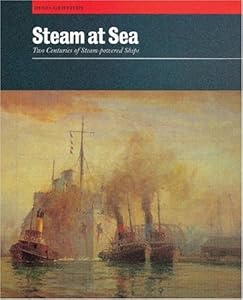
Steam at Sea

Tuesday, March 26, 2013 0 comments

Steamships!

The adoption of steam power in shipping during the 19th century marks one of the greatest changes in global transportation that the World has ever see.  Prior to the adoption of steam power, shipping was always at the mercy of the wind and tides. Human powered vessels, like galleys and the Norse long boat, while swift were unsuitable for carrying bulk cargoes. Steam power made possible regular trans-oceanic shipping of bulk cargoes and enabled the rapid industrialization of many countries around the World.

This book "Steam at Sea", by Dennis Griffiths,  is a history of the 200 years of steam propulsion in sea going vessels. It is not a history of steamships but a history of the steam plants themselves. Filled with illustrations and diagrams this book is a masterful technical treatise and an entertaining historical analysis of the development and use of steam power for shipping. 

There are sections on the early use of steam power, the development of river vessels and then seagoing ones. Improvements in engines and propulsion systems including the triple expansion engine and the development of  turbines and even nuclear power plants. 

A highly recommended addition to any technical bookshelf!


Title
Steam at Sea
Two Centuries of Steam-powered Ships

Author
Denis Griffiths
B Eng.M Sc.PhD.CEng FIMarE

Publisher
Conway Maritime Press
London

Date
1997

ISBN
0-85177-666-3

Keep your sightglass full, your firebox trimmed and your water iced.
KJ


Heavy Metal

Monday, March 18, 2013 0 comments

I love old industrial spaces!

This is a fantastic and moody shot.
What is this facility, what does, or did, it do?
The way it fades into the darkness beneath is awesomely mysterious too.

Found it online at Apostrophe9

Keep your sight glass full, your firebox trimmed and your water iced.
KJ

Royal Navy in Victorian Times

Thursday, March 7, 2013 0 comments

A fantastic collection of old photographs.

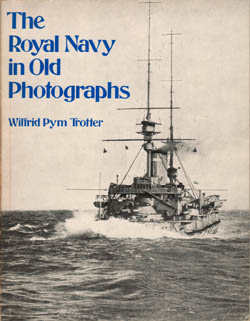
This slim volume "The Royal Navy in Old Photographs" by Wilfred Pym Trotter, is a treasure trove of Victorian and Edwardian naval ships.
The 190 photos cover vessels from the 1850s to the outbreak of WWI. The photos are reproduced with care and each has a date, ship name and location when possible. The locations come from all across the vast Empire, from Esquimalt in British Columbia to Trincomalee in Sri Lanka, from South Africa to Scapa Flow.

There are also great pictures of the crews themselves.  These are particularly fascinating because they chronicle the transition from the old Jack Tar to the professional Matelot. Their lives were hard, discipline was harsh, but as the century turned things rapidly improved.

Highly recommended, if you can find it anywhere.

Keep your sightglass full, your firebox trimmed and your water iced.
KJ

Title
The Royal Navy in Old Photographs

Author
Wilfrid Pym Trotter

Publisher
J.M.Dent and Sons
London

Date
1975

ISBN
0-460-04132-0


Steam Runabout "Kristies Flyer"

Tuesday, March 5, 2013 0 comments

I so want one of these!

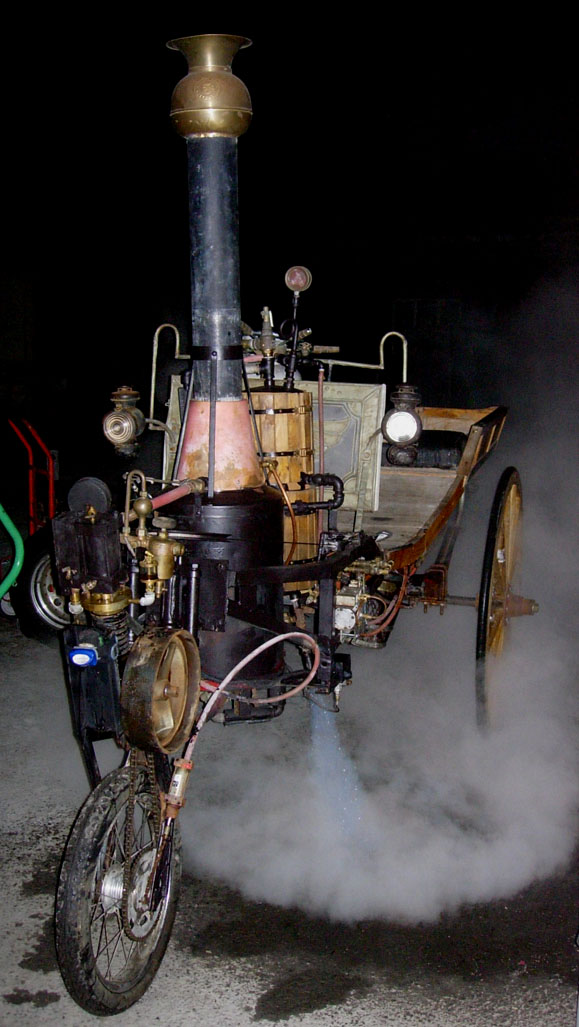
Created in 2006 to be the runabout for the Neverwas Haul, this little tri-wheeler would be just the thing for heading off to the chemists wot!

Double acting slide valve steam engine, powered by a Lamont style boiler made from a steam cleaner, running at about 100psi. Boiler is propane fired.

This film was taken at the 2008 Maker Faire in San Mateo California.

Keep your sightglass full, your firebox trimmed and your water iced.
KJ


Practical Airship Design 5b

Wednesday, February 6, 2013 0 comments

Full Steam Ahead!


NOT practical, but still fantastic! North Wind by *Voitv
Last time we talked about more details of how the Steam generation was used to create the power for our Airship.

There are still some interesting things to describe in the Engine room and some proposals for how this airship would actually be operated. I know I've promised that I will be dealing with the crew's comforts as well. So to make things a little clearer I'm going to split these posts into two streams. One will continue with the technical aspects of the design and operation of our ship and the other will deal with the more "colorful" and human friendly aspects. That way I can continue to indulge in which ever side I feel like, without disrupting the overall flow of the series.

This post will be the next in the "Technical Stream", the first "Crew Stream" post will be up when I get around to writing it.  smile

First a quick recap of the Airship which we are discussing, If you would like to start at the beginning of this series go here: Practical Airship Design Part 1

  • Our Airship is a novel design utilizing low pressure steam as the lifting gas (see http://www.flyingkettle.com/jbfa.htm) Because steam has only 60% of the lift of helium our airship is a truly immense structure, of the same general size as the Hindenburg!  
  • The steam is generated using a fantastically powerful heat source known simply as the "Core", the exact nature of which is "unknown", but that I have chosen to describe as being like a small fission nuclear reactor. The core is located inside a large tank of water which serves both to cool the core by generating steam and as shielding for the crew.
  • Propulsion is by large counter rotating props on the stern of the airship abaft the fins. These props are driven by an electrical engine that derives its power via Tesla wireless transmission from turbine driven generators in the engine room amidships.
  • The turbine is driven by high temperature and high pressure steam produced in a flash boiler that utilizes the intense heat from inside the core.
  • The hull of our airship is pretty conventional looking, being similar to the large rigid airships developed by Zeppelin. She is a fabric covered duraluminum truss structure like the Graf Zeppelin, or the Hindenburg. A shell like structure covers the top portion of the hull, called the condenser, and a pair of elegant funnels are placed just forward of condenser.
  • The purpose of the condenser is to recover all the steam used in the turbine, and any steam vented from the lift system, by condensing it back to water to be re-used in the Steam Generator. The condenser is sized to take ALL the steam generated when the core is operating as it must be continuously cooled.  In the event of an emergency, a condenser failure from damage, or if there is too much back pressure through the condenser, steam can be directed to the funnels and exhausted to atmosphere. Of course this is wasteful of the water and automatically limits the duration of any flight, so this would only be used if absolutely necessary.
  • As is typical of the big rigid airships, heavier loads are placed along the bottom of the hull either inside it along the keel or in extensions that extend beneath. 
  • From forward we have the crew accommodations (officers and passengers) and the flight deck, from which the airship is controlled. Proceeding aft of this is the forward cargo hold (and armory when on military service), above this is the  remaining crew accommodations, next aft is the engine room, the reactor/steam generator with its large water tank, the aft cargo hold, and finally an emergency steering and control position inside the lower fin.
  • These spaces are connected by a narrow triangular "keel walk" similar to that found in the Hindenburg.
So with that summary as context, let's continue our discussion of the engine room layout of our airship.
If you recall from Part 5, the after end of the engine room is made up of the flash, high pressure, steam boiler. This boiler is integral with the water tank that surrounds the core. On either side against the walls of the engine room are the primary and secondary feed pumps used to insure a steady flow of water into the flash boiler. The primary pump is electrically driven whereas the secondary is a conventional steam driven feed pump. Forward of this is the primary steam turbine and its directly connected Tesla generator set. Along the walls of the engine room are work benches, tool and spare part lockers, and the panels containing all the gauges and controls necessary to monitor the boiler, turbine and generator.

The generator looks pretty conventional where it is connected to the turbine, but it gets very interesting and weird looking above. The power is transferred to the main engine at the stern by wireless transmission using the "Tuned Resonance" system that Tesla invented (I'm assuming that we have perfected it) This requires that the very high voltages and currents be sent up an antenna like structure reaching from the engine room all the way to the center of the hull. I imagine this structure to look a lot like some of the fantastic equipment you see in a Frankenstein movie. 

Forward of the generator is the control area for the engine room. The "Watch Engineer" is stationed here to monitor the activity in the engine room. There is a desk and file cabinet on the right side, which is my "Chief Engineer's Office", and on the left side there is a partitioned off space with a table and chairs for the watch to sit when taking a break. Against the forward wall of the engine room is the stairway leading up to the keel walk.

Traditional rigid airships had all their controls consolidated in the control car near the bow. This is true of our airship as well with one major exception. Traditional airships used the balance between inflation and ballast to control the static lift condition of the ship. These were simple open valve and close valve controls. In our ship however, the control of static lift is more complex. The engineers must maintain a careful balance of steam volume, temperature and condensation rate. So I have decided to concentrate that control in the engine room itself. Since we have a single engine whose power comes from inside the engine room as well, it makes sense to concentrate all the engineering personnel there. This is more like the situation in a surface ship, where the bridge could steer, but all other functions were controlled from the engine room on orders sent from the bridge by either engine "telegraph" or voice pipe.

Of course "flying" an airship is more than simply controlling the engine speed, and ship's buoyancy, so there are traditional controls on the flight deck, which I will discuss in a later post about the layout of the flight deck itself.

In flight there are three kinds of orders that could be sent to the engine room.
Engine speed; 1/4, 1/2, 3/4, Full, Flank (or Emergency), and direction forward or astern.
Static Lift; positive (light), neutral, or negative (heavy).
Hull trim; pitch up or pitch down.


These are sent by means of three "telegraphs" similar to those used on surface ships for engine control. These telegraphs are located in the control area of the engine room so that the Watch Engineer can keep an eye on them and relay the required orders to the rest of the engine room watch. There is also a "Telephone" connection direct to the flight deck. This might be a an old fashioned speaking tube rather than an electrical telephone, I haven't decide which yet.

I'll be trying to illustrate the commands and orders that would be given when this ship is underway in a later post.

While this seems like a fairly large space as described, it should be kept in mind that the space is very narrow maybe at most 5 meters across and most of the floor space is taken up by the turbine and all its ancillary equipment. It would also be HOT, not unlike the stoke hold  and engine room in a narrow hulled destroyer or torpedo boat. I suspect that, apart from the lack of coal to shovel, an engine room hand would not see much difference between being afloat and being aloft in a vessel like this one. In our Role Play we actually call the engine room crew the "Black Gang" and the lower ranks are called "Stokers" just like in the Victorian surface navy. smile

Thanks for reading and join me next time for more "Practical Airship Design".

Keep you sightglass full, your firebox trimmed and your water iced.
KJ
You can follow the full design thread by clicking on the tag "Flight Engineer".

"On Naval Warfare with Steam" 1860

Monday, February 4, 2013 0 comments

Found this gem at the Internet Archives.

This book is an interesting treatise on the changes in naval warfare in the mid 19th century brought on by the adoption of steam power for naval vessels. What is most fascinating to me is the attempt by the author, an ARMY General, Sir Howard Douglas, to try to predict what effect steam power would have. Note this document pre-dates wide spread adoption of armour plating even, the French La Gloire was launched November 1859 and the British Warrior in 1860.

An interesting read, highly recommended to get a feel for the effect such technological change was having.

Title
On Naval warfare with Steam


Link to File
http://archive.org/details/onnavalwarfarew01douggoog


Author
General Sir Howard Douglas
Bart., G.C.B, G.C.M.B, D.C.L., F.R.S.

Date
1860

Publisher
John Murray
Albermarle Street
London

Quote from Introduction

We are now at the commencement of a new era in
naval warfare, in consequence of the introduction of
steam as a propelling power for ships, and its applica-
tion, by all the maritime powers of Europe, to vessels
of war, from those of the lowest class to line-of-battle
ships of the greatest magnitude. This new power
will necessarily modify, and, to a great extent, over-
turn, the present tactics of war on the ocean.

Hitherto the execution of naval evolutions has de-
pended on atmospherical conditions, and often the best-
concerted plans for attack or defence at sea have been
frustrated, when at the point of being successfully
carried out, by sudden calms, or by unforeseen changes
in the direction of the wind ; while now, an elaborate
system of appropriate machinery, put in motion by the
expansive force of steam, by enabling a vessel to be
moved at pleasure, with more or less rapidity, or to be
brought to a state of rest, or again, to have the direc-
tion of its motion changed through the guiding power
of the helm, will enable the commander of a ship or
fleet to put in practice, without risk of failure, what-
ever manoeuvre he may have determined on, whether
for coming to action, or for counteracting the measures
taken by his opponent, previously to, or during, all
the battle movements of the fleet.

It is generally supposed that the present naval su-
premacy of Great Britain is mainly due to circum-
stances arising out of the particular nature of the
moving power by which the evolutions of vessels,
singly or in fleets, have been performed. That moving
power is the wind acting on the sails of the ships — a
power in its nature very variable ; and it is evident
that the introduction of steam, as a propelling power,
whose action is entirely under the control of the engi-
neer, will bring about great changes in the relative
conditions of British and foreign navies, affecting, in
consequence, the maritime importance of the several
European nations.

====================
Keep your sightglass full and your firebox trimmed.
KJ

More Crabfu Awesomeness

Tuesday, January 29, 2013 0 comments

I love these machines.


Lots of construction pictures and details here:
Crabfu Steam Beetle

Keep your sightglass full, your firebox trimmed and your water iced.
KJ

Steam Cars Speed Demons

Friday, January 18, 2013 0 comments

This is a record breaker!


From Wikipedia
In 1906 the Land Speed Record was broken by a Stanley steam car, piloted by Fred Marriott, which achieved 127 mph (204 km/h) at Ormond Beach, Florida.

Keep your sightglass full, your firebox trimmed and your water iced.
KJ

Power in Steam and Steel

Tuesday, January 15, 2013 0 comments

Found this photo while looking for costume photos to put on Pinterest.

This photo by Phil Pantano really captures the sense of quiet power embodied in large utility steam engines.

Check out the link for thee full size photo.

This is a shot from an old steam pump water facility dating back to 1905.

The full image can be found here.

I love the lighting, and the elegance of the human scale guages and walkways, next to the enormous engine itself.

That there are two more of these monsters behind this one, and possibly another beside the photographer indicates the vast scale of this facility.

Keep your sightglass full, your firebox trimmed and your water iced.
KJ

About Gears, Goggles, and Steam oh My!

Here I collect interesting bits of information related to the world of Steampunk.

Category List

Absinthium (12) accessories (15) Airships (69) Art (1) Beakerhead (3) Books (65) comics (5) computation (11) costumes (16) etiquette (19) events (30) fiction (87) Flight Engineer (33) Fun (57) games (36) history (109) howto (21) Inventions (57) manners (6) Meetup Repost (90) movies (4) music (4) Musings (44) mystery (23) news (8) Parasol Duelling (46) Photos (67) Pie In the Sky (3) poetry (1) resources (50) Role Playing (59) Serial Story (28) Ships (39) Steam (34) Steampunk Sports (26) Tesla (13) video (77) website (57) What Ifs (16)

Recent Comments

Theme images by sndr. Powered by Blogger.

Followers