A New Adventure.
Maddie Hatter, intrepid investigator and fashion reporter, has a new adventure coming out!
Check out this teaser trailer.
RE-RELEASE 2021!
Keep your sightglass full, your firebox trimmed and your water iced.
KJ
More info on Maddie here at Jayne Barnard's blog:
Clockworks and Crime
Showing posts with label website. Show all posts
Showing posts with label website. Show all posts
New Maddie Hatter Book!

Graphical calculations
Graphs, straight edges, and math oh my!
An interesting "Pie in the Sky Project"
Back in the days before the
availability of ubiquitous computing capabilities complex mathematical
relationships and rules of thumb were often calculated using graphical
computations known as Nomograms or Abacs.
These graphs were laid
out in a way that using a straightedge one could determine the result of
often complex multi-variable calculations. They were used in everything
from engineering and navigation to accounting. They were also used in business and government
where there was only a vague mathematical relationship between inputs.
This one for example, is used for "quantitative risk assessment of food to guide sampling/analysis for the
purposes of official control of food and to support the enforcement of
food safety/consumer protection law."
.png/428px-Risk_Based_Sampling_Nomogram_(3yr).png)
This series of posts by Ron Doerfler describes the process by which such graphs are generated:
http://myreckonings.com/…/the-art-of-nomography-i-geometri…/

So what is the Pie in the Sky Project here?
- Why not create our own Steampunk Nomograms?
- What kind of Nomograms would our Steampunk Mad Scientists use?
- Would they be complex and arcanely illuminated or simple and elegant?
- Would they be kept in massive bound books chained in our laboratories or kept in our pockets in miniature books with fold out pages?
- Would they have pockets in the covers to hold exotic curves and circular slide rules or would they have a simple straightedge that would also work as a bookmark.
- What kinds or equations and nomograms would a Dr Frankenstein use?
- What about an Airship Engineer?
- What would the Abac book of an Aetherwave operator look like?
Keep your sightglass full, your firebox trimmed and your water iced.
KJ
P.S. This book from 1918 has an amazing amount of info and examples of interesting nomograms. The math isn't too bad but it does need some concentration to follow :-)
Graphical and Mechanical Computation
P.P.S Lots of good Nomography tools and some interesting examples here:
Society for the Conservation and Advancement of Nomography
Three Years Ago Today!
Time flies when you are having fun!
Three years ago today I started blogging here.
It has been a great ride and I hope you have found it as interesting and fascinating as I have.
Thanks for coming along for the ride, lots more to come!
As always...
Keep your sightglass full your firebox trimmed and your water iced!
KJ
Airship Technical Papers from the NACA
An Airship Technical Gold Mine
Previously I reviewed one of the only books ever published on real airship design.
The author Charles P. Burgess worked for the National Advisory Committee for Aeronautics, the NACA.
During the heyday of the great rigid airships, in the first third of the 20th century, the NACA commissioned and collected a series of technical studies, papers and technological reviews of airship design. These papers show just how seriously rigid airships were taken as the future of heavy lift and long distance aircraft.
Recently NASA (the direct descendant of the NACA) has made scans of these reports and analyses available through the Internet Archive.
If you are curious check out this simple search:
Airship Technical Gold Mine
 Here you will find yellowed type written reports, with hand drawn graphs, diagrams, plans, and old photographs, documenting in detailed analyses the state of the art in Airship design in 20's and 30's.
The files are available in many formats including plain text, colour PDFs, html, epub and other ebook formats.
The titles alone make this old Flight Engineer drool!
Here are some examples to "wet yer whistle":
THE PRESENT STATUS OF AIRSHIP CONSTRUCTION, ESPECIALLY OF AIRSHIP FRAMING CONSTRUCTION
By Hans Ebner
1938
FULL-SCALE TURNING CHARACTERISTICS OF THE U.S.S. LOS ANGELES
By F. L. THOMPSON
CONTRIBUTION TO THE TECHNIQUE OF LANDING LARGE AIRSHIPS
By 0. Krell
PART I
Part II is here
From Zei'tschrift f'.r FLigteohnik und. Motorluftschiffahrt
September 28, 1928
RECENT RESEARCHES IN AIRSHIP CONSTRUCTION I
Forces of Flow on a Moving Airship and the Effect of he Control Surfaces
By H. Naatz
1928
Many of these reports are translations of German reports. The Germans were the acknowledged world leaders in Airship design at the time. The first report listed includes a German paper written in 1933 while the Hindenburg was under construction and before the loss of the Akron, which is noted in a footnote. The full report was not translated and acquired by the NACA till 1938.
Since these reports were typewritten they often contain typos, to me these little errors bring these fairly dry technical reports alive. In a way they show them as being human made. Prepared to record important information not just display elegant formatting.
For anyone interested in the technical details of real airship designs these reports are truly a gold mine of information.
Keep your sightglass full, your firebox trimmed and your water iced.
KJ
Here are some sample pages of the kinds of details included in these reports:


Copperfield Ensemble
Steampark March!
A wonderful group from England.
Definitely worth checking out.
COPPERFIELD ENSEMBLE
Here is a taste.
Enjoy
Keep your sightglass full your firebox trimmed and your water iced.
KJ
Steampunk Explained
A wonderful documentary.
I found this linked on Steampunk Canada.
Enjoy this look into the Steampunk world.
Keep your sightglass full, your firebox trimmed, and your water iced.
KJ
I'm not dead yet!
In case anyone was wondering, heh.
I have had an amazingly busy September.
Calgary hosted the first annual Beakerhead event this year and the various Steampunk groups I belong to were trying to get organized to attend. We actually had a pretty good turnout and had a great time.
Beakerhead is a five day festival celebrating Science, Technology, Engineering and Art. With street displays, interactive exhibits, a mini Maker Faire and one hell of a lot of partying.
 |
| One shouldn't drive one's couch when under the influence of Absinthe. |
If you are interested in helping out check out the Steampunk Arts and Sciences Society Facebook page.
Keep your sghtglass full, your firebox trimmed and your water iced.
KJ
How to recognize a Steampunk
Found this posted on the Book of Faces today.
How to Recognize a Steampunk
By
Austin Sirkin
at Steampunk R & D
Steampunks don't always walk around wearing their full Steampunk
finery, so how can you tell whether someone is a Steampunk or not?
Here's a tongue-in-cheek (and yet 100% true!) guide to help you
determine whether someone you know is a Steampunk.
They may be a Steampunk if....
- ...their eyes light up whenever someone throws something metal away.
- ...their everyday clothes are several decades out of date.
- ...they adopt an English accent for no discernible reason.
- ...they wear goggles but don't actually need them.
- ...all of their plastic items have been spray-painted to look like brass.
- ...they own more than one hat that isn't a baseball cap or a fedora.
- ...many of their stories start with "I was in the workshop and..."
- ...they eschew a wristwatch in favor of a pocket watch.
- ...they use words like "eschew".
- ...they own more broken than working clocks.
- ...they own more books than movies.
- .......most of which were written more than a hundred years ago.
- ...they take pride in how old their belongings are.
- ...they own more than one set of cufflinks.
- ...they know what a cravat and/or bustle is.
- ......and the difference between a gear and a cog.
- ...their Nerf guns are all in various stages of being painted and/or taken apart.
- ...their ears perk up whenever someone says the word "esteem".
- ...they have a crush on Nikola Tesla.
- ......and they get angry whenever someone mentions Thomas Edison.
- ...their wardrobe consists entirely of shades of brown.
- ......and yet will tell you that brown isn't the only color in Steampunk.
- ...they use a smart phone, but it has a wood or leather case.
- ...they visit their local thrift store more often than their local department store.
- ...they've picked up something someone has thrown away and said, "Oh, I could make ___ out of this..."
- ...they visit the hardware or sewing supply store more often than the grocery store.
- ...they work odd historical facts into every conversation.
- ...they used to drink coffee, but now exclusively drink tea instead.
- ...even their underwear is historically accurate.
- ......or only their underwear is historically accurate.
- .........or their underwear is so concealing that it would qualify as outerwear.
- ...when they refer to The Wild, Wild West without the word "bad", they mean the TV show from 1965, and not the 1999 movie.
- ......and likewise when they refer to The League of Extraordinary Gentlemen, they mean the comic books and not the movie.
- ...when they wear Steampunk clothes, they insist that it's an "outfit, not a costume".
- ...they carry a cane, but don't need it.
- ...they own a parasol, and don't refer to it as an umbrella, or worse as a "sunbrella".
- ...they don't like anise, but cultivated a taste for absinthe.
- ......or they drink vodka screwdrivers just for the name.
- .........or they've learned to appreciate the taste of gin.
- ...it never occurred to them to wear their corset under their clothes.
- ...they are convinced that they alone know the true definition of Steampunk.
If more than twenty of these apply, the person in question doesn't need a list for other people to know they're Steampunk, because they ooze it out of every pore!
=============================================
Keep your sightglass full, your firebox trimmed and your water iced.
KJ
Steampunk Art by Vadim Voitekhovitch
My favourite artist...
Vadim Voitekhovitch has a moody and atmospheric style that I like to use to illustrate the Steampunk worlds I build in my head.
I have used his images to illustrate my Airship Design posts, mainly because his airships are both whimsical and apparently practical. The scenes are serene but complex. The environments are rich and detailed without being chaotic.
You can see them in detail here at the Steampunk Art of *Voitv
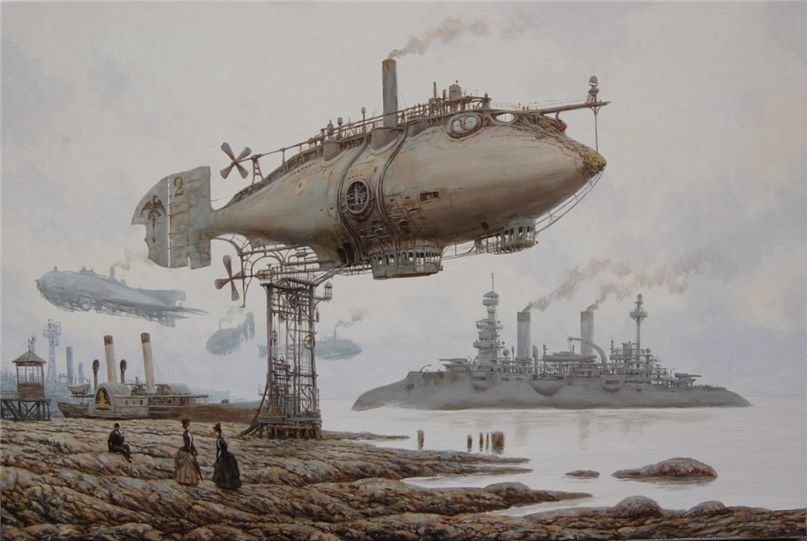
This is a world I could quite happily inhabit!
Enjoy.
Keep your sightglass full, your firebox trimmed and your water iced.
KJ
Steam Powered Box Factory
Steam power in action.
This steam powered wooden box factory has been in use since 1897.
Wonderful video of the whole process. Lots of belts and gears working together.
Enjoy
Keep your sightglass full, your firebox trimmed and your water iced.
KJ
At Home in the Machine
Wonderful imagery!
I came upon this image quite by accident and thought I would share it.
 |
| http://www.emptykingdom.com/featured/gilles-tran/ |
You can see many more images by this talented digital artist at http://www.emptykingdom.com/featured/gilles-tran/ and at his website Oyonale
Keep your sightglass full, your firebox trimmed and your water iced.
KJ
Vickers Airship Catalog 1920-22
Airships for sale!
This catalog was produced by the Vickers company in Britain in 1920.
What is so interesting about this catalog is that it obviously assumes the existence of a commercial market for airships of all types from small scout and/or personal ones to large military, cargo, and passenger ones.
This was definitely wishful thinking on the part of the Vickers company in light of sdubsequent history but it is still fascinating to peruse.
Who wouldn't want one of these little gems for a quick Sunday afternoon flight through the countryside.

                                                   No. 1         No. 2
Gross Gas Capacity ..    ..    Cubic Feet         70,000       100,000
                               Cubic Metres        1,960         2,800

Length ..    ..    ..    ..    Feet                  145           170
                               Metres                 44            52

Maximum diameter   ..    ..    Feet                   30            36
                               Metres                9.2            11

Maximum Speed      ..    ..    Miles per hour         48            55
                               Kilometres per hour    77          88.5

Cruising Speed     ..    ..    Miles per hour         40            45
                               Kilometres per hour    64          72.5

Length of Flight at Cruising   Miles                 200           300
 Speed, allowing 30% Reserve   Kilometres            322           483
 Fuel

No. of Passengers carried                              4             6
-------
This section on Rigid Airships, thought soon to be available, is what dreams are made of. Imagine ordering one from a catalog!
-------

Rigid Airships for Commercial Services
                                                 No. 1         No. 2
Gross Gas Capacity ..    ..    Cubic Feet      1,250,000     3,500,000
                               Cubic Metres       35,000        98,000

Length ..    ..    ..    ..    Feet                  535           800
                               Metres                163           244

Maximum diameter and width     Feet                   70           100
                               Metres               21.3          30.5

Maximum Speed      ..    ..    Miles per hour         65            75
                               Kilometres per hour   105           121

Cruising Speed     ..    ..    Miles per hour         55            60
                               Kilometres per hour  88.5          96.5

Suitable non-stop Distance     Miles               1,000         4,000
                               Kilometres          1,609         6,436

Weight of Passengers and       Tons                    6            15
 Freight carried for above     Kilogrammes         6,096        15,241
 distance

No. of Passengers accommodated                        50           100
THE SPECIAL REQUIREMENTS OF ANY PROPOSED SERVICE
This design for a first class passenger ship is interesting because the passenger accommodations were on the top of the hull!

You can peruse the entire catalog online here:
The Vickers Airship Catalog
Keep your sightglass full, your firebox trimmed and your water iced.
KJ
How to make a top hat
Brilliant!
Found this while writing my post on Pinterest boards.
A nice howto on making a stovepipe style top hat. The full image can be found here but this is a just a taste to whet yer whistle!

Keep your sightglass full, your firebox trimmed and your water iced.
KJ
Pinterest Lost in Time...
0
comments
Labels:
accessories,
costumes,
Photos,
resources,
website
In more ways than one!
Pinterest is an amazing thing.
I use it to collect Steampunk costume photos the latest of which appear on the sidebar of this blog.
However as Boromir once said...
 Like YouTube before it one can easily loose many an hour wandering the beautiful, interesting, funny and scary labyrinth that is Pinterest.
Each board is a collection of "pins" usually photos or images with links to the sources.
My Pinterest Board is mostly for Steampunk costumes, but there are many many boards that also include gadgets, artwork, jewelery, tattoos, buildings and other exotic bits of Steampunk wonderfulness.
There are also Pinterest boards dedicated to historical subjects like real Victorian clothing and artifacts, history, and period photos.
One of my favourite boards is Brenda{SteamCircus.com} which has over 10,000 pins organized into 73 subject groups.
Wandering around here one can easily get lost and spend a very pleasant hour or two.
Please check it out when you have some time to spend!
Keep your sightglass full, your firebox trimmed and your water iced.
KJ
The Winans Cigar Ships 1866
A possible source for Jules Verne's Nautilus.
Found this article at the fantastic Vernian Era website. I have previously discussed another set of pages from this site in my School of Nautili post. Michael Crisafulli has collected some wondeful information on various technologies that existed at the time Jules Verne was writing. Many of these were experimental and considered unworkable but they could easily have been used as inspiration by Verne.
A good example of such a technology was the Cigar Ships that the Winans Family of Baltimore, Maryland, built between 1858 and 1866.

he cigar ships were designed and built by the Winans family, successful railway engineers from Baltimore, Maryland who moved into marine engineering with enthusiasm and great expenditures of their family wealth, but less success. Their radical marine design concept included an ultra-streamlined spindle-shaped hull with minimum superstructure.
The Winans constructed at least four ships between 1858 and 1866. Two of these attracted considerable public attention as well as skepticism and outright criticism from the technical establishment. Ross Winans and his sons were, first and foremost, engineers experimenting with innovative concepts. The innovative technology would certainly have attracted Jules Verne's attention. He may well have seen one of the boats sailing or berthed in England. Some of their innovations were adopted for surface ships in the twentieth century, and many of the pioneer submarines built in the late nineteenth and early twentieth century resembled them. Later in the twentieth century, aerodynamicists rediscovered the benefits of the spindle.
The site discusses the history of these odd vessels and many of the design problems that the Winans had to overcome.
The final ship built using this design was the yacht Ross Winans built in 1866.
From the website:
The Winans launched their final effort in 1866 in London. The Ross Winans was 256 feet long with the same 16-foot diameter as their first boat and displaced about 400 tons. It did have a nearly conventional superstructure atop the hull amidships, 130 feet long and ten feet wide, tapering to a point at each end. Inverting the first design, it was driven by a 22-foot diameter propeller at each end. These nine-bladed props were powered by an engine room amidships. The Ross Winans underwent trials in the Solent channel but made no more than one or two coastal voyages, never going to sea in earnest.
The woodcut at right, from The Illustrated London News, 3 Mar
1866, shows the stern-first launching of the Ross Winans. The
propeller mounts are visible, but the propellers have not yet been
installed.
|
 |
Highly recommended reading this!
Check out the full article at: The Winans Cigar Ships
Keep your sightglass full, your firebox trimmed and your water iced.
KJ
How to Write a Telegram Properly 1928
The wonders of modern telegraphy stop
This interesting document is a style guide for composing telegrams.
It was written in 1928 by Nelson E Ross and covers the then common practices associated with making sure that telegrams were being used efficiently.
"HOW TO WRITE TELEGRAMS PROPERLY"
There is a lot of good information here on how to write telegrams efficiently and concisely. This was important since transmission of a telegram was charged by the word. There is also some good information on ways encrypt the transmission to save costs and insure security.
Here are some interesting examples:
How to Save Words -- Naturally, there is a right way and a wrong way of wording telegrams. The right way is economical, the wrong way, wasteful. If the telegram is packed full of unnecessary words, words which might be omitted without impairing the sense of the message, the sender has been guilty of economic waste. Not only has he failed to add anything to his message, but he has slowed it up by increasing the time necessary to transmit it. He added to the volume of traffic from a personal and financial point of view, he has been wasteful because he has spent more for his telegram than was necessary. In the other extreme, he may have omitted words necessary to the sense, thus sacrificing clearness in his eagerness to save a few cents.
This apparently insignificant fact often is disregarded by users of the telegraph. Considered from the point of view of economy alone, the question of figures in telegrams is interesting. Any group of figures can be written out so that from two to three words are saved each time the group is used. Take for example the expression "one million." Written "one million" It counts two words. Written 1,000,000, the total count is seven words, and if the commas are to be sent also, the count is nine.
If you are telegraphing the home folks that you expect to arrive on the 20th for that long planned visit, spell it out "twentieth." Two words are saved. The telegraph companies have nothing to sell but service. They undertake to transmit your message from point to point, speedily, accurately and secretly. The cheapest way of handling that message is invariably the safest way, and your cooperation is welcomed by the companies. When groups of figures are spelled out, the chance of an error in transmission is reduced to a minimum.
The suffixes "th," "rd," or "nd" appended to figures are counted as additional words. When the figures are spelled out, as in "fourth," "third," or "second," the count is automatically reduced.
How to Write Figures -- The following table illustrates the principles just set forth:
1st (two words) -- first (one word)
2nd (two words) -- second (one word)
3rd (two words) -- third (one word)
100 (three words) -- one hundred (two words)
1000 (four words) -- one thousand (two words)
1,0000 (five words) -- ten thousand (two words) etc
How Unnecessary Words Creep In -- To paraphrase, "Brevity is the soul of telegraphy." Except perhaps in the case of a long Night Letter, the practice of adding such words as "Dear Madam." or "Dear Sir," at the beginning of the message, is obsolete. This likewise applies to such phrases as "Yours very truly," "Yours sincerely," etc., commonly used in closing a letter. These words are charged for, and so accustomed is the public to telegraphic brevity, that their use often produces amusement rather than the expression of formality which the sender desired.
When telegrams are received without the well known title of "Mr." do not censure the sender as lacking in respect. To insure accuracy in transmission the title is omitted lest through inadvertence it should be confused with "Mrs." or "Miss." "Esquire" also is dropped in transmission.
An entertaining and useful little pamphlet that can help you add some telegraphic style to your next email.
KEEP YOUR SIGHTGLASS FULL YOUR FIREBOX TRIMMED AND YOUR WATER ICED STOP
Uniform Bits and Pieces
Uniforms!
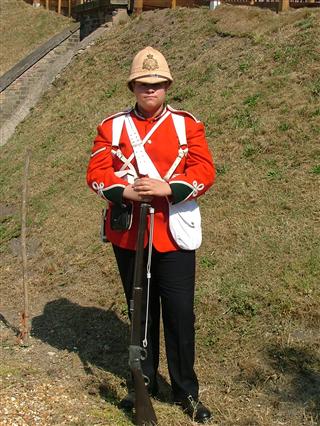
This site has an amazing amount of British Victorian era uniforms available.
Definitely worth checking out.
I have not purchased anything from them so I would be interested in haring from anybody who has.
Keep your sightglass full, your firebox trimmed and your water iced.
KJ
The
Victorian
Strollers
Uniforms
and Accoutrements of
The British Army
throughout the Empire of
Queen
Victoria.
Britain
and the Colonies
Victoria Steam Expo IV May 31- June 2 2013
Awesome!
The fourth annual Victoria Steam Expo will be held in Victoria British Columbia in a couple of weeks.
This is Canada's premiere Steampunk event check it out!
Keep your sightglass full, your firebox trimmed and your water iced.
KJ
Victoria Steam Expo IV
Scavenger-hunt in Darkened Alleys, Secret Lodges, The Martial Art of Sherlock Holmes, Steampunk Beer Launch, Burlesque Diva Lydia DeCarllo, and More!
The premiere steampunk event in the Dominion of Canada is back for a fourth year in Victoria, British Columbia. Where previous years have been encased in palaces of cut-crystal and gleaming brass, this year it's the gritty back-alleys of the 19th century colonial capital which are brought to the fore – after-hours corners and upstairs dives where the paths of explorers and inventors cross with those of airship scoundrels & duplicitous courtesans.The weekend is wrapped around Alleyways: An Alternative Reality Game / scavenger hunt specially designed for this event – sending the braver of attendees through brick alleys, half-forgotten nooks, and opulent lodges of secret societies in pursuit of treasure-unlocking puzzle-clues. At the Exposition's old-brick 1909 headquarters there will be merchants, outfitters, panels, artists and authors, speakers and performers, history lections, and craft activities for families.
FRIDAY:
The Weekend kicks off with Friday Night Reception at the 1885 Bard & Banker, with a history lecture of Victoria's seedy underbelly presented by Chris Adams of Ghostly Walks. Hear the real story of Her Majesty's colonial capital with tales of murder, madness, arson and opium.SATURDAY:
On Saturday, we switch venues to the 1909 old brick Victoria Event Centre: set in the dark heart of a labyrinth of storied alleys of the capital's Old Town. Speakers, panelists, merchants, booksellers, artists and artisans will all be on hand to display, discuss and trade in wares. Saturday morning will see the briefing of the scavenger hunt, and teams will be presented with their initial "rabbit holes."We are proud to announce there will be an exhibition of Bartitsu – the authentic 19th century mixed martial art of Sherlock Holmes – presented by Vancouver's David McCormick of Academy Duello.
Saturday evening Longwood Brewery presents the 19+ Steampunk Cabaret Burlesque, a costume ball and raucous dance suited for this year's theme of discretion, decadence, deviousness & debauchery. Vancouver Burlesque star Lydia DeCarllo will tease and titillate, followed by the riotous Folk Glam Gypsy Marching Band Bucan Bucan – in celebration of the launch of Vancouver Island's very own Steampunk Beer.
SUNDAY:
More presentations, final round and prizes for the scavenger hunt, family craft activities and the fashion show!
History of Newspapers in Canada
This is a fascinating look at the development of the newspaper industry in Canada.
The article is included in the online version of The Canadian Encyclopedia.
The first part of this detailed article is included below to give you a taste.
Keep your sightglass full, your firebox trimmed and your water iced.
KJ
http://thecanadianenc...
Canada's
first newspaper, John Bushell's Halifax Gazette, began publication in
1752. Like most colonial newspapers in North America, it was an adjunct
of a commercial printing operation. Moreover, it was dependent on the
printing and patronage largesse of the colonial government. This
reliance on revenues from sources other than readers - from governments,
political parties and ADVERTISING - would remain a characteristic of
Canadian newspapers.
The First Newspapers
There
were no newspapers in New France, in part because of the opposition of
French officialdom to the establishment of printing presses in the
colony. The British Conquest, and the termination of the SEVEN YEARS'
WAR in 1763, brought a trickle of printers from the American colonies.
In 1764, 2 Philadelphia printers, William Brown and Thomas Gilmore,
began the bilingual Quebec Gazette at Québec City. In 1785 Fleury
Mesplet, a French printer who had been jailed because of his attempts to
persuade Québec to join the American Revolution, started publication of
the Montreal Gazette (now the oldest continuing newspaper in the
country).
In 1793, under the auspices of Upper Canada's first
governor, a Québec printer started the Upper Canada Gazette at Newark
[Niagara-on-the-Lake], the first newspaper in what is now Ontario. Like
the Halifax Gazette, these first papers - operating in colonies where
populations were low - remained utterly dependent upon government
patronage. In Upper Canada, William Lyon MACKENZIE pressed the Assembly
to subsidize the province's first paper mill, in part to ensure a source
of newsprint for his journal - a telling example that the close
relationship between newspapers and government patronage held even for a
democratic firebrand.
The development of legislative assemblies
in British North America encouraged political factions. At the same
time, particularly in Halifax, Saint John, Montréal, Kingston and York
[Toronto], a merchant class, with an interest both in reading commercial
intelligence and in advertising, was growing. Weekly newspapers
sprouted up, allied with political movements and the various mercantile
and agricultural interests.
In Lower Canada, the Québec City
Mercury (1805) and the Montréal Herald (1811) became mouthpieces for the
province's English-speaking merchants, while Le Canadien (1806) and La
Minerve (1826) spoke for the rising French Canadian professional
interests.
In Upper Canada, William Lyon Mackenzie used his
Colonial Advocate (1824) to argue the cause of Reformers in general and
farmers in particular against the dominant professional and mercantile
groups. In the Maritimes, newspapers such as Joseph HOWE'S Novascotian
(1824) of Halifax also worked to challenge the authority of colonial
oligarchies.
Newspapers, Politics and the State
By the
early decades of the 19th century, most newspapers were allied with
either the Reform (now Liberal) or Conservative Party. These early
newspapers were by no means simple tools of the parties they claimed to
support but rather were organs of specific leaders or factions within
the parties. Thus the Toronto Globe (1844) was a personal organ of its
publisher, the Reform politician George BROWN. The Toronto Mail (1872),
while set up to act as spokesman for the whole Conservative Party, was
quickly captured by the dominant faction led by John A. MACDONALD.
Moreover,
it was not unusual for an organ to deviate from the party line. The
Mail, for example, broke with the Macdonald Conservatives in the 1880s,
forcing the party to set up the Empire in 1887. The relative
independence of newspapers from political parties and governments varied
from place to place. But in general, newspapers had more potential for
independence from parties as their revenues from circulation and
advertising grew.
In part, the politicization of newspapers
continued because readers demanded partisanship. POLITICS was a serious
matter in 19th-century Canada; newspapers were expected to have views.
Thus occurred the phenomenon of the 2-newspaper town. By 1870 every town
large enough to support one newspaper supported 2 - one Liberal and one
Conservative. As well, newspapers have never cut themselves off
completely from government patronage. Since 1867 the federal government
has subsidized newspaper publishers by granting them special postal
rates. Canada's first international wire service, Canadian Associated
Press (1903), was subsidized by the federal government, as was the
domestic news co-operative, CANADIAN PRESS, during the initial years
after its founding in 1917.
The Rise of Advertising
While
partisanship remained, the financial dependence of newspapers on
governments and political parties did decline throughout the 19th
century. The reason has to do with the economics of newspaper publishing
and with overall economic development. Newspapers faced high overhead
costs, ie, newspapers were forced to incur the same initial outlays for
equipment, typesetting and editorial matter whether they printed one
copy or a run of 10 000. In the 1860s, when daily circulations were
usually under 5000, these overhead costs were covered by party or
government patronage. But as population expanded and literacy increased,
publishers were able to spread these overhead costs over more readers.
In addition, as a newspaper's circulation increased, merchants became
more interested in it as an advertising medium. With productive capacity
increasing in all industries, advertising - as a means of persuading
people to buy the massive volume of goods being produced - became
crucial.
Early advertisers were wholesalers trying to catch the
attention of other merchants, but by the 1880s retail advertising, aimed
at a mass market, was dominant. By 1900 consumers were flooded with
newspaper advertisements calling upon them to purchase such things as
soap, patent medicines or electric belts. Big-city dailies were earning
between 70% and 80% of their revenues from advertising.
Technological
developments in the newspaper industry, and in the economy as a whole,
hastened the trend to large-circulation, advertising-based newspapers.
The spread of the TELEGRAPH during the 1850s and the laying of the
Atlantic cable in 1866 increased the availability of world news to
newspapers, but at the same time increased their overhead costs of
production. By the 1880s, high-speed web presses and stereotyping
allowed newspapers to expand their circulations in order to earn more
revenue to cover these costs. In 1876 the combined circulation of daily
newspapers in the 9 major urban centres was 113,000. Seven years later,
it had more than doubled. Railway building, from the mid-19th century
onwards, put more of the population within reach of daily and weekly
newspapers. By the 1890s, typecasting machines such as the linotype were
allowing daily newspapers to expand their size from the standard 4-, 8-
or 12-page format to 32 or 48 pages. This greatly increased the amount
of advertising space.

"The Design of Jules Verne’s Submarine Nautilus" by Stuart Wier
The Nautilus Design
I recently found a PDF document of an analysis of Jules Verne's iconic submarine the Nautilus.
In a previous post, A School of Nautili, I linked to a catalog of designs based on Verne's descriptions in 20,000 Leagues Under the Sea.
This analysis by Stuart K Wier entitled simply "The Design of Jules Verne’s Submarine Nautilus" examines not only the details of the design but also some ideas of why Verne designed the Nautilus as he did and what some potential influences and inspirations he may have had.
Examining the original illustrations done for Verne's book is fascinating, since the illustrators were friends and acquaintances of Verne they had discussed the details with him before creating the illustrations. The paper includes many of these images which show the interiors of the Nautilus in all her glory.
I highly recommend this paper for anyone interested in the details of the Nautilus.
There are some snippets of the paper below to give you a taste of the style of this excellent paper.
Enjoy
Keep your sightglass full, your firebox trimmed and your water iced.
KJ
IntroductionWier's analysis of the propulsion system is interesting
In 1867 when Jules Verne was beginning to plan a novel about an undersea voyage, he and his brother Paul traveled to the United States on board the Great Eastern. The Great Eastern was an enormous vessel for its time, 213 meters (698feet) long, and 23 meters (75 feet) wide, in fact the largest vessel afloat, and it incorporated some of the newest features of marine architecture. It had a double iron hull, sails, steam engines, paddle wheels, and a propeller 7.3 meters (24 feet) in diameter. Verne showed and described his keen interest in the ship, and noted details of its design, construction, and operation. Thinking of an advanced undersea vessel, he found himself living on the the most advanced ship of his time. In the United States Verne saw other new technology, such as the large and fast Hudson River steamboats. This was a period of delight in rapid technical progress.
For the past century the submarine has played an important role in naval affairs, and more recently submersibles have become valuable in exploration of the oceans. Yet a fictional submarine, conceived decades before real submarines took up seagoing duties, remains a candidate for the most renowned: Jules Verne's Nautilus, from his novel Twenty Thousand Leagues Under the Sea.
Jules Verne is rightly regarded as a prophet of many of the inventions which characterized twentieth century life. The novels of Jules Verne are as well known for their technical innovations as for their plots of journeys to exotic locations. The submarine Nautilus and its enigmatic captain Nemo are among Verne's most famous creations. Even some who have not read Verne know that the Nautilus foreshadowed large modern submarines.
“The dynamic power of my engines is nearly infinite”:
Power, Propulsion, and Control
Despite a popular notion that Verne's Nautilus had some sort of futuristic power supply, such as atomic power, Verne based his technology on what was known in his day. The power supply is chemical batteries. Verne realized that the actual batteries of his day were far from adequate, as batteries remain today, but suggested they might be greatly improved. Nemo says he uses “large and powerful” Bunsen batteries rather than Ruhmkorff batteries which are less powerful. Nemo has improved the Bunsen battery by using elements of a sodium zinc amalgam in place of zinc alone, which Nemo claims doubles the “electromotive force” of the batteries (what we call today the voltage). Perhaps Verne was unaware of the explosive property of sodium in contact with water.
Nemo extracts sodium from sea water on a remote island, where the process is fueled with sea coal. The new sodium would recharge Verne's hypothetical batteries, which seem to last for months between charges.