Showing posts with label Musings. Show all posts

Practical Airship Design Part 7

Saturday, December 23, 2017 0 comments

Splendid she must be!

"How time flies when you are having fun."
Or conversely...
"Life is what happens when you have other plans."

This is the final post in my Practical Airship Design series, which I started way back in November of 2012, 5 years ago!

You can read that initial post and start the series here.

According to the "Contents and Prospectus" this post should have been:

"In conclusion, our Captain has ordered that she must, in addition to being one of the most technologically advanced airships of the age, be one of the most "Splendid"(tm) and this post will attempt to grant his wishes to the best of this poor flight engineer's ability."

Alas, I never got around to writing that post and cannot at the moment remember what I had intended to cover...

However, I think this series does need a formal conclusion, so if you have landed here please stay with me for a bit.

Like any good fictional tale, the action does not take place in isolation from the world around it.  Fictional tales always have a framework that supports the story. For speculative fiction like Steampunk, that framework/world may or may not bear much of a resemblance to the real one. The world of our Role Play group, "The Airship's Mess Deck", is no exception. The world in which we traveled, on the experimental airship the Velvet Brush which is the subject of this series, was similar to the real world physically but its technical and political history was slightly different.

As I mentioned in the first post we tried to limit the fantastical to keep the world realistic, with only a few key changes to make it interesting. Authors are allowed to create any kind of world they like in which to place their tales, but in the case of our Role Playing, we consciously decided to make our shared world a parallel one only slightly different. Physics still works like normal, and even the most fantastical elements are still "believable" in context.  The awesomely powerful core of the Velvet Brush herself being a good example.   

In our world the Velvet Brush was truly a technical marvel, the finest ship in the Royal Airship Navy. No other airship in the world could match her. Being experimental, and therefore fantastically expensive, she was never equaled or copied. During the course of our role play, she survived storms, sabotage, intrigues, and political machinations. Those of us who flew with her across the skies of the world always had her as a solid base for our adventures.

The crew and passengers have moved on to new adventures, however the shared world we created still exists in the imaginations of those who played in the Airship's Mess Deck (see more below). Like the crew of any "happy ship" in the real world, lasting friendships have resulted.

As the Engineering Officer, and eventually the Commander, of our ship, I see her in my minds eye still, an enormous silver and polished brass ship,  moving through the clouds, steam rising from her twin funnels, signal flags hanging from her rails. The Velvet Brush is truly as "Splendid" as she was intended to be. 

Thanks for following along as I tried to do some Practical Airship Design.

I hope you have enjoyed the journey.

Keep your sightglass full, your firebox trimmed, and your water iced.
KJ

==================================

Epilogue

My character's adventures, along with some of the crew, are posted as Serial Tales on this blog:
"Frozen Sky"
"Lost at Sea"
"Ice and Clockwork"

One of the passengers on our ship has her own adventures chronicled in the brilliant Maddie Hatter stories written by Jayne Barnard
Maddie Hatter and the Deadly Diamond
Maddie Hatter and the Gilded Gauge
Maddie Hatter and the Timely Taffeta
And more coming soon.

Oh, and Parasol Duelling is now a formal sport played all over the world!

Thanks for reading.
KJ

Four Years and counting!

Friday, July 22, 2016 0 comments

A Four year run!

Gears, Goggles, and Steam Oh My! is four years old.

Thanks for joining me on this journey of imagination, history, and "Mad Science" (tm).

Keep your sightglass full, your firebox trimmed, and your water iced!
KJ


Anemoia

Friday, February 5, 2016 0 comments

A longing for the past.

 “The past is a foreign country: they do things differently there." –L.P. Hartley

I have a macabre fascination with moving images of the past. All these people going about their lives. Living in a world we can never know.

These old videos are full of ghosts because anything filmed more than 100 years ago contains images of people who are now dead.

This video from The Dictionary of Obscure Sorrows describes this feeling perfectly.


Keep your sightglass full, your firebox trimmed and your water iced.
KJ

Practical Airship Design Analysis of a Real System!

Sunday, November 22, 2015 0 comments

Steam Plants for Aircraft analysed in 1926!

I found an interesting report from NACA (NASA's original name) concerning the analysis and experimentation of light weight steamplants for use in aircraft.

The paper is entitled "Steam Power Plants in Aircraft" and compiled by  E.E. Wilson at the Bureau of Aeronautics in 1926, and you can get the paper in PDF format here.

In this paper the author analyses a lightweight boiler setup capable of generating sufficient steam at high enough pressures to power an aircraft. He then estimates the weight and efficiency of a complete system model using this boiler and compares it to the current internal combustion power plants used in the heavier than air craft of the time.

The result of the analysis is that with the current state of the art in 1926, using steam power for heavier than air craft was NOT practical. This is not really a surprise given the power/weight ratio of even an efficient boiler and turbine setup. However there were two constraints that really tipped the analysis over against the use of steam power for aircraft.

  1. Fuel consumption/efficiency of steam power compared to internal combustion power plants.
  2. Weight and area of the system for condensing the steam for re-use.
If you have been reading the other parts of my Practical Airship Design series you will note that neither of those constraints exist in the design of our airship!

First the fuel consumption issue doesn't exist because of our fantastical core, which uses no fuel but produces steam at potentially very high temperatures and pressures. Second the condensation issue is moot because the exhaust steam can simply be added to the lift system and condensed on the hull condenser as described in Part 4.

Interestingly enough the author concludes something similar and even postulates a turbine electric propulsion system, which was very cool to read indeed!

Again we do not have any worries about efficiency in our design.


Fascinating to see this analysis and it is an interesting read if you are curious about the analysis of a real system that could be implemented in an airship like I have been describing.

Keep your sightglass full, your firebox trimmed and your water iced.
KJ

Here is the table of contents for the whole series of Practical Airship Design posts.

You can see all the posts related airships and airship design here.

Morcambe Seafront in 1900

Friday, August 14, 2015 0 comments

A panorama of Ghosts!

This delightful film, taken from the footplate of a tram in 1901, shows the harbourside of Morecambe in the UK.

A look at a typical day with ordinary people of all classes and occupations going about their business on a bright sunny day.

Also a little creepy to me because these are all ghosts, nobody in this film is still alive.


Keep your sightglass full, your firebox trimmed and your water iced.
KJ

Steampunk Negative

Sunday, August 9, 2015 0 comments

A "mirror mirror" version of Steampunk

Recently I posted the following picture on our local Steampunk community's Facebook page.

My comment on it was "At least she is wearing her goggles!" which was meant to be ironic, because it is very rare to see Steampunks actually wearing their goggles!

welder by creativephotoworks

Needless to say it elicited a fair amount of comment!

Some were critiquing her badly adjusted cutting torch, others suggested that perhaps her safety gear was insufficient... One comment attracted my attention for two reasons, first it missed the intended irony entirely and second it said, "Not even sure why it was posted as it is in no way Steampunk related."

For this poster missing the ironic point was not a surprise, however the second point got me thinking.  This picture is not Steampunk in the traditional sense, BUT it illustrates several Steampunk aesthetic elements that are worthy of comment. The elements are displayed in the negative, much like the "Mirror Mirror" episode of Classic Star Trek!  

For starters there is the obvious element of the goggles actually being used as I mentioned. Then the lack of any overt Victorian dress, no corset, no lace, no leather, no brass, not even a hat. 

Being inappropriately dressed for a dangerous activity such as welding or cutting is pretty common in Steampunk imagery so in this sense it is not an opposite, although exposing this much skin when doing so is and would definitely run a foul of the local O.H. and S. inspectors!

The gritty industrial setting is common in Steampunk, but this one has no gears, no gauges, no steam even.

It is an interesting counterpoint to our "standard" Steampunk industrial imagery. So in that sense I think it works as a Steampunk illustration.

After all who didn't think that this version of Spock was a more interesting one?


Keep your sightglass full, your firebox trimmed and your water iced.
KJ
 

Three Years Ago Today!

Tuesday, July 21, 2015 0 comments

Time flies when you are having fun!

Three years ago today I started blogging here.

It has been a great ride and I hope you have found it as interesting and fascinating as I have.

Thanks for coming along for the ride, lots more to come!

As always...

Keep your sightglass full your firebox trimmed and your water iced!
KJ


More History in Colour

Friday, July 10, 2015 0 comments

A city of ghosts.

Previously I mentioned the odd effect that colorized historical photos had on me.

This delightful film of Berlin in 1900 has been colourized and edited for Facebook by Paul Hardy.

It is a city of ghosts indeed, since every single person shown has passed now.
Seeing black and white photos and the grainy old movies sometimes brings on  a bit of "memento mori" but this film with its muted colours, showing street scenes from a bustling metropolis is moving indeed.

Keep your sightglass full, your firebox trimmed and your water iced.
KJ


https://www.facebook.com/video.php?v=10153303691386248&set=vb.769001247&type=1

SOMEWHERE IN TIME 1900.
A HUNDRED AND FIFTEEN YEAR OLD FILM MADE NEW. MAINLY BERLIN & MUNICH, GERMANY.

Over a Million FB viewers have been moved by my film, experiencing a surreal mixture of emotions that few have been able to fully describe.It was coloured about 10 years ago but I've now digitally sharpened it as well as removed dust and grain to give an even better experience.Truly magical, moving footage that I've cut and edited to my favourite piece of classical music. The original film which I took the footage from is very much darker and also depicts a large amount of military segments.I wanted to edit this however to show the positivity and pride of the everyday people in their day to day lives as they embrace all the splendour of that time period on a human level.Clearly, like today, some seem richer than others, yet all of them seem to display a sense of dignified purpous often missing in todays world.

All these forgotten souls are left rotting on old grainy dark films often with sombre depressing music thrown over. It's my belief that they deserve better. Beautiful music and beautiful images presented in the right way can be incredibly emotive and powerful and I felt that this was needed in order to properly transport the viewer back through time and really ''feel'' what it was like.I've worked hard to convey that sense of splendour and make people see and feel that a sunny day then looked just like a sunny day today. These people lived, loved, laughed and cried and had real lives. They did not live in darkness with grey skies and grainy mist as we are often used to seeing on decaying films.

The wonderfully emotive music I've used is the soundtrack from the movie 'Somewhere In Time' and was written by Film Composer John Barry, not to be confused with 'The Eighteenth Variation of Sergei Rachmaninoff's Rhapsody on a Theme of Paganini' which also runs throughout the film.Savour this as you watch it. All these people whose lives were just as important to them in their time era as we think ours our now. I noticed how happy they seem to be going about their business and I tried to study different characters.... who were they?... what was their story? Watch the woman adjusting her hat for example at the end of the film. She seems very concerned about her image as she proudly sports the latest fashion..and notice how happy the kids are playing in the street.The more you study these people the more it will fascinate you. Their lives are less complicated than ours in terms of technology but you can clearly see the overwhelming community spirit here without video games, TV or computers. Somewhere in time, all gone forever..all just ghosts....yet frozen here for you to glance upon as if through some magical time machine window.

Enjoy, The Time Guru.
Posted by Paul Hardy on Thursday, 30 April 2015

The past in colour.

Sunday, July 5, 2015 0 comments


History to me was always Black and White.

Previously I posted how colour changed how I viewed history. How the modern wars of the 20th C were mostly in black and white whereas the wars of history were in colour, but the colour of romanticized paintings.

The same goes for the early days of photography, which of course was black and white.

Now through the use of computers and careful analysis, artists can recreate classic photos from the past in colour.

Posted on Powerful Primates are a selection of  53 Colourized Photos from the Past

These pictures produce an odd effect for me.  My mind does not know how to treat obviously historic images when they are so realistically coloured. It's as if I can't figure out if they are real or not. If they were in their original black and white form that wouldn't be a problem.

Here are some examples for you:


Madison Square Park New York City around 1900.
Mark Twain in 1900


Union Soldiers taking a break in 1863


See what I mean?


I recommend checking out the linked article for more fascinating photographs.

Keep your sightglass full, your firebox trimmed and your water iced.
KJ


Practical Airship Design Part 6a

Sunday, January 4, 2015 0 comments

More Domestic Tranquility Systems


In Part 6 I described some of the crew spaces and layout of our airship.
This post is a document I produced for our RP group, to give the other players a mental map of the spaces in which we conduct our role play. It references some of the adventures we have had too.

Keep your sightglass full, your firebox trimmed and your water iced.
KJ

The table of contents for the whole Practical Airship Design series is HERE.

You can find all my Airship posts by clicking on the tag "Flight Engineer".

Interior layout HMAS Velvet Brush


Since some of our adventures are centered around the physical aspects of our fine ship, I thought it might be useful to have a mental map of how the ship is laid out.

I'm a lousy graphics guy so my attempt at doing a diagram was a miserable failure. Although I could draw one on paper. I might do that and scan it to include here if this description isn't good enough.

Probably the biggest thing to keep in mind is that even though our ship is enormous all the interesting stuff is along the bottom of the hull. If we exclude the lifting part we are a long narrow set of spaces connected by the keelwalk.

What I find fascinating is how the design of our ship has evolved over the last year. There have been some interesting changes that have resulted simply from the need to have identified places in which episodes of our story could take place. A good example is the position of the Captain's cabin. Originally we didn't have one, because we didn't really have a Captain smile Once Captain Hodgson arrived we needed a place for him to hang out.  Another example is the "viewing platform" that Madame flew her bird off of while flying from Esquimalt.  We were never specific about where that was on the ship, it had to be close to her cabin though because she could get there easily. Having it used by the British Consul in Venice means it must be fairly large and accessible from the accommodations.

At the risk of being arbitrary then, the following is the layout as it seems to be at the moment. We can change some parts if needed as long as they don't get in the way of what we already have. We can also do a refit at an Air Dock sometime too, to add extra spaces if needed.
 When thinking about the cabins remember that this is essentially the first floor of a two story block. So far (as of May 20) the upper floor is not populated with named spaces, with the exception of the Captain's cabin right at the front above the Flight-deck and possibly the cabin that First Officer MacLeod was in when the KAR* exploded in Portsmouth.

The Keelwalk is a triangular passageway integral with the base of the ship's hull, inside the circular cross section. This walkway runs the entire length of the ship, some 700 feet, from the Captain's Cabin in the bow all the way to the lower fin at the stern. Note that this walkway is above the cabins in the diagram. It is reached by a ladder outside the Bubble Bath Room aka "Secured Storage" as well as a ladder in the Flight-deck that goes directly into the Captain's Cabin.

Personally I view this passageway as being a corridor like the one that runs through the accommodations with a couple of (as yet undefined) cabins on either side.  Once you head aft of the accommodations however, the keelwalk becomes a simple triangular girder framed walkway, like that in the Hindenburg.

Just aft of the accommodations there is a ladder that runs all the way up to the top of the hull. This ladder reaches an observation platform in font of the bases of the funnels.  Climbing this ladder is quite a process and very hot as it is between two of the lift bags which are filled with steam of course.

The "Last Step" is the main access to the ship and is on the Starboard (right) side just aft of the galley as you can see on the diagram.

Engineering is located nearly 300' aft of the accommodations! This is another space similar in shape to the accommodations and also below the hull. It is reached by a ladder down from the keelwalk.  I've described the layout of engineering on my blog if you are interested.  There are no windows in Engineering except perhaps one over Max's desk and one in the break room for the off watch. Above Engineering on either side of the keelwalk is all the steam and condensate piping. the Tesla power transmission system extends from Engineering right up to the center of the hull which is 50' above. The keelwalk is offset as it passes this device.

There are two cargo holds in our ship. Originally I had them attached to Engineering but not extending all the way to the forward accommodations, but that doesn't work given the ships behaviour, and the movement of loose bits of cargo, in the storm over the Baltic. Also the ease in which people seem to be able to get into and out of it means it needs to be closer to the main accommodations up forward.  Placing the forward cargo hold as an extension of the accommodations makes a lot of sense and also provides a perfect place to put the viewing platform.

This is my proposed layout of the forward hold. From the diagram of the accommodations you can see that the Bubble Bath room is right at the end of the central corridor. I propose that the cargo hold is immediately aft of that space and extending maybe another 60' or so. The forward part of that hold, right up against the aft wall of the bubble bath room, is now walled off with the "secret" machinery installed by the company workman sealed inside. Briggs' armoury and weapons storage is against the wall of the secret compartment.

Access to the cargo hold is just aft of the end of the accommodations and is by a hatch with a ladder down from the keelwalk which runs over the top of the hold.  There is an outside access to the cargo hold in the form of a large cargo door in the side of the hold. This is not normally opened while in flight of course. The hold has no windows or other accesses.

The "aft viewing platform" is a broad platform built around the outside of the forward cargo hold. It is reached from a doorway in the accommodations just outside the Bubble Bath Room. This platform has  a railing is the perfect place to observe fireworks and the passing world below.

The aft cargo hold is a similar extension of Engineering. It is reached by a ladder and hatch from the keelwalk. It also has a large outside cargo door that is sealed while in flight.

The general crew bunk in spaces above the forward hold on either side of the keelwalk and the Black Gang bunk in similar spaces over the aft cargo hold.

Things to keep in mind from an RP perspective is that it takes time to get from Engineering to the Flight-deck, especially for Max who has to use a cane. smile

With the exception of the Captain's Cabin, and the crew and Black Gang's bunks, everything is BELOW the keelwalk. That means having to climb a ladder to get to the keelwalk to move forward or aft in the ship.

I hope this will be of some help in keeping track of what's where in our fine ship.

Part 7 is here.

*KAR Kamikaze Automaton Rat. An automoton shaped like a large rat and loaded with explosives.

The Colour of Memory

Tuesday, November 11, 2014 0 comments

Lest We Forget

When I was growing up history was something that permeated our house.

There were books and photos, and old records.

There were fossils, models, maps and artifacts.

I was always interested in military history, because the military and warfare runs like a horrible bloody thread through the history of civilization. Didn't matter if it was ancient history, Romans, Greeks, Persians, Celts, or Mediaeval sieges and battles, or 18th and 19th C wars, or the great upheavals of the 20th C. I was interested in them all. There was one thing that I remember very clearly though and that was the major difference in the way my Father treated the wars of the 20th C compared to those of history.

These wars were different, they were different because they were still MEMORY not just HISTORY. My Grandfather fought in the First World War and I had friends whose parents had fought in the Second.
The Ghosts of these wars were not ready to be history yet. They were real people still living, still working, still hugging their loved ones and trying to live with the MEMORY of chaos and destruction that they had been forced to live through. They also struggled with the memory of those they had lost.

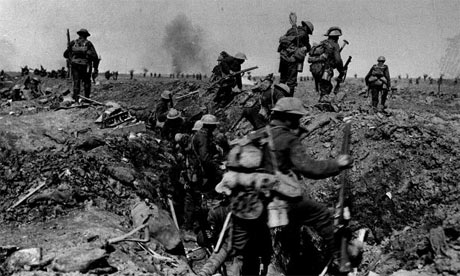
British troops negotiate a trench as they go forward
in support of an attack on the village of Morval
during the Battle of the Somme. Photograph: PA

As a kid my strongest impression of the difference between the Wars of History and the Wars of Memory was simply that History had colour whereas the modern wars of the 20th C were BLACK and WHITE.

We had photographs of these titanic struggles in all their gritty horror, you could see the face of war in its terror and its destruction, but there was no colour. That made them real in some senses but strangely unreal in others.


The Thin Red Line. 93rd Highlanders at Balaclava.
Illustration for Scotland for Ever (Hodder and Stoughton, c 1900).


The wars depicted in the history books were often illustrated in colour paintings, romanticized,
propagandized, draped with the colours of empire and the gloss of academic history. The Wars of living Memory were written of that way but they were illustrated with photographs that gave a glimpse of the true nature of war.

The first time I saw colour photos from the Second World War I was shocked, these were real people, they looked my age, they were not the Black and White ghosts that I had seen for so many years. Along with the colour came the realization that these great upheavals had been filled with REAL people who smelled the earth, the smoke the blood and the death just as I could.

Suddenly War changed from a historical event to a mass tragedy, necessary sometimes but never something to take lightly. Suddenly to stand with the dwindling numbers of veterans on November 11th became not only a duty, but an honour. These men and women had seen unimaginable horrors, they had lived through chaos and destruction and they were REAL people. People I could shake the hands of, people I could see standing with tears for their lost youth and their lost friends. The colour that is in their memories we can never see, we only have the black and white old photos.

There is now, no longer anyone alive who knows the colours of WWI, who remembers the smell of the mud of Flanders, the sound of artillery or the shrieks of dying companions. That war has become history.

Soon the same will happen for those who lived through WWII. And still, there are wars where young men and women fight because they are told to. There are still men and women now much younger than me who will have such memories. 

To stand beside them today is to stand beside all of those who are now history, to stand and remember is to make sure that History is not forgotten.

Keep your sightglass full, your firebox trimmed and your water iced.
KJ
  

Lost Power Makers

Thursday, August 21, 2014 0 comments

Heavy Metal!

There is something wondrous, and also a bit melancholy, about abandoned buildings and factories.
All the energy, thought, labour, and pride expended in creating these great buildings and their complex machines is apparent even in the signs of decay and collapse.

Probably the most melancholy though, are abandoned power plants.

These are places where man manipulates the basic forces of nature into forms that can be used for human purposes. Whether those forces come from rushing water, coal, oil, or even the fundamental building blocks of matter itself, these are the places where we have molded them and converted the energy they contain into standardized human designed forms.

This collection of 32 amazing photos collected on Scribdol evokes the lost power of these places.

7 Most Incredible Abandoned Power Plants

Here are a couple of shots to "wet yer whistle".
Keep your sightglass full your firebox trimmed and your water iced.
KJ


Happy Canada Day!

Tuesday, July 1, 2014 0 comments

To all you Steampunk Canucks!

I hope everyone get's to enjoy a fine day with good company and good times!

Canada is a land that was tied together by steam even as it was being born. A land where innovation, creativity, and inventiveness must be matched by hard work, endurance, and an appreciation for the beauty and magnificence of a sometimes hostile environment.

For 147 years we have struggled to carve out our home and native land from rocks, deserts, forests, rocky coastlines, vast prairies and soaring mountains. We have used every technological tool available at the time to do so.

 Steam made it possible, in trains, paddle steamers, power plants, mine hoists, ocean ships, factories and even the lowly, but all important, domestic heat needed for 9 months of every year!

As Steampunks we celebrate the inventiveness and creativity of the exotic and the "might have been". What better place to do it than in a country for which such activity is not a luxury but a necessity.

Happy Birthday Canada!

Keep your sightglass full, your firebox trimmed and your water iced!
KJ

H/T to The Steampunk Scholar for the image!


Tea Duelling Biscuit Test

Friday, May 9, 2014 0 comments

Report from the Max's workbench


To: Vice Admiral Sir Rogers Wainscote OBE
Chief Training and Exercise Office


Re: Analysis of Tea Duelling Biscuits,
and estimation of availability in remote areas of the Empire

Sir
As requested by their Lordships in furtherance of the training requirements of Her Majesty's Airship Crews to insure their ability to do just honour to Her Majesty when called upon to represent Her Majesty's vessels in competitions, or in matters of honour when satisfaction is requested by use of the Honourable Tea Duel (HTD).
And,
Having found the supply of suitable biscuits for use in the HTD in the remote areas of the Empire to be limited, if not unavailable entirely.
Therefore,
As requested in their Lordships written orders of January 6 last, I have undertaken a comparative analysis of the merits and behaviour of common biscuits likely to be found in most areas of the Empire.
A brief summary of the results is here included for your information.

I trust that this meets with your approval.
I remain as always your servant.
Lt Cdr(E) Maxwell MacDonald-Smythe

Test Procedure
My ship undergoing a refit at Her Majesty's London Airdockyard the testing program was carried out in the "Kitchen" amply supplied with a kettle, cooker and fresh water.

Each biscuit was tested multiple times as if a HTD was in progress. The behaviour of the biscuit held as per a successful dunk was observed. To mimic competition conditions the dunked biscuit was held a slight angle and the time at which cohesion was lost was observed.

Comparison was made to the standard Peek Freans "Nice" biscuit used in London, also known as a "Nickie"

Results
All tested biscuits were also produced by Peak Freans and I am reliably informed that it would only be in the very extremely remote areas that none of thes would be available.

The biscuits are ranked according to the behaviour after the Dunk from best to worst.

1) LifeStyle Bran Crunch
2) Digestive
3) An unknown biscuit found in PF assorted Tea collections. The biscuit has blueberry pieces in it so it is technically not allowed but it does behave close enough to the standard Nickie to be used if nothing else is available.

Shortbread and arrowroot like biscuits are totally unsuitable as they are dunk proof!

On Role Playing

Saturday, November 30, 2013 1 comments

What is it about Steampunk...

That makes us want to actually experience all the gadgets and wonderful alternate history for real?
Is it the gadgets, the fearsome weapons and monsters, the complexity of clockwork mechanisms, the power of steam, the elegance of a beribboned bustle, the intriguing glimpse of a lace edged corset?

As you know, if you have been following my posts on Airship design, I am a member of a role playing group that is the crew and passengers of an exotic airship in the service of her Imperial Majesty Queen Victoria.

According to Wikipedia:

A role-playing game (RPG and sometimes roleplaying game) is a game in which players assume the roles of characters in a fictional setting. Players take responsibility for acting out these roles within a narrative, either through literal acting or through a process of structured decision-making or character development. Actions taken within many games succeed or fail according to a formal system of rules and guidelines.
Our group is not a game in the sense of the last line of that quote, rather it is a shared storyline that we are participants in. The story gives our characters a common history, and a chance to play in the alternate world we have created. We have created a complex story with intrigue, action, boredom, danger, humour, travel, and good companionship.  The main purpose of the group is really to have fun with a set of Steampunk characters. Since we all enjoy the costuming and gadgets that Steampunk is famous for, we also have a chance to wear our characters "out in public" so to speak.

Now having a group of like minded people building gadgets and sewing costumes is certainly not new or unique. In fact there are many airship crews, military units, expeditions, and such like out there. The Neo-Victorian world is a world of exploration and adventure after all.

Here are three things our group does that we find helps to increase our enjoyment.

First thing is the "Story" of course.

Originally the group was simply the crew of an airship, with a minimal setting in which to place our characters mostly for costuming purposes. Eventually people began to add back stories to their characters. Since we wanted to share the world, we tried to place the back stories in a common context. That meant that we needed to settle some details of the world so that we all knew where and when our characters were supposed to be.

This was surprisingly hard to do, we didn't want to be too detailed in respect to the alternate history in which our characters lived (mainly because we couldn't agree!) and because we didn't want to be too limiting. We eventually settled on not having a specific date but rather that we would simply be "sometime" in the late 19th c. with Queen Victoria still ruling the vast British Empire. We decided that there were some changes from real history to liven things up. For example the South won the Civil War and North America consists of five countries. The Union, the Confederacy, Texas, the British Colony of Canada and the Spanish provinces of Mexico and California.

The Royal Navy now has an Airship component of which our airship is a part. The military side of our world is that of the Victorian Royal Navy and Army.  The civil world is pretty much that of the Neo-Victorian Steampunk worlds we all know and love.

So far so good.

When we weren't getting together for drinks in our costumes we all hung out online, and it was a natural extension to roleplay interactions between the characters. As time went on it became apparent that as we did so a story line began to develop too. A realtime history began to appear recorded in the conversations and roleplay.

One of us suggested that, since we were an airship crew, why not have the airship arrive somewhere and then we could get together in costume as if we were actually at that place. So when we went to London we went to see "Gaslight" and when we went to Venice we had dinner in an Italian restaurant before going to see Gilbert and Sullivan's "Gondoliers". Of course it helped to have the story follow along with reasons for being in these places.

My wife is a mystery writer as well as a member of our group and she volunteered to keep track of the story and help to move it along. Essentially she became what in a normal RPG is known as the Dungeon Master.  We have had some really interesting twists and turns in the story which has seen our crew involved in corporate intrigues, spies, sabotage, battles, and storms.

Not everyone in the group participates in the online roleplay which is fine because really the roleplay is just adding colour to our character's shared history.

Second thing is the "Technology".

We are an airship crew and consequently the airship itself becomes a major character in the story.
My Practical Airship Design posts cover how I see our fine ship, being her Chief Engineer and all.  But this is an alternate history and a Steampunk one so our airship isn't the only exotic technology we have to play with.

Personally I like Steampunk tech to be close to real tech (see my first article on Airship Design) but not  everybody in the group thinks like that of course.

The trick is to make the technologies "appropriate" to the world, so for example we have complex semi intelligent machines but they appear to be clockwork driven mechanisms. Fiendishly complex but still clockwork. If someone wants to add a new piece of tech we try to decide how it fits in, because the nature of our roleplay means once introduced it becomes part of the world. So far nearly everything has fit, mechanical rats, ornithopters, mechanical augmentation, and even "brass bound blasters" for our detachment of Royal Airship Marines.

Third is Non Player Characters (NPCs)

This has turned out to be one of the most interesting aspects of our story, because not all our members are active in the roleplay, often it is necessary to have other characters involved in the action. What is a crew without crew members? So we have added NPCs as other members of the crew and other people in the World that can help to move the story along. For example as Chief Engineer I have a "Black Gang", as the engine room crew of a Victorian Royal Navy ship was known, of six men each slightly different characters useful as other points of view from my main character. When used judiciously the NPCs can really help to flesh out the action, and keep the story moving even if most of the other members are busy doing real life things.

Plus if a "Red Shirt" is ever needed...

These three elements, a real time story, appropriate technology, and NPCs, have really helped to add life and colour to the shared story that our characters inhabit. When we do get together in our costumed finery we have a shared history of adventures, dangers, excitement and travel.

And a finer bunch of shipmates a man could not hope for.


Keep your sight glass full, your fiebox trimmed and your water iced.
KJ

How to recognize a Steampunk

Tuesday, August 27, 2013 0 comments

Found this posted on the Book of Faces today.

How to Recognize a Steampunk
By 


Steampunks don't always walk around wearing their full Steampunk finery, so how can you tell whether someone is a Steampunk or not? Here's a tongue-in-cheek (and yet 100% true!) guide to help you determine whether someone you know is a Steampunk.
They may be a Steampunk if....

  • ...their eyes light up whenever someone throws something metal away.
  • ...their everyday clothes are several decades out of date.
  • ...they adopt an English accent for no discernible reason.
  • ...they wear goggles but don't actually need them.
  • ...all of their plastic items have been spray-painted to look like brass.
  • ...they own more than one hat that isn't a baseball cap or a fedora.
  • ...many of their stories start with "I was in the workshop and..."
  • ...they eschew a wristwatch in favor of a pocket watch.
  • ...they use words like "eschew".
  • ...they own more broken than working clocks.
  • ...they own more books than movies.
  • .......most of which were written more than a hundred years ago.
  • ...they take pride in how old their belongings are.
  • ...they own more than one set of cufflinks.
  • ...they know what a cravat and/or bustle is.
  • ......and the difference between a gear and a cog.
  • ...their Nerf guns are all in various stages of being painted and/or taken apart.
  • ...their ears perk up whenever someone says the word "esteem".
  • ...they have a crush on Nikola Tesla.
  • ......and they get angry whenever someone mentions Thomas Edison.
  • ...their wardrobe consists entirely of shades of brown.
  • ......and yet will tell you that brown isn't the only color in Steampunk.
  • ...they use a smart phone, but it has a wood or leather case.
  • ...they visit their local thrift store more often than their local department store.
  • ...they've picked up something someone has thrown away and said, "Oh, I could make ___ out of this..."
  • ...they visit the hardware or sewing supply store more often than the grocery store.
  • ...they work odd historical facts into every conversation.
  • ...they used to drink coffee, but now exclusively drink tea instead.
  • ...even their underwear is historically accurate.
  • ......or only their underwear is historically accurate.
  • .........or their underwear is so concealing that it would qualify as outerwear.
  • ...when they refer to The Wild, Wild West without the word "bad", they mean the TV show from 1965, and not the 1999 movie.
  • ......and likewise when they refer to The League of Extraordinary Gentlemen, they mean the comic books and not the movie.
  • ...when they wear Steampunk clothes, they insist that it's an "outfit, not a costume".
  • ...they carry a cane, but don't need it.
  • ...they own a parasol, and don't refer to it as an umbrella, or worse as a "sunbrella".
  • ...they don't like anise, but cultivated a taste for absinthe.
  • ......or they drink vodka screwdrivers just for the name.
  • .........or they've learned to appreciate the taste of gin.
  • ...it never occurred to them to wear their corset under their clothes.
  • ...they are convinced that they alone know the true definition of Steampunk.
If more than five of these apply, the person in question is probably a Steampunk. If more than ten of these apply, the person in question is definitely a Steampunk.
If more than twenty of these apply, the person in question doesn't need a list for other people to know they're Steampunk, because they ooze it out of every pore!

=============================================
Keep your sightglass full, your firebox trimmed and your water iced.
KJ


Experiments in Steam Lift Part 1

Sunday, May 26, 2013 0 comments

Science!

As you know if you have been reading my Practical Airship Design series, the airship I am describing/designing uses low pressure steam as the lift gas. While not anywhere near as powerful a lift agent as Hydrogen or Helium it has several advantages that I have discussed in that series here and here.

I have decided to do a some quick experiments for myself to see how steam worked as a lift gas. Nothing fancy really just a quick check on how steam behaves at low pressure in an enclosed space like our airship's lift bags.

In order to test this I needed a few items:

1) A source of low pressure steam of fairly large volume.
2) An envelope to contain the steam.

For the Steam source I decided to use a small 1/2 liter electric kettle, one that has no automatic shutoff just a whistle to tell when it is boiling. It would keep boiling until it was dry if I let it.

I thought finding an envelope would be a bit tricky as it has to be light enough to show if there was any lift available, but not be too sensitive to the temperature of the steam (100c at sea level of course but about 98C at our elevation). I wasn't sure how most light weight materials would handle the heat.

The lightest materials I had on hand were Safeway shopping bags and green garbage bags. These are plastic of course so I was concerned that they would potentially be damaged by the steam. Easiest way to test was to put a chunk of each in boiling water and see what happened.

Making sure my wife was out of the kitchen smile I filled a saucepan with water and got it boiling furiously on the stove. Then I immersed the samples, and after a few minutes I found that surprisingly they were completely unaffected! They didn't stretch or show any signs of being softened by the boiling water. They also didn't seem to give off any smell as a result of being boiled (so I escaped the kitchen and my wife unscathed). I decided to use these as the test envelopes for my lift experiment.

The first "proof of concept" experiment was to simply fill a shopping bag with steam from the kettle and see what happens. Anybody who has blown air into a shopping bag with a fan knows that the bag will expand as the air is pushed into it. In my case I wanted to see if the steam was doing any lifting not just expanding the envelope by pressure. How to do that?

The trick is to leave the bottom of the bag open to the atmosphere. That insures that there can be no over pressure inside the bag to hold it up. If the bag stays "inflated" even when it is open at the base then the inflation must be the result of the lift from the steam.

I fired up the kettle in the back yard and when it was boiling I placed the shopping bag over the kettle. I collapsed the bag into a long package first to exclude as much air as possible. As the steam beagn to flow the bag began to fill and lift the surface until it was nearly inflated! The bottom was open and the steam was not coming out of the bottom yet, which showed that there was no pressure building up in the bag.

I expected to see a lot of condensation of the steam on the surface of the bag, but there was very little during the few minutes of my test.

Next I did the same thing with the green garbage bag. This showed the same behaviour, the bag filled and extended even with the bottom open to the air. The garbage bag is much bigger of course and it was able to hold itself up by the lift of the steam. While I was doing this a slight breeze came up which kept collapsing the bag so I was not able to fully inflate it.

Again there was very little condensation on the inner surface of the bag. I'm not sure why that is unless the bag, by heating up to nearly the temperature of the steam, prevents much condensation.

My next set of experiments should be interesting.  I will try the garbage bag again inside and see if there is sufficient lift to actually lift the bag from the ground! I will also measure the temperatures of the bag surface and the steam inside. Allowing the bag to cool by removing it from the kettle will show how fast the steam condenses.

Stay tuned for part 2 coming soon.

Keep your sightglass full, your firebox trimmed and your water iced.
KJ

On gadgets...

Wednesday, May 22, 2013 0 comments

Everybody likes gadgets!
Steampunk has lots of gadgets. Machine like objects that appear to have some kind of use. Festooned with pipes, gauages, gears, wires levers and springs. In polished brass and copper, and tooled leather and varnished wood.

Some are elegant works of art like this clock by Roger Wood.

http://www.etsy.com/listing/113732228/iphone-5-dock-ipod-dock-new-lighting
These elegant Steampunk iPod stands are decorative holders for real technological objects.

I love the IDEA of such gadgets and objects, they liven up our surroundings and give us a sense that maybe our Steampunk worlds can be real. BUT these objects are really a pastiche, which Wikipedia defines as:
A work of art, literature, film, music or architecture that closely imitates the work of a previous artist, usually distinguished from parody in the sense that it celebrates rather than mocks the work it imitates
These objects do not DO anything, yes the clocks run and the iPods work, but all the geegaws around them don't do anything except look cool.  I'm a technical kind of guy, as you no doubt have noticed, and I can't help trying to make sense of these objects. It's as if the technical side of my brain really wants all the decorations to actually work.

Take a gear train for example, often used by Steampunks as a decorative treatment on T-shirts, phone cases and letterhead. I always start to follow the gears around, seeing which one turns which way and when I see that the gears would be locked up there is almost a jarring sense of disappointment. The same goes for following pipes and gauges and wires.

It's not that I think all this decoration should be functional of course since it is simply a gloss put on for effect. Of course there is nothing wrong with that.  They are pastiches in the sense that they mimic the real elegance of form following function that Victorian machinery and gadgets have. Those real objects are the inspiration for our gadgets and even when their function is not obvious they still look like they could be functional. 
 
I have never been successful building such gadgets myself, mainly because I can't escape the feeling that the layout should somehow work. I am in awe of artists like Roger Wood who can build such beautiful objects and successfully pull off the decoration. And even though I will always try to figure out if all the bits fit together it doesn't change the fact that these gadgets are stylish objet d'art and definitely brighten up or Steampunk worlds. 

 Keep you sightglass full, your firebox trimmed and your water iced.
KJ

Practical Airship Design Part 5c

Sunday, April 21, 2013 0 comments

A self mobile cloud!

In my last technical post I talked about the layout of the engine room of our airship and hinted at some of the controls that would allow the officers on the flight deck up forward to send commands to the engine room.  Since then I have received a couple of questions about how the lift system would be controlled in practice. I was also asked about how the steam lift system would actually operate, given the enormous volume of the lift bags inside the hull.  I will try to answer those queries in this post.

First I'd like to remind everybody of the scale of vessel we are talking about here.  Our airship is about the same size as the Hindenburg.

  • Length: 245 m (803 ft 10 in)
  • Diameter: 41.18 m (135.1 ft 0 in)
  • Volume: 200,000 m3 (7,062,000 ft3)
  • Powerplant: 4 × Daimler-Benz DB 602 diesel engines, 890 kW (1,200 hp) each
  • Maximum speed: 135 km/h (85 mph) 
  • Dead Weight: 149 T


That is only slightly shorter than the RMS Titanic at 269 m (882 ft 6 in).

We are almost twice as long as the largest Victorian Battleship the HMS  Magnificent built in 1894


  • Length: 128 m (421 ft)
  • Beam: 23 m (75 ft )
  • Powerplant: 2 × 3-cylinder triple expansion steam engines, twin screws
  • Maximum speed: 30 km/h (18 mph)
  • Dead Weight: 15,810 T
Note the difference in weight though!

Even though we are the largest moving man made object ever constructed, we are essentially a self propelled cloud.

Here is an image of our Airship that I put together:
As you recall from Part 3b The Case for Steam the static lift for our ship is provided by low pressure steam generated by our fantastical power Core. In that post I also described why we wanted to use steam as our lift gas and how steam, along with our core, eliminated some of the constraints traditional rigid airships faced in operation.  But steam has some constraints of its own that a traditional hydrogen or helium lift airship doesn't have.

The biggest constraint being that steam must be maintained at a temperature of at least 100C or it quickly turns back into liquid water!

Once generated, the steam immediately begins to loose heat by conduction through the piping and the envelope of the lift bag. The inner surface of the envelope will be streaming with water constantly. Unlike a traditional lift gas system, where once inflated a lift bag will not loose volume unless intentionally vented, (ignoring for the moment the unavoidable leakage through the envelope) a steam lift system will rapidly collapse by condensation unless additional steam is added or some mechanism for adding heat directly to the volume can be found.

This is why steam as a lifting gas is in reality not very practical, the amount of fuel needed to reboil the condensate makes it impossible to maintain flight for very long. Our airship doesn't have that problem of course due to its power core, which doesn't use any fuel. So this means that the losses due to condensation can be readily made up. The addition of fresh steam also serves to add heat to the total volume reducing the condensation rate from convection losses as the steam circulates inside the volume and flows across the cooler envelope.

One of the benefits of using steam is the ability to control the gross lift by varying the volume of the lift bag. The volume can be varied by adjusting the balance of steam flow to condensate rate. If we add more steam  than is lost through condensation the volume increases and we get additional lift without having to drop any ballast. If we allow the rate of steam flow to be less than the condensation rate the volume has to decrease and we loose lift. Unlike in a traditional lifting gas ship, we are not permanently loosing the lift gas as we have an essentially unlimited supply.

To see how our steam airship controls the lift we first need to understand how a traditional gas lift airship does it.
 
In a traditional rigid airship the lift gas bags are very close to the atmospheric pressure at the altitude she is flying at. The ship is "weighed off" such that she is neutrally buoyant at the starting elevation with the gasbags inflated to 80% or so of their total volume. This neutral condition continues to exist at any elevation above the starting point, because as the airship ascends the volume of gas expands. The expanded gas volume displaces the equivalent weight of the lower pressure atmosphere so the buoyancy is the same. Thus at any elevation above the starting point the pressures inside and outside the gas bags continue to be equal. Obviously there is a limit to how high the airship can go before the gas can no longer expand inside the hull structure. This is known as the pressure height and is the maximum elevation the ship can attain for a given weight.  In a traditional rigid airship exceeding the pressure height is problematic because the gas must be released from the lift bags to prevent over pressure. Once that happens the ship will descend because there is no longer enough volume of gas to sustain the weight aloft. As the ship descends the gas bag volume decreases and the ship continues to descend! Ballast must be dropped to allow the ship to remain aloft at all. 

Something to keep in mind here is that within the limits of the starting elevation and the pressure height the airship is free to move vertically without either dropping ballast or venting gas!  Thus altitude control during powered flight is by the use of the dynamic lift from the forward motion of the hull. The angle of the hull is under the control of the elevators on the tail planes.

Of course, as I pointed out in previous posts, this gas venting and ballast dropping is a permanent change to the airship. Since the gas cannot be replaced, and neither can the ballast, there is a limit to how long flight can be maintained before there is no longer any way to control the buoyancy.

Now lets look at how we handle this control in our steam lift airship.

Exactly the same conditions exist with respect to the volume changes due to elevation, we also start our flight "weighed off" to be neutrally buoyant at our initial elevation, and have our lift bags with some spare volume available for expansion as we fly higher. In order to maintain the volume however we must be continually adding steam to replace that lost due to condensation and to maintain the temperature of the total volume at 100C. As the ship ascends the steam filled lift bag volume increases just as the gas filled one does.  Our airship also has a pressure height above which we would have to vent steam to prevent over pressure. And just like in the traditional airship that would cause us to descend.

Here is where the benefits of our steam system really show, although the control is tricky.

Unlike the gas lift bags of the traditional airship, ours are in constant flux. The engineer (me) is constantly juggling the balance of  steam flow vs condensate rate and temperature. Now when we hit pressure height steam will have to be vented just like gas would. Only we send the steam being vented to our condenser on the top of the hull, where it is turned rapidly back into water and recovered for use later. The ship will descend of course, just like a gas lift airship would, but instead of having to drop ballast the engineer simply boosts the steam flow slightly and the volume is made up again. To intentionally exceed our pressure height we would have to drop ballast of some sort, however when we returned below pressure height we would be able to control the volume of the steam lift bags again unlike a tradtional airship which could never replace it's lift gas while in flight.

In our roleplay group, as I was describing this behaviour over coffee one day, it was pointed out that all this juggling of steam flow, volume, and temperature could lead to some nasty oscillations in elevation.  Unavoidable time delays in making adjustments could result in chaos and the inability to control the ships elevation.  (We actually role played that problem a bit for fun.)

An excellent point and one that I have been thinking about for a while.

Here is one solution to the problem. In the absence of detailed sensor information and computer control of the various valves (we are a Victorian air ship after all) there is no way to predict the required changes at any point in time. However the same could be said for driving a car in gusty crosswinds! Yet people do that all the time.  The trick is to maintain the control dynamically instead of statically. Instead of treating the steam lift bag as a static container that needs to be adjusted to match changing conditions, we make the lift bag intentionally leaky. That is we allow for the steam to be flowing into the condenser ALL THE TIME.  So in addition to the steam needed to make up for the condensation we allow more steam than needed to be flowing into the lift bag.  Since we don't want the volume to be changing there is a balance between the flow in and the flow out that needs to be maintained.  More steam would need to flow in than flow out because some would be needed to make up for the condensation losses. An additional benefit is the addition of heat to the gross volume as the new steam is admitted.

Now instead of trying to guess what changes need to be made at any point in time the engineers could adjust the balance between the two valves, inlet and condenser outlet via a single control. We control the flow not the volume. Once balance was achieved the two valves work in opposition one opening while the other is closing. Why this is easier can be seen by comparing how much harder it is to control a car with only one hand instead of two on the wheel. With one hand you have to force the wheel both ways to adjust the steering, with two you just have to shift the tension between the two hands to make the same adjustment. The engineer can then fly the ship vertically like a car driver handles a crosswind adjusting for elevation changes by shifting that balance slightly.  This only works of course since we have unlimited steam volumes to play with courtesy of our core. 

As always thanks for reading. Feedback and questions are always welcome!

Keep your sightglass full, your firebox trimmed and your water iced.
KJ

The next article in the series is here.

You can follow the full design thread by clicking on the tag "Flight Engineer".

Fun with "Unintended Consequences"

Thursday, March 21, 2013 0 comments

Steampunk is all about what ifs!

These "what ifs" occur when a technological development happens at a different time than what history tells us it actually did. In the Steampunk Worlds we play with, this is the divergence that gives us the reason to play with alternate histories.

I was reading some online articles about technological developments during the 19th Century, the developments that lead to our current worlds in fact, trying to find points in time to do some "What If" brainstorming on, just for fun.  I came across this one at Civil War Trust which discusses the effect that the development of Whitney's Cotton Gin in 1794 had on the subsequent history of the American South.

 This machine revolutionized the process of separating cotton from its seed, making it dramatically faster and less expensive to turn picked cotton into usable cotton for textiles. Eli Whitney invented the gin in 1794, and by 1850 the tool had changed the face of Southern agriculture. Before Whitney’s gin entered into widespread use, the United States produced roughly 750,000 bales of cotton, in 1830. By 1850 that amount had exploded to 2.85 million bales. This production was concentrated almost exclusively in the South, because of the weather conditions needed for the plant to grow. Faster processing of cotton with the gin meant it was profitable for landowners to establish previously-unthinkably large cotton plantations across the south. But harvesting cotton remained a very labor-intensive undertaking. Thus, bigger cotton farms meant the need for more slaves. The slave population in the United States increased nearly five-fold in the first half of the 19th Century, and by 1860, the South provided about two-thirds of the world’s cotton supply. Southern wealth had become reliant on this one crop and thus was completely dependent on slave-labor.

This is a classic "unintended consequence" of technological development that was unlikely to have been foreseen by anyone at the time.

So if we look at some major technological darlings of Steampunk, like the Babbage Engine or Airships for example, one can see that the probable unintended consequences of actual utilization of these technologies would have dwarfed that of potentially the entire Industrial Revolution to that point. Both of these two, as just one example, are disruptive technologies, they influence many aspects of society and make possible much more rapid development of other technologies. Like the snowball effect that the microchip had in the 20th Century.

Many of Tesla's inventions, should they have been fully developed, would likely have done the same.

I think that is what makes Steampunk such an interesting genre to play with. We can keep the world mostly as it was for atmosphere, then change one development, the "What Ifs", and then let the unintended consequences run their course.

That my friends is Magick!

Keep your sightglass full, your firebox trimmed and your water iced.
KJ

About Gears, Goggles, and Steam oh My!

Here I collect interesting bits of information related to the world of Steampunk.

Category List

Absinthium (12) accessories (15) Airships (69) Art (1) Beakerhead (3) Books (65) comics (5) computation (11) costumes (16) etiquette (19) events (30) fiction (87) Flight Engineer (33) Fun (57) games (36) history (109) howto (21) Inventions (57) manners (6) Meetup Repost (90) movies (4) music (4) Musings (44) mystery (23) news (8) Parasol Duelling (46) Photos (67) Pie In the Sky (3) poetry (1) resources (50) Role Playing (59) Serial Story (28) Ships (39) Steam (34) Steampunk Sports (26) Tesla (13) video (77) website (57) What Ifs (16)

Recent Comments

Theme images by sndr. Powered by Blogger.

Followers