Experimental airship like mine!
If you read my Practical Airship Design series the design might seem a bit familiar!
The airship described in this NASA paper uses hydrogen as a lift gas rather than steam but it is powered by a real equivalent of our core. Of course using hydrogen on Titan is really safe because there is no free oxygen anywhere to cause problems.
Fascinating.
"Radioisotope Stirling Engine Powered Airship for Atmospheric and Surface Exploration of Titan"
Author and Affiliation:
Colozza, Anthony J. (Vantage Partners, LLC, Brook Park, OH, United States);
Cataldo, Robert L. (NASA Glenn Research Center, Cleveland, OH United States)
Abstract:
The feasibility of an advanced Stirling radioisotope generator (ASRG) powered airship for the near surface exploration of Titan was evaluated. The analysis did not consider the complete mission only the operation of the airship within the atmosphere of Titan. The baseline airship utilized two ASRG systems with a total of four general-purpose heat source (GPHS) blocks. Hydrogen gas was used to provide lift. The ASRG systems, airship electronics and controls and the science payload were contained in a payload enclosure. This enclosure was separated into two sections, one for the ASRG systems and the other for the electronics and payload. Each section operated at atmospheric pressure but at different temperatures. The propulsion system consisted of an electric motor driving a propeller. An analysis was set up to size the airship that could operate near the surface of Titan based on the available power from the ASRGs. The atmospheric conditions on Titan were modeled and used in the analysis. The analysis was an iterative process between sizing the airship to carry a specified payload and the power required to operate the electronics, payload and cooling system as well as provide power to the propulsion system to overcome the drag on the airship. A baseline configuration was determined that could meet the power requirements and operate near the Titan surface. From this baseline design additional trades were made to see how other factors affected the design such as the flight altitude and payload mass and volume.
Publication Date: Jul 01, 2014
Keep your sightglass filled, your firebox trimmed, and your water iced.
KJ
Titan Airship

Monturiol's Dream
A real submarine in 1867?
Previously I wrote about the amazing Ictineo II, the worlds first true submarine.
I am currently reading a fascinating book "Munturiol's Dream" by Mathew Stewart, published in 2004.
The book covers the life of this extraordinary man Narcís Monturiol. A social revolutionary in turbulent 19th century Spain. He lept at any chance to try to create a utopia. He was a staunch non-Marxist Communist and participated actively in many revolts and social actions, mostly in Barcelona, that hotbed of republican/utopian unrest in Spain.
What I find most fascinating was that Monturiol was NOT an engineer, he was trained as a lawyer and spent most of his time as a revolutionary publicist. His various journals, pamphlets, and news papers were popular amongst Barcelona's teeming thousands and he was regularly shut down by the authorities as a result. He was several times forced to go into exile in the countryside to avoid arrest.
So how did this revolutionary/utopian end up creating the marvelous machine that was the Ictineo II?

She was steam powered, made of wood, capable of diving to more than 100', with a mechanism for scrubbing carbon dioxide and whose engine generated oxygen for the crew!
Jules Verne's fictional Nautilus couldn't even do that, she had to surface to replenish her air supply.
A truly remarkable machine.
Mathew Stewart's book chronicles how Monturiol, while in exile on the coast, observed coral divers working to harvest the brilliant coral that grows there. This was an incredibly dangerous job and resulted in many drownings. The divers simply held their breath and held a heavy rock to sink to the sea floor.
He had a dream in which a technological solution would be found to help these people in their dangerous business. In part he figured that if he could show that technological progress could help the poor coral divers without destroying anything, that his dream of a technological and scientific based Utopia could be shown to be feasible.
But he was not an engineer or scientist, he was a writer!
So he set about solving the problem by becoming a self taught engineer. He learned the latest physics, chemistry, materials science, fabrication techniques, everything needed. He conducted experiments and recorded his results. In short he became the classic "Mad Scientist" beavering away on his own to develop a contraption that others thought impossible to achieve.
Chronically short of money, he found surprising support amongst his fellow Utopians and managed to bring his designs to fruition. However that same lack of money meant that his incredible invention was never used or further developed because it was seized for lack of payment of his harbour docking fees and destroyed.
A fascinating technological look at Monturiol's design, and also a look at his time and the point in history that gave birth to the Ictineo II.
A highly recommended read.

Title
Monturiol's Dream
The Extraordinary Story of the Submarine Inventor who wanted to save the World.
Author
Mathew Stewart
Date
2004
Pubisher
Pantheon
ISBN
0375414398
Keep your sightglass full, your firebox trimmed, and your water iced.
KJ
Photographer's Slide Rule
Before there were lightmeters...
Another interesting Nomographic device.
Like the Airship Engineer's Slide rule I discussed previously, other technically complex disciplines made use of nomographic devices to simplify on the fly calculations.
Photographers developed devices for determining exposure times known as Actinographs.
The name originally meant a device that recorded the amount of sunlight for a day but was adopted for the photographer's slide rule that used that data.
Here is an example from the later 19th C

Here is another Actinograph that used a card instead of a roller for the sunlight data.
This is one of the first commercially produced devices made by Ferdinand Hurter and Vero Charles Driffield and patented in 1888.

Keep your sightglass full, your firebox trimmed and your water iced.
KJ
Time keeping by Nomography
Let the Sun shine in!
Last time I presented a link to the fascinating world of graphical calculations known as Nomography.
Now in Steampunk there is an emphasis on the mechanical. Time keeping
being probably the greatest illustration of this. From tiny mechanical
watches to massive clockwork calculating machines the imagery of gears
and clocks are everywhere. But there are older ways of measuring time,
using the motion of the Earth and the apparent motion of the Sun and other heavenly bodies with sundials and sextants, astrolabes etc.
This paper has some exotic patterns and calculations for devices that would make wonderful additions to our gadgets:
Regiomontanus, Apian and Capuchin Sundials by Fer J. de Vries, Mac Oglesby,William S. Maddux and Warren
Thom
So how would using this old "primitive" technology be used in Steampunk?


Elegant AND functional, scientific and technical, the Steampunk aesthetic on display indeed.
Keep your sightglass full, your firebox trimmed, and your water iced.
KJ
Practical Airship Design Analysis of a Real System!
Steam Plants for Aircraft analysed in 1926!
I found an interesting report from NACA (NASA's original name) concerning the analysis and experimentation of light weight steamplants for use in aircraft.
The paper is entitled "Steam Power Plants in Aircraft" and compiled by E.E. Wilson at the Bureau of Aeronautics in 1926, and you can get the paper in PDF format here.
In this paper the author analyses a lightweight boiler setup capable of generating sufficient steam at high enough pressures to power an aircraft. He then estimates the weight and efficiency of a complete system model using this boiler and compares it to the current internal combustion power plants used in the heavier than air craft of the time.
The result of the analysis is that with the current state of the art in 1926, using steam power for heavier than air craft was NOT practical. This is not really a surprise given the power/weight ratio of even an efficient boiler and turbine setup. However there were two constraints that really tipped the analysis over against the use of steam power for aircraft.
- Fuel consumption/efficiency of steam power compared to internal combustion power plants.
- Weight and area of the system for condensing the steam for re-use.
First the fuel consumption issue doesn't exist because of our fantastical core, which uses no fuel but produces steam at potentially very high temperatures and pressures. Second the condensation issue is moot because the exhaust steam can simply be added to the lift system and condensed on the hull condenser as described in Part 4.

Again we do not have any worries about efficiency in our design.
Fascinating to see this analysis and it is an interesting read if you are curious about the analysis of a real system that could be implemented in an airship like I have been describing.
Keep your sightglass full, your firebox trimmed and your water iced.
KJ
Here is the table of contents for the whole series of Practical Airship Design posts.
You can see all the posts related airships and airship design here.
Ada Countess Lovelace, Charles Babbage and...
The wondrous machine that might have changed the world!
In the Airship Technology Speech I gave back in January at the Absinthe Cafe the place where our Role Playing World separated from the real world was when Babbage's Analytical engine was actually constructed and working in 1880.
This world changing event was due to the work of Augusta Ada King, Countess Lovelace.
In the real world Ada died in November of 1852 before Charles Babbage had perfected his design. In our alternate world she outlived Babbage and was responsible for making his designs work, under contract to the Royal Navy for whom Babbage was working as well.
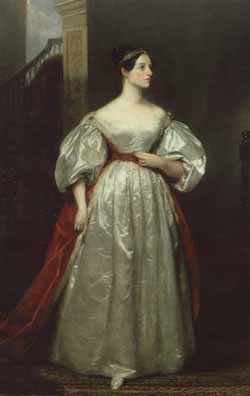
The Honerable Augusta Ada Byron was the only legitimate daughter of Lord Byron. She married Baron William King in 1835 and when he became the Earl of Lovelace in 1838 she became a countess. Her fascination with mathematics and science as well as what she called "poetical science", describing herself as an "Analyst (& Metaphysician)",brought her into contact with Charles Babbage.
Of her work with Babbage on his Analytical Engine she said:
[The Analytical Engine] might act upon other things besides number, were objects found whose mutual fundamental relations could be expressed by those of the abstract science of operations, and which should be also susceptible of adaptations to the action of the operating notation and mechanism of the engine...
Supposing, for instance, that the fundamental relations of pitched sounds in the science of harmony and of musical composition were susceptible of such expression and adaptations, the engine might compose elaborate and scientific pieces of music of any degree of complexity or extent.
You can read more details of the Countess' work with Charles Babbage on her Wikipedia page.
From the Wikipedia article:
During a nine-month period in 1842–43, Ada translated Italian mathematician Luigi Menabrea's memoir on Babbage's newest proposed machine, the Analytical Engine. With the article, she appended a set of notes. Explaining the Analytical Engine's function was a difficult task, as even other scientists did not really grasp the concept and the British establishment was uninterested in it. Ada's notes even had to explain how the Engine differed from the original Difference Engine. Her work was well received at the time; scientist Michael Faraday described himself as a supporter of her writing.
The notes are longer than the memoir itself and include (in Section G), in complete detail, a method for calculating a sequence of Bernoulli numbers with the Engine, which would have run correctly had the Analytical Engine been built (only his Difference Engine has been built, completed in London in 2002). Based on this work, Lovelace is now widely considered the first computer programmer and her method is recognised as the world's first computer program.
The Countess's translation of Menabrea's memoir and her detailed comments are available at Fourmilabs here:
Sketch of

Invented by Charles Babbage
By L. F. MENABREA
of Turin, Officer of the Military Engineers
from the Bibliothèque Universelle de Genève, October, 1842,
No. 82
ADA AUGUSTA, COUNTESS OF LOVELACE
A truly fascinating look into what could have been a major turning point in world history.
As the author of the Fourmilab web page says:
“Sketch of the Analytical Engine” by L. F. Menabrea, translated and with extensive commentary by Ada Augusta, Countess of Lovelace. This 1842 document is the definitive exposition of the Analytical Engine, which described many aspects of computer architecture and programming more than a hundred years before they were “discovered” in the twentieth century. If you have ever doubted, even for a nanosecond, that Lady Ada was, indeed, the First Hacker, perusal of this document will demonstrate her primacy beyond a shadow of a doubt.
Indeed!
Keep your sightglass full, your firebox trimmed and your water iced.
KJ
P.S.
A fun bit of information given how the Countess' contributions to mechanical computation were fundamental to the development of the fantastic airship we use in our Role Play check this out from her Wikipedia page:
Ada was often ill, beginning in early childhood. At the age of eight, she experienced headaches that obscured her vision. In June 1829, she was paralyzed after a bout of measles. She was subjected to continuous bed rest for nearly a year, which may have extended her period of disability. By 1831, she was able to walk with crutches. Despite being ill Ada developed her mathematical and technological skills. At age 12, this future "Lady Fairy", as Charles Babbage affectionately called her, decided she wanted to fly. Ada went about the project methodically, thoughtfully, with imagination and passion. Her first step in February 1828, was to construct wings. She investigated different material and sizes. She considered various materials for the wings; paper, oilsilk, wires and feathers. She examined the anatomy of birds to determine the right proportion between the wings and the body. She decided to write a book Flyology illustrating, with plates, some of her findings. She decided what equipment she would need, for example, a compass, to "cut across the country by the most direct road", so that she could surmount mountains, rivers and valleys. Her final step was to integrate steam with the "art of flying".Oh if only the Real World had been less cruel.
Happy 270th Volta!
Happy birthday Alessandro Volta!
From Wikipedia
Alessandro Giuseppe Antonio Anastasio Volta (18 February 1745 – 5 March 1827) was an Italian physicist[2][3] credited with the invention of the first electrical battery, the Voltaic pile, which he invented in 1799 and the results of which he reported in 1800 in a two part letter to the President of the Royal Society.[4][5] With this invention Volta proved that electricity could be generated chemically and debased the prevalent theory that electricity was generated solely by living beings. Volta's invention sparked a great amount of scientific excitement and led others to conduct similar experiments which eventually led to the development of the field of electrochemistry.[5]
Alessandro Volta also drew admiration from Napoleon Bonaparte for his invention, and was invited to the Institute of France to demonstrate his invention to the members of the Institute. Volta enjoyed a certain amount of closeness with the Emperor throughout his life and he was conferred numerous honours by him.[1] Alessandro Volta held the chair of experimental physics at the University of Pavia for nearly 40 years and was widely idolised by his students.[1]
Despite his professional success Volta tended to be a person inclined towards domestic life and this was more apparent in his later years. At this time he tended to live secluded from public life and more for the sake of his family until his eventual death in 1827 from a series of illnesses which began in 1823.[1] The SI unit of electric potential is named in his honour as the volt.
And Google has a cool "doodle" to mark the day

KJ
Airfoiled
A fun short film!
The trials of being an inventor.
Keep your sightglass full, your firebox trimmed and your water iced.
KJ
Human powered helicopter flies!
At last!
While not technically Steampunk, I think this definitely qualifies as being both whimsical and magnificent!
Who hasn't wanted to pedal off into the skies on ones winged penny farthing wot?
The grace and sense of elegant design in action of this enormous yet fragile machine is a palpable demonstration of the technical creative spirit of Steampunk.
In my humble opinion of course!
Keep your sightglass full, your firebox trimmed and your water iced.
KJ
The Winans Cigar Ships 1866
A possible source for Jules Verne's Nautilus.
Found this article at the fantastic Vernian Era website. I have previously discussed another set of pages from this site in my School of Nautili post. Michael Crisafulli has collected some wondeful information on various technologies that existed at the time Jules Verne was writing. Many of these were experimental and considered unworkable but they could easily have been used as inspiration by Verne.
A good example of such a technology was the Cigar Ships that the Winans Family of Baltimore, Maryland, built between 1858 and 1866.

he cigar ships were designed and built by the Winans family, successful railway engineers from Baltimore, Maryland who moved into marine engineering with enthusiasm and great expenditures of their family wealth, but less success. Their radical marine design concept included an ultra-streamlined spindle-shaped hull with minimum superstructure.
The Winans constructed at least four ships between 1858 and 1866. Two of these attracted considerable public attention as well as skepticism and outright criticism from the technical establishment. Ross Winans and his sons were, first and foremost, engineers experimenting with innovative concepts. The innovative technology would certainly have attracted Jules Verne's attention. He may well have seen one of the boats sailing or berthed in England. Some of their innovations were adopted for surface ships in the twentieth century, and many of the pioneer submarines built in the late nineteenth and early twentieth century resembled them. Later in the twentieth century, aerodynamicists rediscovered the benefits of the spindle.
The site discusses the history of these odd vessels and many of the design problems that the Winans had to overcome.
The final ship built using this design was the yacht Ross Winans built in 1866.
From the website:
The Winans launched their final effort in 1866 in London. The Ross Winans was 256 feet long with the same 16-foot diameter as their first boat and displaced about 400 tons. It did have a nearly conventional superstructure atop the hull amidships, 130 feet long and ten feet wide, tapering to a point at each end. Inverting the first design, it was driven by a 22-foot diameter propeller at each end. These nine-bladed props were powered by an engine room amidships. The Ross Winans underwent trials in the Solent channel but made no more than one or two coastal voyages, never going to sea in earnest.
The woodcut at right, from The Illustrated London News, 3 Mar
1866, shows the stern-first launching of the Ross Winans. The
propeller mounts are visible, but the propellers have not yet been
installed.
|
 |
Highly recommended reading this!
Check out the full article at: The Winans Cigar Ships
Keep your sightglass full, your firebox trimmed and your water iced.
KJ
"The Design of Jules Verne’s Submarine Nautilus" by Stuart Wier
The Nautilus Design
I recently found a PDF document of an analysis of Jules Verne's iconic submarine the Nautilus.
In a previous post, A School of Nautili, I linked to a catalog of designs based on Verne's descriptions in 20,000 Leagues Under the Sea.
This analysis by Stuart K Wier entitled simply "The Design of Jules Verne’s Submarine Nautilus" examines not only the details of the design but also some ideas of why Verne designed the Nautilus as he did and what some potential influences and inspirations he may have had.
Examining the original illustrations done for Verne's book is fascinating, since the illustrators were friends and acquaintances of Verne they had discussed the details with him before creating the illustrations. The paper includes many of these images which show the interiors of the Nautilus in all her glory.
I highly recommend this paper for anyone interested in the details of the Nautilus.
There are some snippets of the paper below to give you a taste of the style of this excellent paper.
Enjoy
Keep your sightglass full, your firebox trimmed and your water iced.
KJ
IntroductionWier's analysis of the propulsion system is interesting
In 1867 when Jules Verne was beginning to plan a novel about an undersea voyage, he and his brother Paul traveled to the United States on board the Great Eastern. The Great Eastern was an enormous vessel for its time, 213 meters (698feet) long, and 23 meters (75 feet) wide, in fact the largest vessel afloat, and it incorporated some of the newest features of marine architecture. It had a double iron hull, sails, steam engines, paddle wheels, and a propeller 7.3 meters (24 feet) in diameter. Verne showed and described his keen interest in the ship, and noted details of its design, construction, and operation. Thinking of an advanced undersea vessel, he found himself living on the the most advanced ship of his time. In the United States Verne saw other new technology, such as the large and fast Hudson River steamboats. This was a period of delight in rapid technical progress.
For the past century the submarine has played an important role in naval affairs, and more recently submersibles have become valuable in exploration of the oceans. Yet a fictional submarine, conceived decades before real submarines took up seagoing duties, remains a candidate for the most renowned: Jules Verne's Nautilus, from his novel Twenty Thousand Leagues Under the Sea.
Jules Verne is rightly regarded as a prophet of many of the inventions which characterized twentieth century life. The novels of Jules Verne are as well known for their technical innovations as for their plots of journeys to exotic locations. The submarine Nautilus and its enigmatic captain Nemo are among Verne's most famous creations. Even some who have not read Verne know that the Nautilus foreshadowed large modern submarines.
“The dynamic power of my engines is nearly infinite”:
Power, Propulsion, and Control
Despite a popular notion that Verne's Nautilus had some sort of futuristic power supply, such as atomic power, Verne based his technology on what was known in his day. The power supply is chemical batteries. Verne realized that the actual batteries of his day were far from adequate, as batteries remain today, but suggested they might be greatly improved. Nemo says he uses “large and powerful” Bunsen batteries rather than Ruhmkorff batteries which are less powerful. Nemo has improved the Bunsen battery by using elements of a sodium zinc amalgam in place of zinc alone, which Nemo claims doubles the “electromotive force” of the batteries (what we call today the voltage). Perhaps Verne was unaware of the explosive property of sodium in contact with water.
Nemo extracts sodium from sea water on a remote island, where the process is fueled with sea coal. The new sodium would recharge Verne's hypothetical batteries, which seem to last for months between charges.