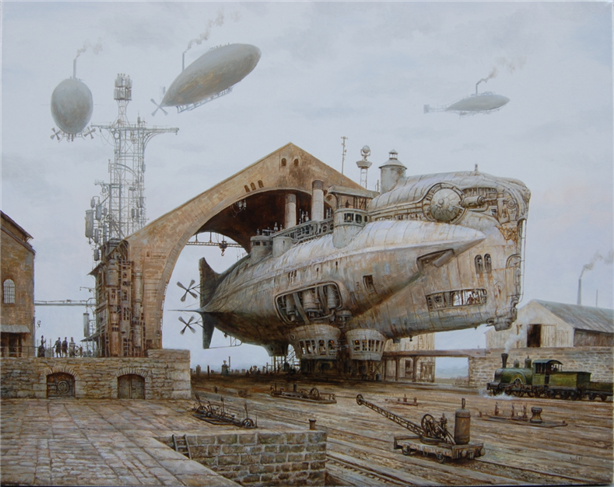
Gears

Tuesday, December 11, 2012 0 comments

Why Gears?

Of all the archetypal symbols of Steampunk the gear is probably second only to goggles in prominence.
Immortalized in the parody song "Just glue some gears on it and call it Steampunk", these bits of machinery festoon our gadgets, our hats and our clothes. We print them on our business cards, display them proudly on our banners and website backgrounds, and even include them in our tattoos.

But why gears?

What is it about these round, spiky, bits of brass and steel that conjure up the essence of Steampunk?

There is something about the utility of them that attracts the eye. They embody purposeful design in their shapes. When built into working machines they spin, transforming energy into useful motion, shifting speeds into power and vice verse. Whether it is the tiny gears of a finely crafted watch or the massive bull gears of a powerhouse. Each one holds a mystery of purpose that can only be determined when it is in place in the machine for which it was designed.

Even when a gear is isolated from its place it still has an essence of purpose about it.

At a recent event I attended, the host's son received a Christmas present, the wrapping of which included a home made ornament on which were glued tiny real gears made of brass. It was a very neat bauble. But glue doesn't stick to brass very well so some of the gears fell off and we had to find then. Each little brass sparkle shone like a star against the floor. There was no mistaking them, they stood out like snowflakes made of gold.

As I picked one of these gears up I marveled at the intricacy of the mechanism it would originally have been a part of. Probably a watch of some kind I suppose, but sitting there in the palm of my hand the gear could have been a part of anything. Maybe it had been designed as part of a control mechanism for a much larger machine, an automaton, or a power plant. Maybe it was the critical gear from the control of some fearful weapon. Or maybe it had been part of a miniature Babbage engine used to calculate the navigational equations used on an airship.

Gears are quintessentially human artifacts, they are mathematical constructions frozen in brass and steel.  They fit together with others of their kind to make things happen. Without them mechanical systems cannot work efficiently. Even in the digital world of today, gears still spin at the heart of the smallest and largest machines. They may be hidden inside cases of plastic and steel, but they spin along in the darkness as they have for hundreds of years.

Perhaps there are gears spinning inside the very foundations of the Universe itself.

In the Steampunk world, we celebrate these creations of art and science. We display them proudly in visible mechanisms and in symbolic form, for they are the means by which magic happens.

Keep your sightglass full, your firebox trimmed and your water iced.
KJ

Leviathans

Monday, December 10, 2012 0 comments

Of all the industrial creations of the Victorian world,
the great steel battleships were probably the most impressive, expensive, and popular of all.

HMS Majestic in an artist's conception, heading out to take over as flagship of the British Mediterranean Fleet, 1899. The artist has accurately depicted the standard Victorian colour scheme approved by the Queen herself

THE savage can fasten only a dozen pounds on his back and swim the river. When he makes an axe, fells a tree, and builds a raft,  he can carry many times a dozen pounds.  As soon as he learns to rip logs into boards and build a boat, he multiplies his power a hundredfold; and when to this he adds modern sciences he can produce the monster steel leviathans that defy wind, storm and distance, and bear to the uttermost parts of the earth burdens a millionfold greater than the savage could carry across the narrow river."
--Horace Mann
Keep your sightglass full, your firebox trimmed and your water iced.
KJ

New Airship Nearly Ready

Friday, December 7, 2012 0 comments

Now this is sweet!
An article from Gizmag discussing the progress of a new airship being built in California.

Keep your sightglass full, your firebox trimmed and your water iced.
KJ

Aeroscraft dirigible airship prototype approaches completion

She is the first "rigid" type airship built in over 40 years.

The dirigible airship, the oddball aircraft of another era, is making a comeback. California-based Aeros Corporation has created a prototype of its new breed of variable buoyancy aircraft and expects the vehicle to be finished before the end of 2012. With its new cargo handling technology, minimum fuel consumption, vertical take-off and landing features and point to point delivery, the Aeroscraft platform promises to revolutionize airship technology.
The Aeroscraft ship uses a suite of new mechanical and aerospace technologies. It operates off a buoyancy management system which controls and adjusts the buoyancy of the vehicle, making it light or heavy for any stages of ground and flight operation. Automatic flight control systems give it equilibrium in all flight modes and allow it to adjust helium pressurized envelopes depending on the buoyancy requirements. It just needs one pilot and has an internal ballast control system, which allows it to offload cargo, without using ballast. Built with a rigid structure, the Aeroscraft can control lift at all stages with its Vertical Takeoff and Landing (VTOL) capabilities and carry maximum payload while in hover. What makes it different from other vehicles is that it does not need a runway or ground infrastructure.

SteamPed Moped Conversion

Thursday, December 6, 2012 0 comments

Ooooh!

Something to add to my holiday wish list!

Here is a project where a Moped, powered by a conventional two stroke gasoline engine, has been converted to run with steam.  The project not only converted the existing engine but also added a compact boiler and controls.
The engine was converted to a unaflow steam engine. 

A very cool project, lots of possible uses for similar conversions!

The Steam Car Club of Great Britain website has lots of good information on historic and modern steam powered vehicles.

Enjoy

Keep your sightglass full, your firebox trimmed and your water iced.
KJ

The SteamPed in all her glory! 
 a Steam project by Roger Ulsky

My SteamPed started life as a Motobecane Moped which I obtained in a non running condition but with all the parts intact. I eventually want to build a steam car and decided this would be a good way to get my feet "dry" with steam land vehicles.
Continued at the link above...


"Futility, or the Wreck of the Titan" 1898

Wednesday, December 5, 2012 0 comments

Strange this...

From Wikipedia

en.wikipedia.org/wiki/Futility,_or_the_Wreck_of_the_Titan

Futility, or the Wreck of the Titan is an 1898 novella written by Morgan Robertson. The story features the ocean liner Titan, which sinks in the North Atlantic after striking an iceberg. The Titan and its sinking have been noted to be very similar to the real-life passenger ship RMS Titanic, which sank fourteen years later. Following the wreck the novel was reissued with some changes, particularly in the ship's gross tonnage, to make it closer to the Titanic.

Similarities to the Titanic

Although the novel was written before the Olympic-class Titanic had even been designed, there are some remarkable similarities between the fictional and real-life counterparts. Like the Titanic, the fictional ship sank in April in the North Atlantic, and there were not enough lifeboats for the passengers. There are also similarities between the size (800 ft long for Titan versus 882 ft 9 in long for the Titanic), speed (25 knots for Titan, 22.5 knots for Titanic) and life-saving equipment.

Beyond the name, the similarities between the Titanic and the fictional Titan include:

Both were triple screw

Both described as "unsinkable"
The Titanic was the world's largest luxury liner (882 feet, displacing 63,000 long tons), and was once described as being practically "unsinkable".
The Titan was the largest craft afloat and the greatest of the works of men (800 feet, displacing 75,000 tons, up from 45,000 in the 1898 edition), and was considered "unsinkable".
Shortage of lifeboats
The Titanic carried only 16 lifeboats, plus 4 Engelhardt folding lifeboats,[4] less than half the number required for her passenger and crew capacity of 3000.
The Titan carried "as few as the law allowed", 24 lifeboats, less than half needed for her 3000 capacity.
Struck an iceberg
Moving at 22½ knots, the Titanic struck an iceberg on the starboard side on the night of April 14, 1912 in the North Atlantic 400 miles away from Newfoundland.
Also on an April night, in the North Atlantic 400 miles from Newfoundland (Terranova), the Titan hit an iceberg while traveling at 25 knots, also on the starboard side.
Sinking
The unsinkable Titanic sank, and more than half of her 2200 passengers and crew died.
The indestructible Titan also sank, more than half of her 2500 passengers drowning.
Went down bow first, the Titan actually capsizing before it sank.
-----
Interesting and a bit creepy.

Keep your sightglass full, your firebox trimmed and your...
Never mind about the water and ice bit confused
KJ

The Graf Zeppelin in Action

Tuesday, December 4, 2012 0 comments

Oh the wonder of real airships!
This video is a compilation of clips from the flights of the Graf Zeppelin, including some from her circumnavigation in 1929. She carried thousands of passengers in almost 300 flights without any issues at all.


"What ifs" abound here.
What would the world be like if this had been the preferred mode of civilian transport?

Keep your sightglass full, your firebox trimmed and your water iced.
KJ

Practical Airship Design Part 5

Saturday, December 1, 2012 0 comments

Engines Tanks and Bulkheads Oh My!

Having described last time  how we are able to generate the steam needed to both lift and power our globe circling airship, it is time to attempt a layout of the system so that we can see how it would fit into the hull. Since in my position as Flight Engineer I will be spending most of my role play time here I admit that it is a subject close to my heart smile

What would such an airship look like if it must include such a novel power and lift source?
I would like to say she would look like this...

Thunderer by *Voitv
But alas the "practical" bit gets in the way, sigh.

Unlike a vessel that floats on water, an airship is way more delicate in her balance and weight restrictions. The system I described last time is relatively heavy! My back of envelope calculations suggest that it would be the equivalent of all the engines, fuel and ballast water that the Hindenburg carried and then some. This weight is concentrated into a small area which has implications for where it is positioned in the hull.

The main propulsion engine in the stern with its large counter rotating props, powered by Tesla's wireless electrical system, is also fairly weighty for its power output. One other design idea I had was to use a larger number of smaller engines spread around the hull to avoid this concentration of weight, but it doesn't look quite so cool. (The "Splendid" requirement remember.) In this system these two weights, the power plant and main propulsion system, are at least small in area which simplifies the gross layout somewhat. By placing the power plant appropriately in the design we can balance the ship. The crew accommodations, cargo holds, and bridge are relatively light by comparison.

One other significant weight that needs to be accounted for is the steam condenser. This condenser is needed to recover the water from the high pressure steam used for power, plus the steam vented from the lift system when trimming the ship and any excess steam generated when the core is operating. Remember that our power core is either on or off, and when on must be cooled by steam generation constantly.

When I was originally doodling around with my design I had thought to give our airship a hull that was a shell of a light metal, like duraluminum, rather than the truss and fabric type structure the traditional rigid airships used. The condenser in that design was simply the upper surface of the hull itself. Alas, a quick calculation showed that a hull the size of the Hindenburg would be way too heavy built that way. In fact even using a light metal such as duraluminum the condenser becomes a significant weight in its own right, the third largest weight after the power core and main propulsion engine in fact.

Interestingly, if our airship was buoyed aloft by hydrogen, instead of steam, such a hull would work, and wouldn't need the weight of a condenser. This has some implications for a modern airship design using composite materials like modern graphite fibres etc.

Since we want our airship to be mostly appropriate to Victorian times, and use steam as its lifting gas, our airship will have a more or less conventional hull structure of duraluminum trusses with a fabric cover for the majority of the hull. The three primary weight blocks of power, propulsion, and condenser are laid out in such a way that the airship is in balance. The simplest way to visualize her is something like the Hindenburg with a pair of counter rotating props at the stern aft of the fins, a pair of funnels just forward of amidships, and what looks like a shell of metal on her upper hull just aft of the funnels.

I think that is pretty "splendid" really so our Captain should be happy.

Now let's get into the engine room and get our hands greasy, what would it look like?  How do you arrange all the bits that are the core systems that support our airship in flight?  As mentioned above the power core and its water tank are the heaviest parts and so must be the lowest in the hull. Water is a good shield for radiation so the rest of the engine room can be close to the core without problems. From an aerodynamic standpoint we don't want to disrupt the hulls smooth contour more than necessary so as much as possible we should keep everything inside the hull along the keel structure.

Here is my proposed gross layout. I would draw a picture but "Dammit Jim, I'm a Flight Engineer not an artist!" smile

At the lowest point, close to amidships, is the core and its tank. There is really no pressure in the tank so it doesn't have to be cylindrical like a railway engine boiler. However, a cylinder does minimize the weight of the tank relative to its volume. A sphere would be the best of course, but would be harder to fit into the hull. Above the tank is the main low pressure distribution header. This header leads low pressure steam direct from the core to the lift bags inside the hull. Valves in the header control this distribution. A low pressure channel also connects the header with the condenser on the upper surface of the hull. This channel is controlled by a valve and is the primary means to regulate the flow of low pressure steam between the lift bags and/or dumping the excess to the condenser.

Alongside the main distribution header is the main condensate header. This header's main purpose is to connect to the condenser on the hull and direct the condensed steam back to the main tank. This header also collects steam condensed from within the lift bags, as well as from the condensation collected from the inside of the hull itself that results from lift bag leakage.

Forward of the main tank is the engine room proper. Integrated into the forward bulkhead of the main tank is the high pressure boiler. Inside is the steel coil, filled with high pressure mineral oil, that leads directly into the heart of the power core. (Note: I've changed this slightly see the next article for the reasons why) Water from the main tank is pumped into this boiler where it is flashed into steam. The production of steam is regulated by the pump rate, if the pumps stop so does the steam production. This is similar to the way a water tube steam boiler worked on the more advanced steam cars of the period.

The heart of the engine room is the main turbine that takes the high pressure steam from the boiler and converts the energy to electrical power, by the use of an attached Tesla high voltage AC generator. This turbine is a special light weight version of that employed in high speed torpedo boats. Exhaust steam from the turbine is directed to an exhaust header. This header is connected to the main condenser.

A valve also connects the exhaust header directly to the funnels. When activated all the exhaust steam goes directly to the atmosphere, via the funnels instead of the condenser. This is used for two purposes, in case of a problem with the condenser that produces an unacceptable back pressure on the exhaust, and for when the Captain orders "flank" or emergency speeds and the flow of steam from the turbine would overwhelm the ability of the condenser to handle it. Doing so would rapidly deplete the water in the main tank of course, as none of it would be recovered by the condenser. We are a military ship, as well as an exploratory one, so such speeds may sometimes be necessary. Of course we could only run the ship flat out like this for a limited amount of time before we would be forced to shutdown the core. (Hmmm... I foresee some interesting role play possibilities with that, "Sorry Captain I canna push her much longer or she's goin ta blow!")

Ranged along the walls of the engine room are the auxiliary systems needed to support the primary one. I imagine this to look pretty similar to the engine room of a high speed destroyer of the period. Lots of brass gauges, pipes, pumps, and sparking, glowing, electrical devices of a mysterious and dangerous look.
I'll try to describe these systems in more detail in my next article.

Forward of the engine room is the domestic cargo hold, which carries the baggage and supplies for the crew. Aft of the main tank is a larger general purpose cargo hold.

So that will be my domain on this ship. How large a crew would be needed to man the engine room?  Not many really. If we used a three watch system similar to that used by commercial surface ships and the great rigid airships, a crew of 6, 3 in each watch, including myself would be sufficient for normal operation.

Please join me next time as I continue to flesh out the mechanical side of this airship.
Don't worry, I haven't forgotten the crew's comforts, that's coming soon as well.

Keep your sightglass full, your firebox trimmed and your water iced.
KJ

Click here for the next article in this series.

You can follow the full design thread by clicking on the tag "Flight Engineer".

About Gears, Goggles, and Steam oh My!

Here I collect interesting bits of information related to the world of Steampunk.

Category List

Absinthium (12) accessories (15) Airships (69) Art (1) Beakerhead (3) Books (65) comics (5) computation (11) costumes (16) etiquette (19) events (30) fiction (87) Flight Engineer (33) Fun (57) games (36) history (109) howto (21) Inventions (57) manners (6) Meetup Repost (90) movies (4) music (4) Musings (44) mystery (23) news (8) Parasol Duelling (46) Photos (67) Pie In the Sky (3) poetry (1) resources (50) Role Playing (59) Serial Story (28) Ships (39) Steam (34) Steampunk Sports (26) Tesla (13) video (77) website (57) What Ifs (16)

Recent Comments

Theme images by sndr. Powered by Blogger.

Followers