The "World System" of Nikola Tesla

Friday, October 5, 2012 2 comments

The more I read of  Tesla, that wunderkind inventor and experimenter of the early Electric Age, the more I am fascinated by the immense scale of his vision.
For example, in 1900 he had an idea for what he called his "World System".  Keep in mind that this was when wireless telephony was still in it's very early stages. Tesla's description of what his system could achieve is striking in its scale and depth. It is also very prescient and although we do not use his "World System", which was based on wireless power transmission through tuned resonance between the Earth and its Atmosphere and Magnetic field, the results of our developments have come very close to his predictions.
Below is a description of his "World System" in his own words.
Enjoy

Keep your sightglass full, your firebox trimmed and your water iced.
KJ

From My Inventions By Nikola Tesla
 At the age of 63 Tesla tells the story of his creative life.
 First published in 1919 in the Electrical Experimenter magazine.
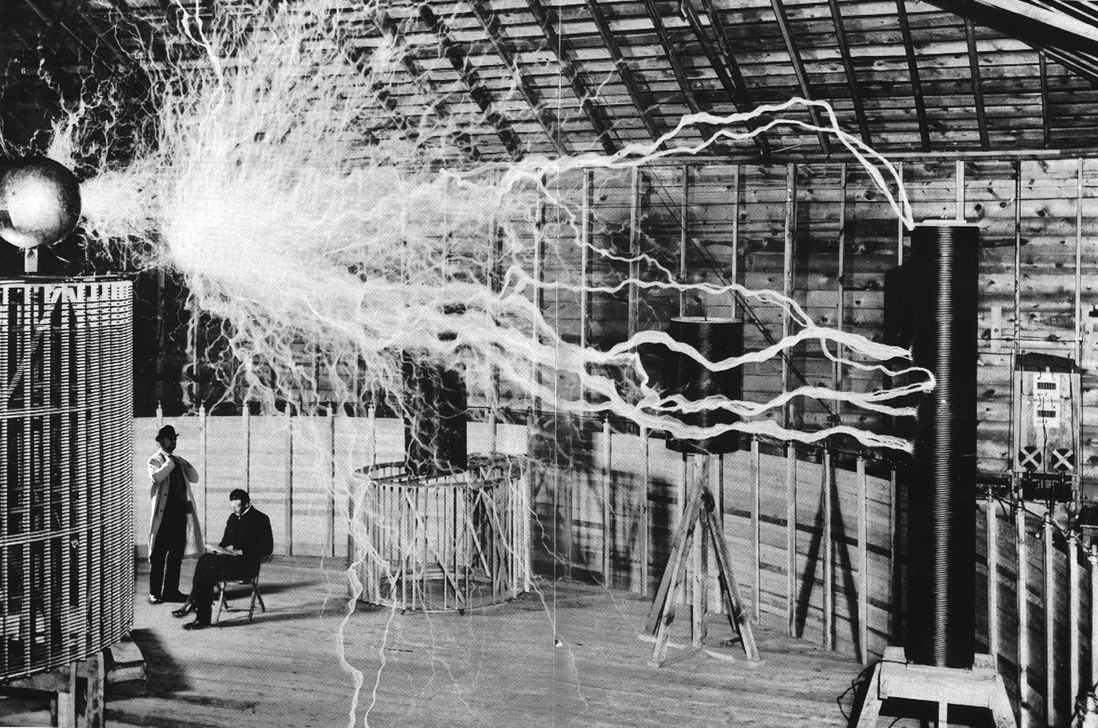

This invention was one of a number comprised in my "World-System" of wireless transmission which I undertook to commercialize on my return to New York in 1900. As to the immediate purposes of my enterprise, they were clearly outlined in a technical statement of that period from which I quote:

"The 'World-System' has resulted from a combination of several original discoveries made by the inventor in the course of long continued research and experimentation. It makes possible not only the instantaneous and precise wireless transmission of any kind of signals, messages or characters, to all parts of the world, but also the inter-connection of the existing telegraph, telephone, and other signal stations without any change in their present equipment. By its means, for instance, a telephone subscriber here may call up and talk to any other subscriber on the Globe. An inexpensive receiver, not bigger than a watch, will enable him to listen anywhere, on land or sea, to a speech delivered or music played in some other place, however distant. These examples are cited merely to give an idea of the possibilities of this great scientific advance, which annihilates distance and makes that perfect natural conductor, the Earth, available for all the innumerable purposes which human ingenuity has found for a line-wire. One far-reaching result of this is that any device capable of being operated thru one or more wires (at a distance obviously restricted) can likewise be actuated, without artificial conductors and with the same facility and accuracy, at distances to which there are no limits other than those imposed by the physical dimensions of the Globe. Thus, not only will entirely new fields for commercial exploitation be opened up by this ideal method of transmission but the old ones vastly extended.

The 'World-System' is based on the application of the following important inventions and discoveries:

1. The 'Tesla Transformer.' This apparatus is in the production of electrical vibrations as revolutionary as gunpowder was in warfare. Currents many times stronger than any ever generated in the usual ways, and sparks over one hundred feet long, have been produced by the inventor with an instrument of this kind.

2. The 'Magnifying Transmitter.' This is Tesla's best invention, a peculiar transformer specially adapted to excite the Earth, which is in the transmission of electrical energy what the telescope is in astronomical observation. By the use of this marvelous device he has already set up electrical movements of greater intensity than those of lightning and passed a current, sufficient to light more than two hundred incandescent lamps, around the Globe.

3. The 'Tesla Wireless System.' This system comprises a number of improvements and is the only means known for transmitting economically electrical energy to a distance without wires. Careful tests and measurements in connection with an experimental station of great activity, erected by the inventor in Colorado, have demonstrated that power in any desired amount can be conveyed, clear across the Globe if necessary, with a loss not exceeding a few per cent.

4. The 'Art of Individualization.' This invention of Tesla's is to primitive 'tuning' what refined language is to unarticulated expression. It makes possible the transmission of signals or messages absolutely secret and exclusive both in the active and passive aspect, that is, non-interfering as well as non-interferable. Each signal is like an individual of unmistakable identity and there is virtually no limit to the number of stations or instruments which can be simultaneously operated without the slightest mutual disturbance.

5. 'The Terrestrial Stationary Waves.' This wonderful discovery, popularly explained, means that the Earth is responsive to electrical vibrations of definite pitch just as a tuning fork to certain waves of sound. These particular electrical vibrations, capable of powerfully exciting the Globe, lend themselves to innumerable uses of great importance commercially and in many other respects.

The first 'World-System' power plant can be put in operation in nine months. With this power plant it will be practicable to attain electrical activities up to ten million horsepower and it is designed to serve for as many technical achievements as are possible without due expense. Among these the following may be mentioned:

(1) The inter-connection of the existing telegraph exchanges or offices all over the world;

(2) The establishment of a secret and non-interferable government telegraph service;

(3) The inter-connection of all the present telephone exchanges or offices on the Globe;

(4) The universal distribution of general news, by telegraph or telephone, in connection with the Press;

(5) The establishment of such a 'World-System' of intelligence transmission for exclusive private use;

(6) The inter-connection and operation of all stock tickers of the world;

(7) The establishment of a 'World-System' of musical distribution, etc.;

(8) The universal registration of time by cheap clocks indicating the hour with astronomical precision and requiring no attention whatever;

(9) The world transmission of typed or handwritten characters, letters, checks, etc.;

(10) The establishment of a universal marine service enabling the navigators of all ships to steer perfectly without compass, to determine the exact location, hour and speed, to prevent collisions and disasters, etc.;

(11) The inauguration of a system of world-printing on land and sea;

(12) The world reproduction of photographic pictures and all kinds of drawings or records."

Horology Horde!

Thursday, October 4, 2012 0 comments

Ordered this DVD in the mail with 3.1 GB of pdf files, most are from the 19th c. and cover everything you always wanted to know about clocks, clock making and the repair of clocks and watches.
This fantastic horde of information cost me a whopping $14.00 (incl shipping)!
I found it here:
Homesteading Self Sufficiency Survival
They have lots of other collections of interesting info as well.

Here is what's on the DVD:

A Catalogue of Books, Manuscripts, Specimens of Clocks, Watches and Watchwork 1875 - 114 pages.pdf
A Description of a Clepsydra or Water-Clock 1753 - 8 pages.pdf
A Portion of the Papers Relating to the Great Clock 1848 - 55 pages.pdf
A Practical Course in Horology 1944 - 193 pages.pdf
A Practical Treatise on the Balance Spring 1876 - 150 pages.pdf
A Rudimentary Treatise on Clock and Watch Making 1850 - 304 pages.pdf
A Rudimentary Treatise on Clocks, Watches and Bells for Public Purposes 1903 434 pages.pdf
A Treatise on Modern Horology in Theory and Practice 1887 - 895 pages.pdf
A Treatise on the Teeth of Wheels 1868 - 213 pages.pdf
A Ttreatise on Watch-Work, Past and Present 1873 - 320 pages.pdf
Abbott's American Watchmaker and Jeweler 1898 - 383 pages.pdf
Accutron Service Manual Series 214 - 39 pages.pdf
Accutron Service Manual Series 218 - 52 pages.pdf
American Horological Journal - Devoted to Practical Horology Vol 1 1869 - 287 pages.pdf
An Analysis of the Lever Escapement 1895 - 94 pages.pdf
Art of Engraving 1904 - 205 pages.pdf
Bangerters Inventions His Marvelous Time Clock 1911 - 92 pages.pdf
Catalogue of Waltham Watch material 1909 - 158 pages.pdf
Chats on Old Clocks 1917 - 299 pages.pdf
Clock and Watch Work 1855 - 189 pages.pdf
Clocks and Watches 1922 - 147 pages.pdf
Description of an Astronomical Clock 1837 - 2 pages.pdf
Directions for Using Bottum's Patent 1852 - 23 pages.pdf
Former Clock & Watchmakers and Their Work 1894 - 402 pages.pdf
Friction, Lubrication and the Lubricants in Horology 1896 - 93 pages.pdf
Government and Industry Interactions in the Development of Clock Technology 1981 - 22 pages.pdf
Horology - A Popular Sketch of Clock and Watch Making 1849 - 70 pages.pdf
Horology 1868 - 100 pages.pdf
How to Keep the Clock Right by Observations of the Fixed Stars 1876 - 98 pages.pdf
Isochronism of Balance-Springs 1862 - 30 pages.pdf
Kemlo's Watch-Repairer's Handbook - 1882 - 117 pages.pdf
Lessons in Horology Vol 1 1905 - 286 pages.pdf
Mechanical Philosophy, Horology, and Astronomy 1857 - 586 pages.pdf
Modern Electro Plating 1897 - 191 pages.pdf
Modern Letter Engraving in Theory and Practice - A Manual for the Use of Watchmakers 1898 - 185 pages.pdf

Just glue some gears on it...

Wednesday, October 3, 2012 0 comments

This is rapidly becoming a kind of anthem for many of us...


Hmmm...

Thinking about this today it occurs to me that the video raises some excellent points about "jumping on the bandwagon".

This is nothing new of course, it is the standard process by which a new "scene" morphs into a "hipster scene" and then ultimately, either into the "mainstream" or oblivion.

Personally I'm a fan of the aesthetic aspects of Steampunk, so as long as it looks cool I don't particularly care if it works or not smile.

That said, I'm still fascinated by process and, like the tinkerers rules I posted here, I love trying to figure out what some arcane looking piece is supposed to do. The better the illusion of possibly working a piece has the better I like it.

"Glue gears on it and call it Steampunk" is a good slogan for that cashing in on a nascent trend behaviour we are seeing now.   It should not however be taken as a call to arms by any kind of authenticity mavins. One of the great strengths of the Steampunk scene is the creativity and sense of wonder that we share in making and displaying "fabulousness".

Since some of us, me in particular, are not really very creative or skillful, we have to buy our bits 'n bobs to participate. Captian Horatio Hooke's famous line "My tailor is pay pal" is very apropos frankly.

After all it doesn't matter what it is, it matters what it looks like.

Keep your sightglass full and your firebox trimmed.
KJ

Videos about Steampunk

Tuesday, October 2, 2012 0 comments

There are lots of videos out about the Steampunk scene.

Here are some to "whet your steam whistle" with:

From PBS


From BBC


From Make TV
Jake Von Slatt in his own words and works!


A Pirate's view of World Steam Expo 2012


And lots more!
Enjoy
Keep your sightglass full, your firebox trimmed and your water iced.
KJ

Wheels within wheels...

0 comments

Found this picture from DragonCon 2012, taken during the Costume parade.
Imagine the possibilities of cruising down the open road on one of these babies!


The big wheel one also has a smaller wheels under the boiler a la a "Penny Farthing".

Source: flickr.com via Kevin on Pinterest
A better profile shot


Keep your sightglass full, your firebox trimmed and your water iced.
KJ

October 1, 2012 time to...

Monday, October 1, 2012 0 comments

Start thinking about my favourite time of year!

The year is getting colder and darker as we get closer to Halloween. When the "veil between the worlds" is the thinnest and when dressing up in exotic outfits is actually encouraged. This is the time when decorating one's front lawn with tombstones, skeletal hands reaching out from the turf, skulls, black cats and carved pumpkins becomes the new normal in the old neighbourhood.

It is also time to ask that most burning of questions...

What do Zombies have to do with Steampunk!
 An excellent question, to which the easiest answer is simply that they are a Victorian invention (see Dr. Frankenstein's Monster).  My eldest daughter calls them "Tesla's Children" which works too.  The Victorian age was an age of marvels with new technologies and new developments in chemistry and biology appearing almost every week.  Mysterious new phenomenon like electricity, had almost boundless possibilities, including making lifeless bodies twitch and move.  It isn't too big a stretch to see that bringing an otherwise dead being back to "life" would be possible.
 
Mix theses new found scientific and technical marvels with the exposure to exotic myths, legends, and strange religions, brought back from the far reaches of Britain's great empire and it is easy to see where such ideas as Zombies (in the modern sense) could come about.  This is also the time where Dracula first makes his appearance in Bram Stoker's novel, as well as Werewolves and other terrifying creatures which appear in the "penny dreadfuls". The Victorians were just as interested in the arcane, fantastic, and scary as we are today, and authors were always ready to produce the product that the consumers wanted. 

It was during Victorian times that the Gothic Novel reached the pinnacle of that verbose macabre genre.
So in Steampunk, where we deal with scientific what ifs, it makes sense to me that there is a slice of that macbre that comes along for the ride. Zombies, the walking dead, a scientific impossibility shambling through our brass and leather bound world of wonders, to raise the hair on the necks of our gallant explorers, heroes, heroines and plucky street urchins.

IMHO of course!
Keep your sightglass full, your firebox trimmed and your sword cane sharp!
KJ

P.S. Some of the best Steampunk Zombie stories, for me, are Bone Shaker, and Dreadnought, by Cherie Priest.

The Steam Powered Submersible "Ictíneo II' of 1867

0 comments

One of those great "what ifs" of history.
Sigh...confused

Keep your sightglass full, your firebox trimmed and your water iced.
KJ

From a great article at Low-tech Magazine
A steam powered submarine: the Ictíneo

Few Victorian inventions have the grace and charm of the Ictíneo, the series of two wooden submarines built by Narcís Monturiol i Estarrol in the second half of the nineteenth century.

Unlike some of the better known early submarines from his contemporaries in Germany, France and the United States, the Catalan inventor managed to build submarines that operated flawlessly.

The Ictíneo II was the first combustion engine driven submarine ever, pioneering concepts that were only rivalled in the 1940s. Sadly, both submarines were eventually scrapped and Monturiol died penniless and forgotten.

---------------


---------------
Monturiol had successfully resolved the two basic obstacles presented to submarine inventors: air supply and mechanical power. In fact, he devised an early form of anaerobic (air-independent) propulsion only to be repeated in the 1940s with the Walter turbine in Germany, and finally with the first atomic submarine, the USS Nautilus.

The Ictíneo II was the first of its kind providing its own oxygen, without surfacing regularly or using a snorkel, as seen on the Nautilus. Perplexing is the reality that Monturiol, never having patented his ideas, is absent in many maritime records of the progression of submarines.

On account of all the machinery in the vessel, only 2 men could fit in the submarine originally designed for a crew of 20. The Ictíneo II made almost 20 problem free demonstration drives. It could stay submerged for eight hours and plunge to a depth of 50 meters. Monturiol calculated that the maximum possible depth was 500 meters, but chose not to take the risk of diving to this depth.!?!

In 1868, shortly after its launch, the groundbreaking Ictíneo II was seized by the shipyard and scrapped, together with her predecessor. The reason? Monturiol could not pay the bills.
--------------------

About Gears, Goggles, and Steam oh My!

Here I collect interesting bits of information related to the world of Steampunk.

Category List

Absinthium (12) accessories (15) Airships (69) Art (1) Beakerhead (3) Books (65) comics (5) computation (11) costumes (16) etiquette (19) events (30) fiction (87) Flight Engineer (33) Fun (57) games (36) history (109) howto (21) Inventions (57) manners (6) Meetup Repost (90) movies (4) music (4) Musings (44) mystery (23) news (8) Parasol Duelling (46) Photos (67) Pie In the Sky (3) poetry (1) resources (50) Role Playing (59) Serial Story (28) Ships (39) Steam (34) Steampunk Sports (26) Tesla (13) video (77) website (57) What Ifs (16)

Recent Comments

Theme images by sndr. Powered by Blogger.

Followers