Showing posts with label howto. Show all posts

Photographer's Slide Rule

Saturday, September 17, 2016 0 comments

Before there were lightmeters...

Another interesting Nomographic device.

Like the Airship Engineer's Slide rule I discussed previously, other technically complex disciplines made use of nomographic devices to simplify on the fly calculations.

Photographers developed devices for determining exposure times known as Actinographs.

The name originally meant a device that recorded the amount of sunlight for a day but was adopted for the photographer's slide rule that used that data.

Here is an example from the later 19th C

Since the exposure time depended on several factors these could be set by sliding the scales. The scales were adjusted to account for plate speed, lens type, and other variables.  The curves on the roller indicated the changing light intensity for different times of the year.  The result was an estimate of the exposure time needed.

Here is another Actinograph that used a card instead of a roller for the sunlight data.
This is one of the first commercially produced devices made by Ferdinand Hurter and Vero Charles Driffield and patented in 1888.


Keep your sightglass full, your firebox trimmed and your water iced.
KJ

Airship Engineer's Slide Rule

Tuesday, March 1, 2016 0 comments

Slip Sticks for the Black gang!

Previously I posted about Nomography, i.e. the use of graphical tools for solving equations.

I have found a perfect example in the Internet Archives!
This article AN AIRSHIP SLIDE RULE By E. R. Weaver and S. F. Pickering, details the calculations and construction of a slide rule for working out problems concerning buoyancy, volumes, temperatures, lifting capability, and altitudes. Specifically for Airship crews this simple device is perfect for the analysis that any Flight Engineer would need to do as part of his duties.

The pamphlet contains the mathematical derivations for the scales and lots of sample problems that can be worked out using the slide rule.

Here is a picture of the slide rule:


And here is a page with some examples of the kinds of problems that could be worked out:


A very useful tool indeed.

Since this pamphlet includes the formulas for how the scales used on the slide rule are laid out, it should be possible to build one!

I think my Flight Engineer needs one, but adjusted for Steam as the lifting gas.

Keep your sightglass full, your firebox trimmed and your water iced.
KJ

Time keeping by Nomography

Sunday, January 31, 2016 0 comments

Let the Sun shine in!

Last time I presented a link to the fascinating world of graphical calculations known as Nomography.

Now in Steampunk there is an emphasis on the mechanical. Time keeping being probably the greatest illustration of this. From tiny mechanical watches to massive clockwork calculating machines the imagery of gears and clocks are everywhere. But there are older ways of measuring time, using the motion of the Earth and the apparent motion of the Sun and other heavenly bodies with sundials and sextants, astrolabes etc.

This paper has some exotic patterns and calculations for devices that would make wonderful additions to our gadgets: 

Regiomontanus, Apian and Capuchin Sundials by Fer J. de Vries, Mac Oglesby,William S. Maddux and Warren Thom

So how would using this old "primitive" technology be used in Steampunk?

Perhaps hidden in our Mad Scientist's notebooks, or printed on our clothing, buried in the shapes on our gadgets, or or on the covers of our children's beds.  The mathematics used in creating these designs and the decorative possibilities of the shapes and patterns, while actually being usable to tell time, would make for some interesting hidden "conceits" don't you think?

Here is an actual card sundial from 1533.
Yes this is "primitive" in the sense that it is not mechanically complex but there is an elegance of form to the curves and shapes.

Elegant AND functional, scientific and technical, the Steampunk aesthetic on display indeed.

Keep your sightglass full, your firebox trimmed, and your water iced.
KJ

Steampunk Painting Technique

Monday, September 2, 2013 0 comments

Painting plastic to look like metal.

I'm working on a device for an upcoming Steampunk event and went looking for techniques to make plastic pipe look like metal.

My artistic skills are just about nil but this tutorial from the talented gang at "Its a Trap" shows one way to do it.

Enjoy
Keep your sightglass full, your firebox trimmed and your water iced.
KJ


How to make a top hat

Sunday, July 7, 2013 3 comments

Brilliant!

Found this while writing my post on Pinterest boards.

A nice howto on making a stovepipe style top hat.  The full image can be found here but this is a just a taste to whet yer whistle!


Keep your sightglass full, your firebox trimmed and your water iced.
KJ

How to Write a Telegram Properly 1928

Wednesday, June 12, 2013 0 comments

The wonders of modern telegraphy stop

This interesting document is a style guide for composing telegrams.

It was written in 1928 by Nelson E Ross and covers the then common practices associated with making sure that telegrams were being used efficiently.

"HOW TO WRITE TELEGRAMS PROPERLY"

 There is a lot of good information here on how to write telegrams efficiently and concisely. This was important since transmission of a telegram was charged by the word. There is also some good information on ways encrypt the transmission to save costs and insure security.

Here are some interesting examples:

How to Save Words -- Naturally, there is a right way and a wrong way of wording telegrams. The right way is economical, the wrong way, wasteful. If the telegram is packed full of unnecessary words, words which might be omitted without impairing the sense of the message, the sender has been guilty of economic waste. Not only has he failed to add anything to his message, but he has slowed it up by increasing the time necessary to transmit it. He added to the volume of traffic from a personal and financial point of view, he has been wasteful because he has spent more for his telegram than was necessary. In the other extreme, he may have omitted words necessary to the sense, thus sacrificing clearness in his eagerness to save a few cents.

If you are telegraphing the home folks that you expect to arrive on the 20th for that long planned visit, spell it out "twentieth." Two words are saved. The telegraph companies have nothing to sell but service. They undertake to transmit your message from point to point, speedily, accurately and secretly. The cheapest way of handling that message is invariably the safest way, and your cooperation is welcomed by the companies. When groups of figures are spelled out, the chance of an error in transmission is reduced to a minimum.

This apparently insignificant fact often is disregarded by users of the telegraph. Considered from the point of view of economy alone, the question of figures in telegrams is interesting. Any group of figures can be written out so that from two to three words are saved each time the group is used. Take for example the expression "one million." Written "one million" It counts two words. Written 1,000,000, the total count is seven words, and if the commas are to be sent also, the count is nine.
The suffixes "th," "rd," or "nd" appended to figures are counted as additional words. When the figures are spelled out, as in "fourth," "third," or "second," the count is automatically reduced.

How to Write Figures -- The following table illustrates the principles just set forth:
1st (two words) -- first (one word)
2nd (two words) -- second (one word)
3rd (two words) -- third (one word)
100 (three words) -- one hundred (two words)
1000 (four words) -- one thousand (two words)
1,0000 (five words) -- ten thousand (two words) etc

How Unnecessary Words Creep In -- To paraphrase, "Brevity is the soul of telegraphy." Except perhaps in the case of a long Night Letter, the practice of adding such words as "Dear Madam." or "Dear Sir," at the beginning of the message, is obsolete. This likewise applies to such phrases as "Yours very truly," "Yours sincerely," etc., commonly used in closing a letter. These words are charged for, and so accustomed is the public to telegraphic brevity, that their use often produces amusement rather than the expression of formality which the sender desired.
When telegrams are received without the well known title of "Mr." do not censure the sender as lacking in respect. To insure accuracy in transmission the title is omitted lest through inadvertence it should be confused with "Mrs." or "Miss." "Esquire" also is dropped in transmission.

An entertaining and useful little pamphlet that can help you add some telegraphic style to your next email.

KEEP YOUR SIGHTGLASS FULL YOUR FIREBOX TRIMMED AND YOUR WATER ICED STOP

Steampunk Train Battleship

Friday, June 7, 2013 0 comments

Battleship on rails!

This video shows the first live steam powered trial of  the Steampunk Rail Battleship Barnum's Dream.


From YouTube:

Published on Apr 14, 2013
Battleship train ship model with cannons and lasers that fire. It has many handmade moving parts that are driven by a live steam engine. The video is a depiction of it's first trial run, with some animation and effects thrown in. It was made from over 50 found parts and took over 2500 hours to construct. Except for the steam engine, which was modified, it is totally hand built using ordinary home tools.
It is almost four feet tall and 51 inches long. Hope you enjoy.
 You can get lots of information on the model and how it was built at the blog here:
Steampunk Machine "Barnum's Dream"

Now that is my kind of model!

keep your sightglass full, your firebox trimmed and your water iced.
KJ

Safely Disassembling Old Clocks

Monday, April 29, 2013 0 comments

Safety First!

Found this at Steampunk Tribune.
Enjoy
Keep your sightglass full, your firebox trimmed and your water iced.
KJ

How to safely take apart a brass clock movement for Steampunk projects....


Obtaining and acquiring Steampunk cogs and bits can often be a challenge, especially with older mechanical devices, soo... I was quite happy to have found this small video gem, from Steampunkartsupply.com, explaining how to properly dis-assemble said devices for project!  Thus, if one has a hankering for more insight on re-purposing perhaps broken clockwork, or just want to learn about the intricacies of real clockwork, please do enjoy (and do pay a visit to Steampunk art supply's blog)!

The Electrotherapy Museum

Friday, February 22, 2013 0 comments

Tesla technology in action.

Found this on Slashdot (thanks to James Rodway for the links).

From the Slashdot Article

Since he was a teenager, Jeff Behary's been interested in the work of Nikola Tesla, and has been collecting antique electric devices of a particular kind: ones that send electricity through the human body to effect medical benefits, many of which do so with the aid of Tesla coils. Tesla's not the only inventor involved, of course, but his influence overlapped and widely influenced the golden age of electrotherapy. Behary's day job as a machinist means he has the skills to rehabilitate and restore these aging beasts, too, along with a growing family of related devices. He's assembled them now, in West Palm Beach, Florida, into the Turn of the Century Electrotherapy Museum. This is a museum of my favorite kind: home-based and intimate, but with serious depth. Though it's open only by appointment, arranging a visit there is worth it, whether you're otherwise part of the Tesla community or not. Behary knows his collection inside and out, with the kind of deep knowledge it takes to fabricate replacement parts and revamp the internal wiring. The devices themselves are accessible, with original and restored pieces up close and personal — you need to be mindful about which ones are humming and crackling at any given moment. (There's also an archive with books, papers, and other effects relating to Tesla and other electric pioneers, not to mention glowing tubes that predate the modern vacuum tube, and the oldest known surviving Tesla coils, recovered from beneath their maker's Boston mansion. Electrotherapy is the organizing principle, but not the extent of this assembly.) And while Behary isn't fooled by all the therapeutic claims made by some machines' makers about running current through your limbs or around your body, he also doesn't discount them all, either, and points out that some of them really do affect the body as claimed. Yes, he's tried most of the machines himself, though he admits he's never dared taking the juice of his personal Tesla-powered electric chair.

The Slashot page also has a transcript of an interview with Jeff Behary.

Fascinating (and slightly scary) stuff here.

Keep your sightglass full, your firebox trimmed and your water iced.
KJ

Messing with gears..."Repairing Old Clocks and Watches"

Sunday, December 23, 2012 0 comments


This wonderful volume by Anthony J. Whiten is filled with 276 pages of practical information and techniques for repairing clockwork of all sizes from wristwatches to grandfather clocks and, by extension, clocks worthy of Hugo Cabret!

Well illustrated with clear line drawings which help to make the practical text very clear. These illustrations are a wonderful source of gear and tool illustrations for other things too cool

One of the most interesting parts of this book for me, was how simple the tools are! Most of them can be made very easily and the instructions for doing so are included in the text.

If you ever wanted to take a clockwork mechanism apart (pretty much all of us I bet!) and THEN PUT IT BACK TOGETHER AGAIN and get it to actually WORK(!?!), this is the book for you.

It also brings the skill and craftsmanship of the watchmaker and designer of yore into perspective with our modern mass produced gadgets.

Keep your sightglass full, your firebox trimmed and your water iced.
KJ

Title
Repairing Old Clocks and Watches

Author
Anthony J. Whiten

Publisher
Van Nostrand Reinhold Company

Date
1979

ISBN
0-442-24730-3

Examples
From the introduction:
"You can buy watches today on which the time is displayed redly, as seen through the eyes of an overhung (sic) wrestler; or you can buy clocks on which the figures march past on horizontal display with relentless precision. These devices are probably manufactured for the use of those who, for reasons known only to themselves, want to know the exact time. The watches and clocks described in this book, were made for such people in their day. Now, however, they provide a leisure time interest, and will still tell us the time as near as most of us want to know it."

An example of the clear warnings in the text:
"All these specimens, of which you are looking at just one, have a mainspring. This may be wound up. Any attempt to dismantle without doing something about this will be either hilarious, disappointing, crippling or even fatal. The timepiece may be harmed, and so may you. Therefore let down the power of the mainspring now." Followed by clear instructions on just how to go about that safely.

"How to be Handsome" beauty tips for women, 1889

Saturday, December 15, 2012 0 comments

Wow!
Found this delightful collection of  "beauty tips" at Mental Floss.
And you thought corsets were a tough fashion requirement!
You can find the original chapter of Burroughs book here:
HOW TO BE HANDSOME, 39
 
Keep your sightglass full, your firebox trimmed and your water iced.
KJ

 How to Be Handsome: 11 Really Terrible 19th-Century Beauty Tips 
  A lot of things have changed since the 19th century. When Barkham Burroughs wrote his Encyclopaedia of Astounding Facts and Useful Information in 1889, he devoted a full chapter to the “secrets of beauty,” and for good reason. To quote Burroughs, “If women are to govern, control, manage, influence and retain the adoration of husbands, fathers, brothers, lovers or even cousins, they must look their prettiest at all times.” Here are 11 of his tips for doing just that.

1. Bathe often(ish)…

At least once a week, but if possible, a lady should “take a plunge or sponge bath three times a week.”

2. … in a household cleaning solution.

What’s better than soap? Ammonia. “Any lady who has once learned its value will never be without it.” Just a capful or so in the bath works as well as soap and cleans the pores “as well as a bleach will do.”

3. Wash your eyes…

Nothing is as attractive as a sparkling eye. The best way to achieve this is by “dashing soapsuds into them.” If that’s not your style, perfume dropped into the eyes is a reasonable alternative. For the same bright-eyed look without the burn, “half a dozen drops of whisky and the same quantity of Eau de Cologne, eaten on a lump of sugar, is quite as effective.”

4. … but don’t wash your hair.

Water is “injurious” to the hair. Instead, wipe “the dust of the previous day” away on a towel. You can also brush your hair during any long, idle breaks in the day. 30 minutes is a good hair-brushing session.

5. And never, ever wash your face.

Simply rub the skin with “an ointment of glycerine” and “dry with a chamois-skin or cotton flannel.” One “beautiful lady” is admired who had “not washed her face for three years, yet it is always clean, rosy, sweet and kissable.”

6. And try not to wash your hands, either.

A well kept hand is soft, pale, and really, really dirty. Red hands can be relieved “by soaking the feet in hot water as often as possible,” but don’t dare touch water with your hands. As with the face, a regimen of ointment and cotton flannel should be used, and gloves worn for bathing. (Burroughs notes here that “dozens of women” with gorgeous hands “do not put them in water once a month.”)

7. Hang out naked by the window every day.

This is also called vapor-bathing, which is a different kind of vapor than the aforementioned ammonia soak, and one more likely to bring the attention of unwanted suitors. To take a proper vapor bath, “the lady denudes herself, takes a seat near the window, and takes in the warm rays of the sun.” If you’re a lady of the restless sort, dancing is advised. A good vapor bath is at least an hour long.

8. Go heavy-metal on the eyes.

Nothing says “handsome lady” like a lined lid. The proper solution is “two drachms of nitric oxid of mercury mixed with one of leaf lard.” Lacking these components, a woman may just as easily produce a nice effect with “a hairpin steeped in lampblack.”

9. Say goodbye to that fringe.

In your great-grandmother’s day, lashes had a tendency to become “unruly.” They were therefore “slightly trimmed every other day” with sharp, tiny scissors, because who wants eyelashes, anyway.

10. Suction!

Nice lips are essential to a woman’s prettiness. As early as possible, a girl should begin thinking about the shape of her lips and how it might be improved. Thin lips “are easily modified by suction,” which “draws the blood to the surfaces” and over time provides a “permanent inflation.” Thick lips “may be reduced by compression.” There are no instructions for this procedure.

11. And try not to be single.

The author’s female acquaintance, after disclosing to her favorite suitor that she had gone those three long years without using soap, found herself back on the market. A note from the gentleman read, “I can not reconcile my heart and my manhood to a woman who can get along without washing her face.”
So remember, ladies: Whatever methods are used, “it would be just as well to keep the knowledge of it from the gentlemen.” Because being married is better than ammonia-water for the complexion.

SteamPed Moped Conversion

Thursday, December 6, 2012 0 comments

Ooooh!

Something to add to my holiday wish list!

Here is a project where a Moped, powered by a conventional two stroke gasoline engine, has been converted to run with steam.  The project not only converted the existing engine but also added a compact boiler and controls.
The engine was converted to a unaflow steam engine. 

A very cool project, lots of possible uses for similar conversions!

The Steam Car Club of Great Britain website has lots of good information on historic and modern steam powered vehicles.

Enjoy

Keep your sightglass full, your firebox trimmed and your water iced.
KJ

The SteamPed in all her glory! 
 a Steam project by Roger Ulsky

My SteamPed started life as a Motobecane Moped which I obtained in a non running condition but with all the parts intact. I eventually want to build a steam car and decided this would be a good way to get my feet "dry" with steam land vehicles.
Continued at the link above...


Practical Airship Design Part 5

Saturday, December 1, 2012 0 comments

Engines Tanks and Bulkheads Oh My!

Having described last time  how we are able to generate the steam needed to both lift and power our globe circling airship, it is time to attempt a layout of the system so that we can see how it would fit into the hull. Since in my position as Flight Engineer I will be spending most of my role play time here I admit that it is a subject close to my heart smile

What would such an airship look like if it must include such a novel power and lift source?
I would like to say she would look like this...
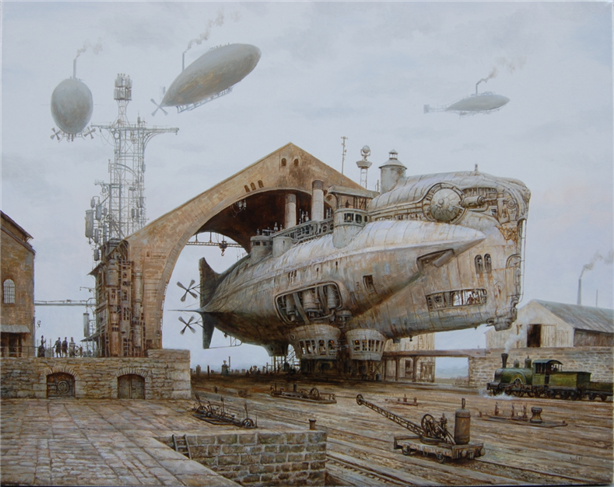
Thunderer by *Voitv
But alas the "practical" bit gets in the way, sigh.

Unlike a vessel that floats on water, an airship is way more delicate in her balance and weight restrictions. The system I described last time is relatively heavy! My back of envelope calculations suggest that it would be the equivalent of all the engines, fuel and ballast water that the Hindenburg carried and then some. This weight is concentrated into a small area which has implications for where it is positioned in the hull.

The main propulsion engine in the stern with its large counter rotating props, powered by Tesla's wireless electrical system, is also fairly weighty for its power output. One other design idea I had was to use a larger number of smaller engines spread around the hull to avoid this concentration of weight, but it doesn't look quite so cool. (The "Splendid" requirement remember.) In this system these two weights, the power plant and main propulsion system, are at least small in area which simplifies the gross layout somewhat. By placing the power plant appropriately in the design we can balance the ship. The crew accommodations, cargo holds, and bridge are relatively light by comparison.

One other significant weight that needs to be accounted for is the steam condenser. This condenser is needed to recover the water from the high pressure steam used for power, plus the steam vented from the lift system when trimming the ship and any excess steam generated when the core is operating. Remember that our power core is either on or off, and when on must be cooled by steam generation constantly.

When I was originally doodling around with my design I had thought to give our airship a hull that was a shell of a light metal, like duraluminum, rather than the truss and fabric type structure the traditional rigid airships used. The condenser in that design was simply the upper surface of the hull itself. Alas, a quick calculation showed that a hull the size of the Hindenburg would be way too heavy built that way. In fact even using a light metal such as duraluminum the condenser becomes a significant weight in its own right, the third largest weight after the power core and main propulsion engine in fact.

Interestingly, if our airship was buoyed aloft by hydrogen, instead of steam, such a hull would work, and wouldn't need the weight of a condenser. This has some implications for a modern airship design using composite materials like modern graphite fibres etc.

Since we want our airship to be mostly appropriate to Victorian times, and use steam as its lifting gas, our airship will have a more or less conventional hull structure of duraluminum trusses with a fabric cover for the majority of the hull. The three primary weight blocks of power, propulsion, and condenser are laid out in such a way that the airship is in balance. The simplest way to visualize her is something like the Hindenburg with a pair of counter rotating props at the stern aft of the fins, a pair of funnels just forward of amidships, and what looks like a shell of metal on her upper hull just aft of the funnels.

I think that is pretty "splendid" really so our Captain should be happy.

Now let's get into the engine room and get our hands greasy, what would it look like?  How do you arrange all the bits that are the core systems that support our airship in flight?  As mentioned above the power core and its water tank are the heaviest parts and so must be the lowest in the hull. Water is a good shield for radiation so the rest of the engine room can be close to the core without problems. From an aerodynamic standpoint we don't want to disrupt the hulls smooth contour more than necessary so as much as possible we should keep everything inside the hull along the keel structure.

Here is my proposed gross layout. I would draw a picture but "Dammit Jim, I'm a Flight Engineer not an artist!" smile

At the lowest point, close to amidships, is the core and its tank. There is really no pressure in the tank so it doesn't have to be cylindrical like a railway engine boiler. However, a cylinder does minimize the weight of the tank relative to its volume. A sphere would be the best of course, but would be harder to fit into the hull. Above the tank is the main low pressure distribution header. This header leads low pressure steam direct from the core to the lift bags inside the hull. Valves in the header control this distribution. A low pressure channel also connects the header with the condenser on the upper surface of the hull. This channel is controlled by a valve and is the primary means to regulate the flow of low pressure steam between the lift bags and/or dumping the excess to the condenser.

Alongside the main distribution header is the main condensate header. This header's main purpose is to connect to the condenser on the hull and direct the condensed steam back to the main tank. This header also collects steam condensed from within the lift bags, as well as from the condensation collected from the inside of the hull itself that results from lift bag leakage.

Forward of the main tank is the engine room proper. Integrated into the forward bulkhead of the main tank is the high pressure boiler. Inside is the steel coil, filled with high pressure mineral oil, that leads directly into the heart of the power core. (Note: I've changed this slightly see the next article for the reasons why) Water from the main tank is pumped into this boiler where it is flashed into steam. The production of steam is regulated by the pump rate, if the pumps stop so does the steam production. This is similar to the way a water tube steam boiler worked on the more advanced steam cars of the period.

The heart of the engine room is the main turbine that takes the high pressure steam from the boiler and converts the energy to electrical power, by the use of an attached Tesla high voltage AC generator. This turbine is a special light weight version of that employed in high speed torpedo boats. Exhaust steam from the turbine is directed to an exhaust header. This header is connected to the main condenser.

A valve also connects the exhaust header directly to the funnels. When activated all the exhaust steam goes directly to the atmosphere, via the funnels instead of the condenser. This is used for two purposes, in case of a problem with the condenser that produces an unacceptable back pressure on the exhaust, and for when the Captain orders "flank" or emergency speeds and the flow of steam from the turbine would overwhelm the ability of the condenser to handle it. Doing so would rapidly deplete the water in the main tank of course, as none of it would be recovered by the condenser. We are a military ship, as well as an exploratory one, so such speeds may sometimes be necessary. Of course we could only run the ship flat out like this for a limited amount of time before we would be forced to shutdown the core. (Hmmm... I foresee some interesting role play possibilities with that, "Sorry Captain I canna push her much longer or she's goin ta blow!")

Ranged along the walls of the engine room are the auxiliary systems needed to support the primary one. I imagine this to look pretty similar to the engine room of a high speed destroyer of the period. Lots of brass gauges, pipes, pumps, and sparking, glowing, electrical devices of a mysterious and dangerous look.
I'll try to describe these systems in more detail in my next article.

Forward of the engine room is the domestic cargo hold, which carries the baggage and supplies for the crew. Aft of the main tank is a larger general purpose cargo hold.

So that will be my domain on this ship. How large a crew would be needed to man the engine room?  Not many really. If we used a three watch system similar to that used by commercial surface ships and the great rigid airships, a crew of 6, 3 in each watch, including myself would be sufficient for normal operation.

Please join me next time as I continue to flesh out the mechanical side of this airship.
Don't worry, I haven't forgotten the crew's comforts, that's coming soon as well.

Keep your sightglass full, your firebox trimmed and your water iced.
KJ

Click here for the next article in this series.

You can follow the full design thread by clicking on the tag "Flight Engineer".

Practical Airship Design Part 4

Sunday, November 18, 2012 0 comments

To Fly Amongst the Clouds

Heavenly Nautilus by *voitv
In the previous articles in this series I talked about some of the ways that airship flight was controlled and the constraints that those ways imposed on flight duration. With the fantastically powerful energy source at the heart of our airship, I have concluded that using steam as the lifting gas essentially eliminates those constraints.

Besides, what better steampunk airship could we have than one that flies and is propelled using steam!

Later in this series I will attempt some calculations, to do a kind of "reality check", for the overall design. However to make sure that I wasn't too far off base, I did some quick calculations using the specs of the Hindenburg to see if steam lifting gas would result in useful lift. For an airship the size and dead weight of the Hindenburg, steam does indeed allow a small payload. You may recall that my buddy Grant's calculations had shown that in order to fly it would have to be 25% larger. But she was saddled with passenger accommodations and infrastructure to handle 40 or more people and their baggage, and since our airship is a military/exploratory one, not a commercial passenger ship, we have a lot of weight that can be re-allocated to our power and propulsion systems.

In a conventional gas filled airship the static lift system is independent of the propulsion. In the case of the great rigid airships like the Graf Zeppelin or Hindenburg, the lift was provided by hydrogen and the propulsion by diesel engines. In our case, courtesy of our power source, we can unify these systems with the attendant benefits I discussed last time.

So how would this work in practice?

First I'll talk a bit about one way to make use of our power source to handle both lift and propulsion. Then I'll discuss a way to bring the power out to the propellers so we can begin our grand voyage. In my next post in this series I'll talk about how all this can be laid out in the hull and perhaps what form that hull will take.

Power Core


At the heart of our airship is the core, a dense block of "something" generating very large amounts of heat. (Personally I prefer to treat this core as a fission type nuclear reactor.) Since for our purposes it is our one major fantastical element, we don't have to deal with the pesky details of how it actually generates so much heat. We do however, need to deal with the practicalities of using it.

To keep things simple the core is either an "on or off", "feast or famine", deal. Once running this core continues to generate heat, whether we need it or not, therefore cooling of the core is a priority. The core is mounted in the center of a large tank of water. Thermosyphoning of the tank water around the core, where it is turned into low pressure steam, carries away this heat. This steam is used as our lift gas. In flight, we only need to generate steam to balance that which is condensed and collected from the gas bags inside the hull. This will not be enough to prevent overheating of the core, so a large radiator ,or condenser, is mounted on the top of the hull to condense any excess steam. This radiator is a primary structural component making up a significant portion of area of the hull itself. The radiator is air cooled, sending excess heat to the atmosphere.

In the event that the hull condenser cannot handle the excess steam, or in case of an emergency, steam will be sent directly to the atmosphere through a couple of elegant funnels on the upper hull. (Just cause it looks so damn cool.smile)

In practice the Chief Engineer (me) and his staff would constantly monitor the heat balance of the main tank, along with the balance of lift steam and condensate reboil, directing excess steam to the condenser as required to keep things stable.   

The main tank also serves to shield our crew from any adverse effects of the core itself. Water is a good shield for ionizing radiation. Two meters of water is sufficient to handle the gamma ray flux of a typical spent fuel rod from a modern reactor for example.

Power Generation

My proposal is for our airship to use a Tesla type electrical power system to drive its main propulsion engine. This power is generated in the engine room by the use of a similar system to that found in a modern nuclear reactor.

Given the very large amount of heat being produced continuously, the interior of the core itself is much hotter than its surface.  A coil of steel pipes built into the structure of the core when it is made, carries a dense mineral oil into the heart of the core. Here the oil picks up the intense heat, and being under very high pressure, does not boil but remains liquid itself. This high pressure, very hot, oil is directed to a more or less conventional boiler outside the main tank. Here it is used to boil water, supplied from the main tank, to make steam. This steam is used to run a high speed turbine in the engine room. Exhaust steam from the turbine is directed to the hull condenser and thence back to the main tank.

Why not have water in the coil and simply flash it into steam directly? 

To keep things simple. If the coil and boiler are arranged and sized correctly, no mechanical pumps are required to maintain the fluid flow through the core, and therefore the heat flow to the boiler. The density effects of temperature will cause the oil to flow in the loop. We want to minimize the amount of things that can fail INSIDE, or close to, the dangerous confines of the main tank near the core. Also it is likely that the fluid used in the loop will become dangerous (radioactive?) as a result of its close exposure to the core. With no mechanical pumps in the loop, there is no need to open the piping for repair or maintenance with the risk of exposure to any contaminated fluid.

The turbine is connected to one of Tesla's high powered AC generators. This power is used to run the main propulsion systems.

Propulsion

Tesla's wireless power transmission system, a kind of tuned resonance, is used to transfer this power to the main engine without wires. The engine drives large counter rotating props at the stern of the airship. These props, by counter rotating, do not induce any rotational torque on the hull. A similar system is used to drive water torpedoes.

Auxiliary engines and propellers are mounted on the hull for use in maneuvering at low speeds during takeoff and landing. These engines also receive their power via Tesla's wireless system.

A side benefit to using Tesla's power system is that lighting and auxiliary power can be taken from the same system without the use of wires, thus helping to minimize weight.

The core gives us both lift and power for propulsion. There are no mechanical pumps necessary to control the primary system, minimizing the points of failure when we are far from our base. With such power at our command we can truly fly amongst the clouds, traveling the world in the search of adventure and in service of Her Majesty, HUZZAH!

Join me next time for some more details of how all this fits together within the airship's hull. An engineer's eye view if you will.

Keep your sightglass full, your firebox trimmed and your heat balance stable!
KJ

Click here for the next article in the series.

You can follow the full design thread by clicking on the tag "Flight Engineer".

Practical Airship Design Part 3b

Monday, November 12, 2012 0 comments

The Case for Steam

In the previous part of this series I talked about some of the details concerning how an airship flies.  In this part I will discuss the pros and cons of using steam as the lifting gas for our airship.

You can get some of the technical details of why steam makes a good lifting gas at this website:
The Flying Kettle. They are actually working on a free balloon that uses steam and have dealt with a lot of the practical details, a fascinating site definitely worth a perusal.

There are lots of different gases that can be used for generating static lift for an airship. In the real world the best one is hydrogen, followed by helium then pure methane. Of these three, hydrogen and methane are explosive when mixed with air and helium, while being non-flammable, is expensive and relatively rare. Ordinary steam is a surprisingly good lift gas being between helium and methane in lift capacity, plus steam is easy to make, cheap, and non-flammable.

This table from Flying Kettle has the properties of various lift gasses.


GAS

M.W.

Temp.

(
‹C)

Density

(kg/m3)

Lift (N/m3)

in ISA

Safety

Cost

Ease of

provision

Buoyancy

control

H2

2

15‹

0.084

1.140
11.19

bad

fair

fair

no

He

4

15‹

0.169

1.056  10.36

good

very

high

very

bad

no

CH4

16

15‹

0.676

0.549  5.39

bad

low

fair

no

NH3

17

15‹

0.718

0.507  4.97

fair

low

fair

no

hot
air

29

(avg)

110‹

(avg)

0.921

(avg)

2.980.327  2.2.98

(avg)

good

very

low

good

yes

steam
(H2O)

18

100‹

0.587

0.638  6.26

good

very

low

good

yes

From the chart you can see that pure steam at sea level and 100C only has the ability to lift 6.26 N/m3 which is better than pure methane but only about 60% of the lift available from helium. My buddy Grant, who is an engineer in real life and also a member of our crew, has calculated that, given steam's lifting capability compared to hydrogen, an airship with the weight of the Hindenburg would need to be about 25% larger in volume to fly!  That is a significant difference and could easily kill the use of steam for any "practical" design on that basis alone.

Another big disadvantage of steam as a lifting gas is that it condenses when the temperature goes below that necessary to keep it as vapour. That temperature is just over 100C at sea level of course, but lower at higher altitudes. As time goes on during a flight the steam will condense back into liquid water, primarily due to heat loss through the envelope, which will reduce the volume available to generate lift. Essentially the airship will constantly be "leaking" lift gas by this condensation.

To maintain flight this condensate must be re-boiled and returned to steam constantly, plus any leakage through the envelope that contains the steam must be balanced somehow, just like a normal gas filled airship must balance against the leakage or venting of lift gas by the dropping of ballast. In a conventional airship the energy that would be necessary to re-boil the condensate must be supplied by fuel and boilers that take up payload capacity.

So why am I proposing the use of steam given these disadvantages?

What really tips the issue in favour of steam for our airship is the power source we are using. In part one I mentioned that the main fantastical element of our airship was this power source, the exotic core of Verne's Nautilus. I prefer to think of this source as being like a fission type reactor core and will treat it as such for this design. Part 4 and 5 of this series will deal with the design decisions that such a power system requires. For the purposes of this discussion here, the key elements we are concerned with are that such a reactor uses up no fuel with time, and it generates prodigous quantities of heat continuously with a very high power to weight ratio.

This power source neatly deals with the disadvantage of condensation as it can easily re-boil any condensate and return it to the envelope.  Liquid water can be boiled to make up any leakage through the envelope to the atmosphere as well.

I am a big fan of simple systems, especially mission critical ones. Since we have an almost unlimited supply of heat available with our power core, we do not need much complxity to generate large volumes of low pressure steam. Thermo syphoning through the core may be all that is required for lift gas production. I will look at some proposed details of how the core and steam production can be controlled in following articles.

Let us now look at the three constraints to airship flight duration I discussed in the last article.

The three constraints are: lifting gas supply, ballast supply, and fuel supply. These are constraints because as a flight continues, the need to balance the buoyancy by releasing ballast and venting gas to account for changing conditions, place a limit on flight duration. Venting gas to lower buoyancy must be balanced eventually by dropping ballast to increase it again. As fuel is consumed the airship gets lighter and gas must be vented to adjust for that as well. In the case of a conventional gas filled airship both of these actions, venting gas and dropping ballast, were irreversible. Once the ballast supply was used up no further adjustments were possible. Ditto once the volume of gas vented reduced the airships buoyancy below that necessary to maintain lift. At that point the voyage was over!

So how does steam as a lifting gas, with our power core, handle these constraints?

Practical Airship design Part 3a

Saturday, November 10, 2012 0 comments

The Case for Steam (almost)

In part one of this series I talked a bit about why I'm working on a "practical" design for an Airship.  I also mentioned that one of the main fantastical elements was the super powerful energy source that will power the ship.  So in this article I will start to make the case that given this very good energy source the best lifting gas system to use is simple steam.

I thought I would be able to get right to making that case, but first we need to talk a bit about how a conventional gas filled airship flies.

Graf Zeppelin 1933
An Airship is not simply a balloon with an engine and propeller attached. Anybody who has ever tried to throw a kids balloon knows that a balloon has no directional stability at all. Airships tend to have shapes akin to those of the underwater profiles of ships, or the hulls of submarines. This enables some longitudinal stability when moving through the air.


Unlike a surface or underwater vessel however, the airship is moving through a medium that is more than 700 times less dense than water. A ship floats by displacing water equivalent to the weight of the vessel. Since water is so much denser than air a ship hull can be quite small and still be able to support a significant weight.  Plus there is a definite interface between the water and the air so a ship can act like a platform resting on this surface and have all it's "interesting stuff" exposed on top of the hull, in the air. A surface ship usually has a significant amount of reserve or excess buoyancy, which is why a ship floats on the surface and can carry useful amounts of cargo and armaments.

An airship also floats by displacing a volume of air equivalent to it's weight but, since air is so much less dense the volume required is correspondingly higher. There is essentially no "surface" to the air so an airship is more like a submarine than a surface ship. The airship is suspended INSIDE the air it moves through so it needs to be as close to neutrally buoyant as possible. That is, the buoyancy should be sufficient to allow the airship to be stable in altitude but not tend to rise or fall. If the airship is positively buoyant by too large an amount it will rise uncontrollably unless lift gas is vented or buoyancy is otherwise reduced. If it's buoyancy is too negative it will not fly at all or fall to the ground unless weight is reduced by dropping ballast.

In practice airships are usually slightly heavy relative to this neutral point, I'll explain why in a moment.

Since there is no surface against which an airship's hull can push, like a surface ship pushes against the water's surface, there is no "right-side up" except that determined by the distribution of weights in the hull. This distribution is critical, relatively heavy portions of the craft will tend to twist the hull until they are at the lowest point. Thus even though it is popular to show some  Steampunk Airships looking like airborne surface ships it would take a lot of external force, with complex engines and propellers , to keep them that way. Our airship will have the traditional weight distribution where the lowest part is filled with the heavy stuff, engines, power source, crew, cargo, cabins, and most weapons. The large volume needed to make the vessel float in the air will be above this.

The other thing that powered airships use in flight is what I call dynamic or form buoyancy. That is, the movement of the ship through the air generates some of the needed lift. This is in addition to the static lift supplied by the large volume of lifting gas, much like the passage of air over the wing of a heavier than air craft. In the case of the original Zeppelins, and current non-rigid airships, most altitude control in flight was by judicious use of the control planes to change the hulls angle to the airflow. They use the effect of the ships forward motion through the air to control altitude. That is the reason to keep the airship slightly heavy. By having the airship tending to sink in the absence of forward movement the pilots can play the opposing forces against each other which makes control easier.

Airship flight is a constant balancing act between the forces supplied by the vessels buoyancy and propulsion, and the external forces caused by air movement across the surface of the vessel, and any larger atmospheric conditions like winds, frontal systems, storms etc. In a traditional gas filled airship there were three constraints that determined the length of time an airship could operate. The three were fuel supply, ballast supply and lifting gas supply.    

Adjustment for external conditions, like altitude, temperature, humidity etc, required the release of ballast, usually water, to increase buoyancy, or venting of gas to decrease it. As fuel was consumed during a flight the vessel would get lighter with time so gas would have to be vented to maintain static altitude. Obviously there is a limit to how much ballast could be carried, simply to be dropped, and how much gas could be vented before the ability to control the buoyancy would get problematic.

Any emergency conditions, like being caught in a sudden updraft or downdraft near a weather front, could necessitate the dropping of a lot of ballast at once or the venting of a large amount of gas. A single such incident could result in the vessel being unable to continue its voyage, if she survived at all.

Here, finally, we can begin to discuss the case for steam as the lifting gas, because the use of steam essentially removes two of these three constraints! In our case our amazing power source also removes the third, completing the trifecta.

In my next post in this series I'll get to the heart of the Steam as Lifting Gas case.

Until next time here is another image from the Steampunk Art of *Voitv to inspire our airship dreams...
Postal Dragon


Keep your sightglass full, your firebox trimmed and your water iced.
KJ

Click here for the next part of this series.

You can follow the full design thread by clicking on the tag "Flight Engineer".

Practical Airship Design Part 2

Wednesday, November 7, 2012 0 comments

Contents and Prospectus

My fellow crew members suggested that I try to organize this series of posts so they would be able to identify the various sections they were interested in and would, hopefully, like to comment on.
Each entry below will be linked to the actual post (once I write and post them).  There is a lot of interesting stuff to cover and of course many of them overlap so the actual posts may not be quite so specific, but this is my plan so far:

  • Part 1 Making the Fantastical Practical A brief introduction as to why I'm doing this and the introduction of the major fantastical element of this design, that being the mysterious ultra-powerful energy source used in the airship.
  • Part 2 Contents and Prospectus  This post!
  • Part 3a The Case for Steam (almost) A brief discussion of how a conventional airship flies.
  • Part 3b The Case for Steam A discussion of the rationale, pros and cons, for the use of steam as the lifting gas for the airship. Much of the subsequent design discussions revolve around and depend on this design decision, as what allows an airship to fly is probably one of the most important elements to discuss.
  • Part 4 To Fly Amongst the Clouds A proposal for the way our fantastical power core generates both lift gas and propulsion power.
  • Part 5 Engines Tanks and Bulkheads Oh My! A discussion of one proposed layout for the "engine room" and the primary systems  including steam generators and propulsion systems.
  • Part 5a More Engines Tanks and Bulkheads Oh My! After further reflection, here is a more detailed discussion of the high pressure steam system used to drive our main power plant.
  • Part 5b Full Steam Ahead A summary of the design of our airship, and a description of the layout of the engine room.
  • Part 5c A Self Mobile Cloud  A discussion of some of the lift control issues using steam as our lift gas.
  • Part 6 Domestic Tranquility Systems Of course a globe trotting airship like ours is more than just an engine hanging from a balloon! The officers, crew and passengers need to be able to live aboard for extended periods of time. What's more some of the crew members are Ladies so we must include many creature comforts for them.
  • Part 6a More Domestic Tranquility Systems. A document I prepared for our Role Play group summarizing the interior layout of our airship
  • Part 7 Splendid She Must Be In conclusion, our Captain has ordered that she must, in addition to being one of the most technologically advanced airships of the age, be one of the most "Splendid"(tm) and this post will attempt to grant his wishes to the best of this poor flight engineer's ability.  
Additional posts as needed to discuss other aspects of the design like communications, weapons, control systems, role playing etc.
  • Our Airship Presenting the HMAS Velvet Brush
  • Airship Technology Speech  My character, as Engineering Officer , was ordered to give a presentation about the technical wonders of our fine ship. I decided to actually give the speech.
  • An Analysis of a Real System "Steam Power Plants in Aircraft"  by  E.E. Wilson at the Bureau of Aeronautics, 1926
I hope you will follow along with me as we hash out these knotty issues and design our fantastical, yet practical, airship. To give you a taste for the kind of craft we are dealing with check out the fantastic Steampunk Art of *Voitv on Deviant Art.


Keep your sightglass full, your firebox trimmed and your water iced.
KJ

By clicking on the tag "Flight Engineer". you can find lots more Airship information.

Click here for Part 3a of the Practical Airship Design series

About Gears, Goggles, and Steam oh My!

Here I collect interesting bits of information related to the world of Steampunk.

Category List

Absinthium (12) accessories (15) Airships (69) Art (1) Beakerhead (3) Books (65) comics (5) computation (11) costumes (16) etiquette (19) events (30) fiction (87) Flight Engineer (33) Fun (57) games (36) history (109) howto (21) Inventions (57) manners (6) Meetup Repost (90) movies (4) music (4) Musings (44) mystery (23) news (8) Parasol Duelling (46) Photos (67) Pie In the Sky (3) poetry (1) resources (50) Role Playing (59) Serial Story (28) Ships (39) Steam (34) Steampunk Sports (26) Tesla (13) video (77) website (57) What Ifs (16)

Recent Comments

Theme images by sndr. Powered by Blogger.

Followers