Inspiration!
A few years ago I was working on the design of a mechanical Absinthe preparer inspired by a mechanical wine pourer.
I called my device The Absinthium Project.
This machine which prepares a Gin and Tonic might just inspire me to start working on it again.
Enjoy
Keep your sightglass full, your firebox trimmed and your water iced!
KJ
Showing posts with label Absinthium. Show all posts
Showing posts with label Absinthium. Show all posts
Absinthium Redux

Green Faeries!
Absinthe makes the Faun Grow Heartier...


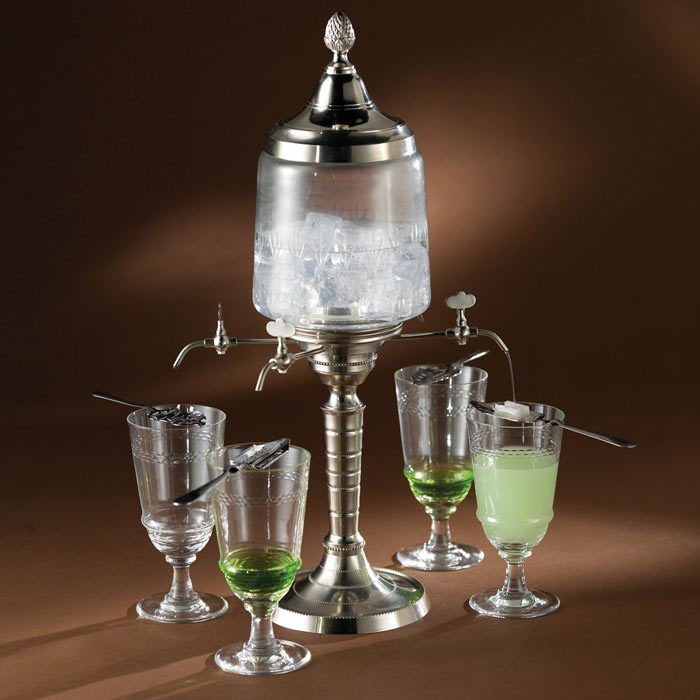


Keep your sightglass full, your firebox trimmed and your water iced.
KJ
Of Green Faeries...
Ahhh... The inspiration of poets, artists and writers.
Nothing like spending an evening of good discussion, with great friends, over a cloudy glass or two of Absinthe.
Keep your sightglass full, your firebox trimmed and your water iced.
KJ
Green Fairy: The symbol of liberté
From: Absinthe Fever a fantastic online site dedicated to the enjoyment and history of Absinthe
 |
Fairy In Green By Derek Brewster |
The symbol of transformation
But Green Fairy isn't just another name for absinthe: she is a metaphorical concept of artistic enlightenment and exploration, of poetic inspiration, of a freer state of mind, of new ideas, of a changing social order. To the ignorant drunk, absinthe will forever remain but potent alcohol, perhaps with a bit of thujone "high" thrown in. To the original bohemians of 1890s Paris, the Fairy was a welcomed symbol of transformation. She was the trusted guide en-route to artistic innovativation; she was the symbol of thirst (for life) to Arthur Rimbaud, the first "punk poet": it was the Fairy who guided him -- and his fellow poet and partner Paul Verlaine -- on their quest to escape the conventional reality of their time into the sanctuary of the surreal.Transformation has always been the fundamental essence of the Green Fairy, for transformation is what she provides on several parallels. During the magical ritual of la louche, the drink itself first transforms from the concentrated, alcohol-rich, deep emerald green liquor into an alluring opalescent, cloudy greenish-white mixture. This, of course, is symbolic of the subsequent transformation that shall take place in the drinker's mind. As the cool water liberates the power of wormwood oil and the other herbal ingredients from the green concentrate, so will new ideas, concepts and notions be set free in the mind of the drinker -- be he a poet, an artist, a scientist, or the common man on the street.
Apparently so, anyway.
The goddess of artistic rebellion
Is the above a fanciful, perhaps absinthe-induced description of the powers of the Fairy? Let the reader -- or perhaps the drinker -- decide for himself. Let there be no doubt, however, that the turn of the last two centuries produced art, poetry and ideas that were, for their time, shockingly original, rebellious and challenging to the extreme. This was the time of Rimbaud and Verlaine, who pursued their quest of challenging convention whenever they came across it. Their antics caused outrage across Europe at the time, but their ingenious poetry -- a reflection of their search for the true meaning of life -- remains with us to this day.
Inspiring and liberating, the Green Fairy was a powerful symbol of the avant-garde elite that gathered in Parisian cafes at the turn of the last two centuries. In this sense, the Fairy was what pot later became to the hippie subculture of the 1960s. In her company -- or under her influence -- Belle Epoque writers and artists became lucid commentators on an emerging new world. With the stroke of a brush or a pen, they experimented, they rebelled, they provoked, and so they successfully subverted the stuffy conventions of the time.
Absintheum as Art
I posted this query back in August:
One thing I've been thinking about, that somewhat complicates the design, is that not only must the design actually work, it also has to look really cool while doing it!My buddy Andrew replied:
That my friends is ART(tm) which I'm frankly lousy at
So my question to you all is this:
Is it better to come up with a practical workable design first and then decorate it?
Or
Is it better to create the artistic design and then make the functional design fit that vision?
Keep in mind that I consider this machine to be as much a sculpture as it is a machine, but it still has to actually work.
Thoughts?
I always find it is better to start with making sure the design is functional before you make it artistic ... because really anything can be considered art these days...Interesting, thanks Andrew.
Plus there is that famous song that goes along the lines of just glue a gear on it
You can always add to the design too once it is fuctional to make it more visually appealing if you think it needs it

For modern equipment I quite agree, because in today's world it is not so much designing a machine to work with a given material as it is designing materials to work with given machine design. Steampunk artifacts are different however, as the Steampunk aesthetic delights in displaying the workings themselves. It is as much about how the machine does its job as it is what it looks like (think Rube Goldberg in brass).
For me personally the most interesting Steampunk artifacts are those that actually do things, and can be seen to be doing them. The hand cranked wine pourer being one of my favourites.
The vast majority of Steampunk things are not like this, they are an aesthetic gloss over an otherwise mundane mechanism or object. The reworked Nerf pistol as Steampunk Ray Gun is probably the archetypal example. In this case 'just glue some gears on it' seems to be the way to go
 Since we don't have real ray guns, jet-packs or mechanical appendages,
this isn't really a problem. We don't actually have a choice if we want
to have one of these gadgets to liven up our outfits.
Since we don't have real ray guns, jet-packs or mechanical appendages,
this isn't really a problem. We don't actually have a choice if we want
to have one of these gadgets to liven up our outfits.However since the Absinthium is to be more like the Wine Pourer than the Ray Gun, it seems to me that the Steampunk aesthetic needs to be 'baked in' from the start, if only to make sure that it is not simply a Steampunk cover for a modern machine. Also the very nature of the materials I would like to use to make this, will constrain the design to a certain extent.
Alas that also raises my original dilemma again, because the design process must try to cover both, the artistic and functional elements.
Perhaps if the materials are suitable, the artistic elements will fall out of a suitable design all by themselves. The beauty of the form will follow the elegance of the design/function.
Keep your sightglass full, your firebox trimmed and your water iced.
KJ
Click here to see the other Absinthium posts.
Mechanical Computers in the US Navy
Friday, September 28, 2012
0
comments
Labels:
Absinthium,
computation,
Inventions,
Meetup Repost,
Ships,
video
Following on from yesterdays video post of Mechanical Principles by Ralph Steiner.
This video has lots of interesting mechanism that could be useful for my Absinthium project.
In this case these mechanisms are used for computation in the fire control systems of US Navy Warships. An interesting solution to the continuous calculations necessary to target a moving ship!
Enjoy
Keep your sightglass full, your firebox trimmed and your water iced.
KJ
Mechanical Computers in the US Navy.
Lots of good information on how calculations are performed with gears and shafts 
Mechanisms in action Ralph Steiner
This video is a section from Mechanical Principles by Ralph Steiner done in 1930.
Lots of funky motions and mechanisms here.
Could be useful for my Absinthium project.
Keep your sightglass full, your firebox trimmed and your water iced.
KJ
The full version is here:Ralph Steiner Mechanical Principles 1930
From the YouTube page:
This is my favorite 4min selection of a larger work by Ralph Steiner.
The original was silent, and the DVD had it set to classical music. I
have swapped the audio for an electronica/industrial track by 3 Liquid
Hz - Little Boy.
Favorite movements:
@ 1:16 - counter mechanism
@ 2:55 - normal gears, but cut to engage on diagonals
@ 3:37 - SQUARE GEARS!
@ 3:41 - variable speed transfer
@ 3:46 - rotary to linear action with a 4 tooth cog
Absinthium Water Cooler
Here's another component that might add some interest...
As part of the water reservoir there could be a refrigeration section that cools the water.
An
"old fashioned" mechanical, air heat pump could chill the water. This
would need to be "pumped down" significantly before use. I would need a
second power section, possibly a chain driven section on the opposite
side.
The idea here is that when setting up a "minion" could spin
the cooler section at fairly high speed to drop the temperature in a
brine container as close to zero as possible.
Then as the Absinthe is prepared the water being dispensed would pass through a coil in the chilled brine.
A temperature gauge on the brine container would indicate when it needs to be pumped down again during use.
Keep your sightglass full, your firebox trimmed and your water iced.
KJ
Click here to see the other Absinthium posts.
The Kinematics of Machines 1928
Could be very useful for my Absinthium design.
Originally
published in 1928, my copy is the Fourth edition from 1940 (it has a
nice standard disclaimer about following the "Recommendations of the War
Production Board for the conservation of paper and other important war
materials").
While not Victorian it does have one of the most extensive discussions on the design and analysis of the physical workings of machines I have ever seen. Starting with basic mathematics of motion it goes into analysing levers, linkage systems, sliders and cranks, cams, gears and gear trains as well as pulley and belt systems.
The examples and chapter questions hold the most amazing selection of odd machine movements for which the student is encouraged to analyse for speed, acceleration, power, friction and other calculations that would be needed to fit a design for a practical purpose.
The chapters on gear design and the analysis of gear trains are wonderful for anybody trying to figure out if their machine could actually work.
Title
Kinematics of Machines
Author
George L. Guillet, M.S.
Associate Professor of Mechanical Engineering, The Pennsylvania State College
Member of the American Society of Mechanical Engineers
Publisher
John Wiley and Sons, Inc.
New York
Date
Fourth Edition 1940
First Published 1928
Keep your sightglass full, yur firebox trimmed and your water iced.
KJWhile not Victorian it does have one of the most extensive discussions on the design and analysis of the physical workings of machines I have ever seen. Starting with basic mathematics of motion it goes into analysing levers, linkage systems, sliders and cranks, cams, gears and gear trains as well as pulley and belt systems.
The examples and chapter questions hold the most amazing selection of odd machine movements for which the student is encouraged to analyse for speed, acceleration, power, friction and other calculations that would be needed to fit a design for a practical purpose.
The chapters on gear design and the analysis of gear trains are wonderful for anybody trying to figure out if their machine could actually work.
Title
Kinematics of Machines
Author
George L. Guillet, M.S.
Associate Professor of Mechanical Engineering, The Pennsylvania State College
Member of the American Society of Mechanical Engineers
Publisher
John Wiley and Sons, Inc.
New York
Date
Fourth Edition 1940
First Published 1928
Keep your sightglass full, yur firebox trimmed and your water iced.
Click here to see the other Absinthium posts.
Absinthium Part 3
Each of the sections of this machine has a series of steps.
For example, the absinthe pouring section needs to be able to do the following:
- Position the glass (This could be manual).
- Measure the "dose" from the Absinthe bottle.
- Add the dose to the glass, directly or via a separate measure.
- Reset the measure for the next dose.
- Position the glass for the water/sugar step.
Within these steps there are paths and motions that need to be coordinated. In a typical mechanism design one would want to minimize the motions for efficiency. In our case we want the system to not only work but be SEEN to be working so some superfluous motions are allowed, and even encouraged.
Personally I like the idea of actually tipping the bottle to pour the dose for visual purposes although that does complicate the control of the pour.
Anybody have any ideas on how one could control the pour?
Step one above as noted could be manual of course, however the ability to load the glasses from a sort of magazine could allow the creation of multiple glasses as a sort of "Green Faerie" assembly line.

Keep your sightglass full, your firebox trimmed and your water iced.
KJ
Click here to see the other Absinthium posts.
Absintheum part 2
So for the "Absintheum", or hand crank Absinth preparer, there
are several separate mechanisms that must be linked together and timed
to accomplish the proper preparation of a glass of Absinthe.
There is no real size limitation on this beast, but it should probably not be bigger than what would fit in a steamer trunk.
General sections:
Drive train
This
distributes the rotation of the hand crank to the various sections and
also coordinates the timing of each piece with the presentation of the
final prepared glass to the user.
Dose preparation
Decants one oz of Absinth from the bottle and delivers it to the glass.
Sugar preparation
Loads a sugar cube onto the spoon and then places the spoon over the glass.
Water dispenser
Delivers the required amount of chilled water to the glass through the sugar.
This step needs to be slow and steady, with an adjustment for the quantity of water needed.
Also
it would be good if there was a display section that might make an
enlarged view of the process available to the patron/user.
Glass delivery
Moves the prepared glass to the user with an appropriate notification like a flag, gong, bell or whistle?
Other sections required:
Bottle holder, glass holder, sugar supply, water chiller and reservoir.
Ideas and designs welcome!
Keep your sightglass full, your firebox trimmed and your water iced.
KJ
The Absinthium, a project
This is a copy of my post to the Calgary Steampunk Assemblage discussion board back in May of 2012.
An interesting project that I am still going to pursue.
Watch for posts labelled Absinthium.
KJ
=============================
Following on from the wonderful thread about the
hand cranked wine bottle opener and pourer, this thread is for
discussion of what would be needed to do the same thing for preparing a
"dose" of Absinthe.
The process of preparing Absinthe properly is described here: The Absinthe Ritual.
As you can see there is much more to this process than simply pouring a shot into a glass .
Of course it is that very process which, in it's ritualistic form,
enhances the experience. So rather than simply having this machine "whip
up a glass", it needs to be a soothing and mellow process so as not to
disrupt the ambiance.
Ideas and suggestions welcome!
Keep your sightglass full, your firebox trimmed and YOUR WATER ICED!
KJ
Some resources:
ROYMECH Linkages
ROYMECH Mechanisms
Web-Based Mechanism Design and Analysis
Four-Bar Linkage Analysis and Synthesis
Virtual Mechanisms Animated by Java
Gear Design (PDF)
Mechanisms and there applications
Edited by Kevin Jepson on May 15, 2012 11:04 AM